"Medical Reality May Cause Patients to Miss Treatment"
"No One Would Say It's Okay to Be Treated by a Drunk Doctor"
The Ministry of Health and Welfare has begun reviewing the establishment of new regulations prohibiting doctors from practicing medicine while intoxicated and strengthening penalties. This move comes in response to recent controversy over an emergency medicine doctor who treated patients while intoxicated but was not criminally charged. A ministry official stated on the 18th, "We are reviewing amendments to the Enforcement Decree of the Medical Service Act to establish regulations prohibiting doctors from practicing medicine while intoxicated and to extend the period of license suspension." The plan is to amend the Medical Service Act and its Enforcement Decree to alleviate the burden of judicial punishment on doctors' medical practices, and it is known that matters related to intoxicated medical practice will be addressed simultaneously.
However, opinions differ on whether legal sanctions would benefit patients. Considering the reality of a shortage of essential medical personnel, there are concerns that legal sanctions against intoxicated medical practice could actually harm patients.
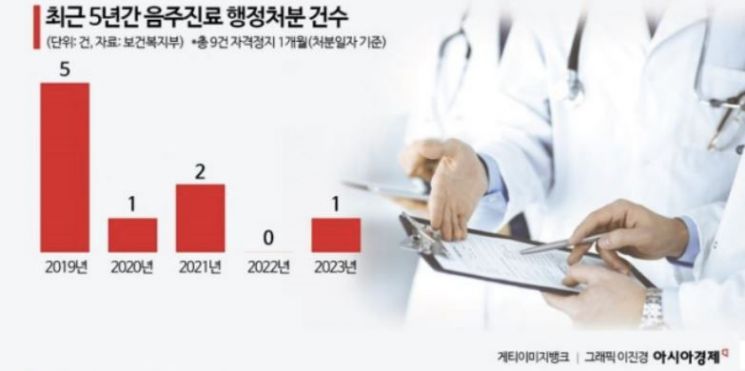
According to the police on the 18th, the Gangdong Police Station in Seoul apprehended a doctor in his 20s, identified as A, from a general hospital who performed surgery on a patient while intoxicated around 11 p.m. on the 12th. However, despite the intoxicated medical practice, A was not booked by the police, sparking controversy. This is because there are no punishment provisions under current law for performing medical acts while intoxicated. The relevant regulation is Article 66, Paragraph 1, Subparagraph 1 of the Medical Service Act, which allows for suspension of medical licenses for up to one year if a medical professional severely damages their dignity. In cases of intoxicated medical practice, a suspension of up to one month is typically imposed. According to the Ministry of Health and Welfare, over the past five years (2019?2023), nine doctors were caught performing medical acts while intoxicated and received license suspensions, all of which were for one month. In December 2020, the Anti-Corruption and Civil Rights Commission recommended to the Ministry of Health and Welfare to strengthen administrative sanctions for intoxicated medical practice beyond a one-month license suspension.
Opinions on the necessity of legal sanctions for intoxicated medical practice are divided. The key issue is whether it benefits patients. The medical community agrees that intoxicated medical practice should never occur. However, given the harsh realities of the medical field, there are concerns that legal sanctions could lead to situations where patients cannot receive treatment. Due to staffing structures, it is common for doctors to come to the hospital in emergencies even outside of their working hours. Although not subject to criminal punishment, doctors who come to the hospital during off-hours due to emergencies and perform intoxicated medical acts are subject to license suspension under current law. Therefore, the medical community argues that improving the essential medical system should take priority over legal sanctions. For example, in essential medical fields like obstetrics, doctors must be on call 24 hours to attend to pregnant women. Due to staff shortages, it is common for there to be no clear boundary between on-duty and off-duty times.
Woo Bong-sik, Director of Medical Policy Research at the Korean Medical Association, said, "Special circumstances, such as doctors coming in urgently during emergencies due to medical staff shortages outside of working hours, should also be considered." Nam Goong-in, Professor of Emergency Medicine at Ewha Womans University Mokdong Hospital, said, "We have no choice but to rely on self-regulation rather than legal sanctions. For essential medical personnel handling certain special procedures and vital signs, even university hospitals have only one or two specialists per field," adding, "They must be on call 24/7, and if they are punished for treating patients after having a drink post-work, it could lead to refusal of emergency patient care to avoid punishment."
There are also claims that a total ban on intoxicated medical practice would accelerate doctors' avoidance of essential medical fields. For example, the only neonatal intensive care unit in the Chungbuk region is facing closure because three night-duty specialists recently resigned. Although two pediatric professors take 24-hour shifts every other day, the situation is unsustainable. It is also reported that two of the five pediatric professors at the same hospital's pediatric emergency center have resigned. In such harsh conditions, to avoid punishment for intoxicated medical practice, doctors would have to abstain from alcohol 24/7 all year round or refuse to treat emergency patients if they have consumed alcohol after work.
On the other hand, those advocating for legal sanctions argue that intoxicated medical practice disregards patient safety. Kim Yoon, Professor of Healthcare Management at Seoul National University College of Medicine, stated, "Patient safety is the most important issue. No one would be comfortable receiving treatment from a doctor who has been drinking," and added, "Since it is impossible to set a clear intoxication standard, intoxicated medical practice itself must be prohibited." Nurse B, working in an operating room at a top-tier general hospital in the Chungcheong region, said, "There are often doctors who perform surgery while still drunk from company dinners until morning. I have even seen someone wanting to vomit due to hangover during surgery," adding, "Although it may vary by hospital, from a patient's perspective, it is like riding in a car driven by a drunk driver."
In 2021, a national petition was posted on the Blue House's public petition board demanding punishment for a doctor who performed surgery while intoxicated, resulting in the loss of a baby. The petition titled "Please punish the murderous doctor and hospital who killed my son whom I carried for ten months" was written by a mother who visited the hospital after her water broke without labor pains. The obstetrician, who had been drinking on a day off, came to the hospital and performed an emergency cesarean section, but the baby died.
Meanwhile, some argue that even if new regulations and stricter penalties for doctors' intoxication are implemented, the severity of punishment will not be high. Lee Dong-chan, Chief Lawyer at The Friends Law Office and a specialist in medical law, predicted, "Even if the punishment level is strengthened, the license suspension period will likely remain around one to two months." He added, "Recently, the 'Medical License Revocation Act' was enacted, which cancels licenses for medical professionals sentenced to imprisonment or higher for general criminal offenses. Given the significant dissatisfaction in the medical community due to the strict enforcement of the Medical Service Act, further strengthening will not be easy."
© The Asia Business Daily(www.asiae.co.kr). All rights reserved.
![Clutching a Stolen Dior Bag, Saying "I Hate Being Poor but Real"... The Grotesque Con of a "Human Knockoff" [Slate]](https://cwcontent.asiae.co.kr/asiaresize/183/2026021902243444107_1771435474.jpg)
















