Last Year, 704 Cases and 769kg of Drug Smuggling Detected
Average Daily Detection of 2 Cases and 2kg, Marked by Larger Scale
This Year Marks the Turning Point to Regain Status as a Drug-Free Nation
Focus on Blocking Drug Smuggling at Border Level
Last year, an average of two drug smuggling attempts weighing 2 kg each were detected daily by customs. Domestic drug smuggling is gradually becoming larger in scale, while small-quantity smuggling for personal consumption has been steadily decreasing. Customs authorities plan to focus on completely blocking drug smuggling at border checkpoints this year, viewing it as a turning point for regaining the status of a drug-free country.
On the 17th, the Korea Customs Service announced that it held a meeting of the "Special Task Force for Drug Smuggling Countermeasures" (hereafter referred to as the Task Force) at Terminal 1 of Incheon Airport. The meeting was organized to share the achievements of the drug control system operated since the Task Force's launch in October last year and to raise internal awareness among related agencies.
 Koh Kwang-hyo, Commissioner of the Korea Customs Service, is delivering opening remarks at the "1st Special Task Force Meeting on Drug Smuggling Countermeasures" held at Incheon Airport on the 17th. Photo by Korea Customs Service
Participants shared and discussed last year's drug smuggling enforcement results, the Task Force's progress on key tasks, reviewed improvement and supplementary tasks, and considered additional measures.
Regarding last year's drug smuggling enforcement status, a total of 704 cases involving approximately 769 kg of drugs were detected by customs. Compared to the previous year, the number of cases decreased by 9%, while the weight increased by 23%. According to the Korea Customs Service, this means that on average, two cases involving about 2 kg of drugs were intercepted daily by customs.
Domestic drug smuggling temporarily declined after the COVID-19 pandemic in 2020 but has recently shown a trend of increasing again. The annual drug smuggling enforcement weights fluctuated as follows: 148 kg in 2020, 1,272 kg in 2021, 624 kg in 2022, and 769 kg in 2023.
Notably, there is a trend toward larger-scale drug smuggling. The Korea Customs Service believes that the average weight per detected smuggling case has recently exceeded 1 kg. The average weight per case by year was 213 g in 2020, 446 g in 2021, 810 g in 2022, and 1,092 g in 2023.
Conversely, small-quantity smuggling of 10 g or less has continued to decline. The annual number of enforcement cases involving small quantities (10 g or less) was 425 in 2021, 175 in 2022, and 117 in 2023, showing a continuous decrease.
The main smuggling routes were international mail (328 cases, 46%; 327 kg, 43%), express cargo (194 cases, 28%; 274 kg, 36%), and travelers (177 cases, 25%; 148 kg, 19%), in that order of proportion.
In particular, last year, while the number of cases involving international mail and express cargo decreased compared to the previous year, traveler smuggling increased sharply. The Korea Customs Service analyzed that this reflects a return to previous smuggling methods due to a surge in drug smuggling through travelers after the COVID-19 pandemic.
The proportions of drugs detected last year were as follows: methamphetamine (438 kg, 57%; 155 cases, 18%), marijuana (143 kg, 19%; 212 cases, 25%), ketamine (38 kg, 5%; 69 cases, 8%), and MDMA (30 kg, 4%; 89 cases, 10%).
The main countries of departure were Thailand (187 kg, 24%; 101 cases, 14%), the United States (152 kg, 20%; 213 cases, 29%), Germany (93 kg, 12%; 44 cases, 6%), and Laos (66 kg, 9%; 18 cases, 2%).
Among these, Thailand and the United States have consistently been the main source countries for domestic drug smuggling from past to present. Meanwhile, smuggling enforcement from Germany and Malaysia has also surged, classifying them as major supply countries. However, recent international cooperation between the Task Force and major drug supply countries has led to a decrease in detected quantities.
Based on these enforcement trends, the Korea Customs Service plans to identify and resolve issues requiring improvement and supplementation in the existing special drug smuggling countermeasures, and to pursue additional measures in customs administration, including discovering new tasks in response to changes in the drug enforcement environment.
Ko Gwang-hyo, Commissioner of the Korea Customs Service, stated, "Since declaring a 'war on drugs' last year and forming the Task Force, we have concentrated customs administrative capabilities on drug enforcement at border checkpoints." He emphasized, "This year marks the second year of the war on drugs and will be a critical turning point to determine whether our country can regain its status as a drug-free nation."
He added, "Our current challenge is to continuously devise new countermeasures in response to changing environments and smuggling methods. The Korea Customs Service will spare no effort this year to prevent drugs from being smuggled into the country starting at the border."
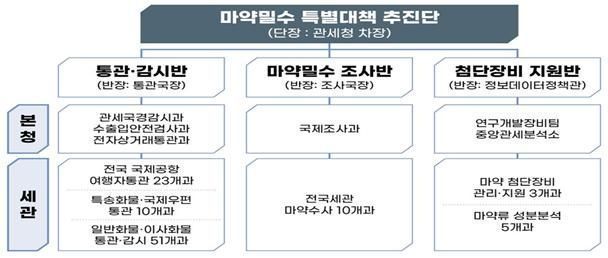
Meanwhile, the Task Force functions as a drug enforcement control tower encompassing the Korea Customs Service headquarters and customs organizations nationwide. Its core role is to concentrate drug smuggling enforcement capabilities by overcoming the structural limitations of customs administrative tasks divided by clearance and investigation.
© The Asia Business Daily(www.asiae.co.kr). All rights reserved.
![Clutching a Stolen Dior Bag, Saying "I Hate Being Poor but Real"... The Grotesque Con of a "Human Knockoff" [Slate]](https://cwcontent.asiae.co.kr/asiaresize/183/2026021902243444107_1771435474.jpg)
















