Suez and Panama Canals
Korean Cargo Volume Low at 4.7%
Impact Still Limited So Far
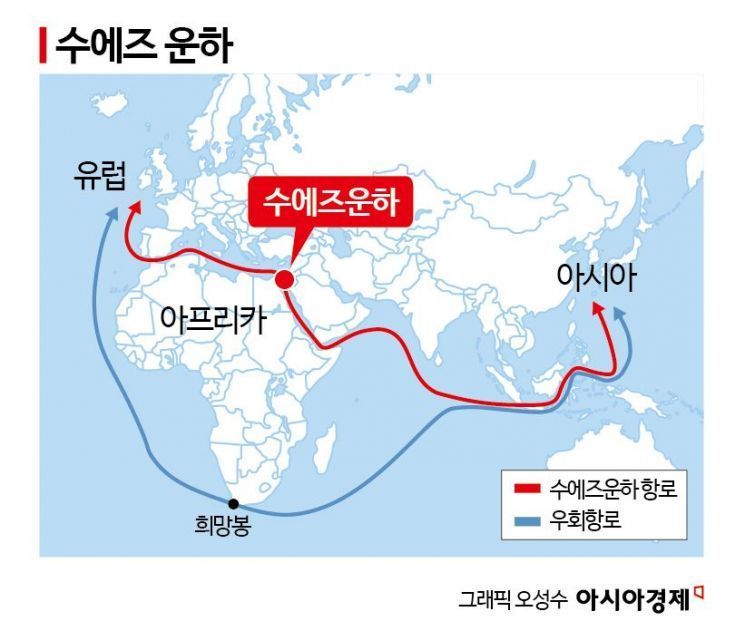
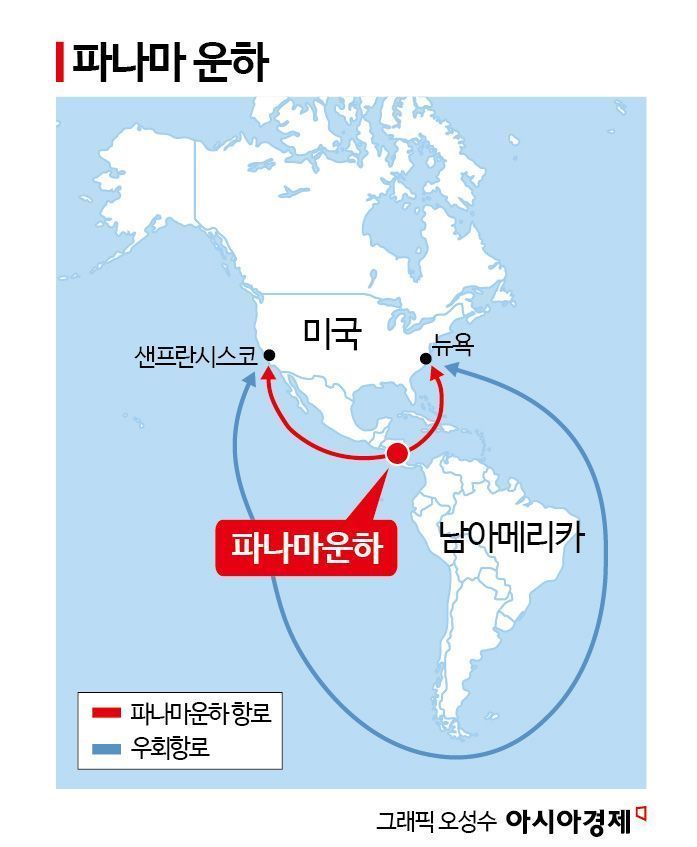
Concerns are rising over the increase in shipping logistics costs as disruptions occur simultaneously in the world's two major canals. The Panama Canal is tightening controls due to drought, while many shipping companies are voluntarily choosing to bypass via the Cape of Good Hope amid armed conflicts in the Suez Canal, causing freight rates to rise.
However, considering that the volume of Korean cargo passing through the two canals accounts for only about 5% of the total and that shipping logistics prices have been falling due to the global economic slowdown, shipping authorities believe the situation will not escalate to a worrisome level. The government is prioritizing enhanced freight support for small and medium export companies and is preparing integrated interdepartmental measures to address potential damages from armed conflicts.
According to the shipping industry on the 17th, the cost of maritime transportation has recently increased sharply. The Shanghai Containerized Freight Index (SCFI), which indicates freight levels on global maritime routes, surpassed 2000 points as the armed conflict around the Red Sea prolonged. This is more than double the 1093.52 points recorded on December 15 last year. The K-Containerized Freight Index (KCCI), developed by the Korea Ocean Business Corporation, showed a similar trend, rising 24.21% (377 points) from the previous week to 1934 as of the 8th.
The simultaneous disruptions in the world's two major canals have caused global shipping logistics bottlenecks. Last December, when global container carriers such as MSC were exposed to attacks by Yemeni rebels, container carriers that used to transit the Suez Canal changed their routes to bypass via the Cape of Good Hope. Taking the Cape route adds about 9,600 km to the journey and delays arrival at major European ports by about ten days. Meanwhile, the Panama Canal is experiencing severe drought, prompting Panama authorities to strengthen navigation restrictions.
The impact on Korean logistics is still considered minimal. The share of the two canals in Korea's total cargo volume is not high. According to related ministries including the Ministry of Oceans and Fisheries, the Suez Canal accounts for only about 4.7% of total cargo volume. The Panama Canal's share varies depending on timing but is similarly low.
Considering that shipping logistics prices fell significantly last year, it is difficult to view the recent surge to around 2000 points on the Shanghai Containerized Freight Index as an absolutely high level. The average Shanghai freight index in 2022 was 3400. However, due to the global economic slowdown, the average last year remained in the 1000 range. A government official explained, "Although freight rates have surged recently, looking over a longer period, it is hard to judge the current level as absolutely high." However, since small and medium export companies in difficult situations may be affected, support such as export vouchers will be strengthened focusing on them.
There are also significant differences by ship type, requiring detailed measures. According to the Korea Ocean Business Corporation, oil tankers and bulk carriers such as dry bulk ships passing through the Suez Canal have maintained levels similar to the previous year without major fluctuations. This is because there are few realistic alternatives besides transiting the Suez Canal. While delays are inevitable if bypass routes are chosen, container carriers have mostly opted for bypass routes since the Houthi rebels' attacks intensified last December, whereas route choices depend on each shipper's judgment. The number of container ships passing through the Suez Canal dropped from a usual maximum of about 150 vessels weekly to 33 vessels in early January.
A government official stated, "Most container ships, involving various stakeholders, have decided to bypass due to risk concerns," adding, "We will respond by sharing the countermeasures prepared by each ministry for different scenarios without compartmentalization."
© The Asia Business Daily(www.asiae.co.kr). All rights reserved.
![Clutching a Stolen Dior Bag, Saying "I Hate Being Poor but Real"... The Grotesque Con of a "Human Knockoff" [Slate]](https://cwcontent.asiae.co.kr/asiaresize/183/2026021902243444107_1771435474.jpg)
















