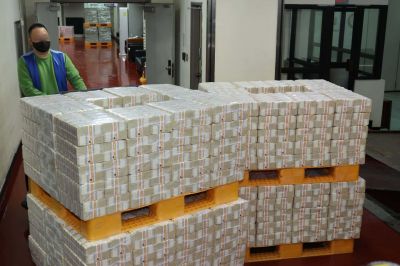
Market liquidity funds increased by about 35 trillion won in one month, showing a rising trend for six consecutive months. This is due to money flowing into time deposits and savings as deposit interest rates rise, and an increase in funds flowing into securities investment trusts due to the growth of funds.
According to the "November Monetary and Liquidity" report released by the Bank of Korea on the 17th, the broad money supply (M2 basis, average balance) in November last year was 3,894.9 trillion won, increasing by 35.3 trillion won (0.9%) in one month. The increase was three times larger than in October (0.3%).
The broad money supply indicator M2 includes cash, demand deposits, and checking deposits (all M1), as well as money market funds (MMF), time deposits and savings under two years, securities investment trusts, certificates of deposit (CD), repurchase agreements (RP), financial bonds under two years, and money trusts under two years?short-term financial products that can be quickly converted into cash.
By product, all sectors except money trusts (-2.7 trillion won) increased, including securities investment trusts (+8.8 trillion won), money market funds (MMF, +7 trillion won), and time deposits and savings (+6.1 trillion won).
Securities investment trusts increased compared to the previous month (1.1 trillion won) as derivative and bond-type funds continued to grow and stock-type funds turned to an increase.
MMFs turned to an increase compared to the previous month (-900 billion won) as the incentive for short-term fund management grew due to increased interest rate volatility.
In the case of time deposits and savings, they increased in November, unlike the previous month (-5.9 trillion won), due to rising deposit interest rates and banks' efforts to attract corporate funds.
By economic agents, other financial institutions increased by 16.8 trillion won, mainly in time deposits, MMFs, and financial bonds.
Households and non-profit organizations increased by 11.6 trillion won, mainly in time deposits and securities investment trusts, and corporations also increased by 4.5 trillion won, mainly in time deposits and foreign currency deposits, while other sectors decreased by 700 billion won.
The narrow money supply (M1) based on the average balance (seasonally adjusted series) was 1,201.7 trillion won, increasing by 4.3 trillion won compared to the previous month. Compared to the same month last year (based on the original series), it decreased by 4.9%, marking a decline for 15 consecutive months.
© The Asia Business Daily(www.asiae.co.kr). All rights reserved.
![Clutching a Stolen Dior Bag, Saying "I Hate Being Poor but Real"... The Grotesque Con of a "Human Knockoff" [Slate]](https://cwcontent.asiae.co.kr/asiaresize/183/2026021902243444107_1771435474.jpg)
















