The three major indices of the U.S. New York stock market are all showing a downward trend in the early trading hours on the first trading day of the week, the 16th (local time), after hovering around the flat line. This week, corporate earnings and consumer indicators that can gauge the economic trend will be announced one after another.
At around 10 a.m. at the New York Stock Exchange (NYSE) on this day, the Dow Jones Industrial Average was trading at around 37,367 points, down 0.6% from the previous session. The S&P 500 index, which focuses on large-cap stocks, was down 0.52% at 4,759 points, and the tech-heavy Nasdaq index was down 0.51% at 14,897 points. The previous day, Monday, was Martin Luther King Jr. Day, and the financial markets were closed.
Currently, all 11 sectors in the S&P 500 are in decline. In particular, energy, industrial, and materials stocks are showing significant drops. Goldman Sachs, which reported earnings exceeding expectations before the market opened, is trading slightly higher. Morgan Stanley fell more than 3% due to the impact of large one-time expenses. Tesla is weak after CEO Elon Musk announced a desire for 25% voting rights the previous day. Apple also fell more than 2% amid concerns about slowing iPhone sales due to discount news in the Chinese market.
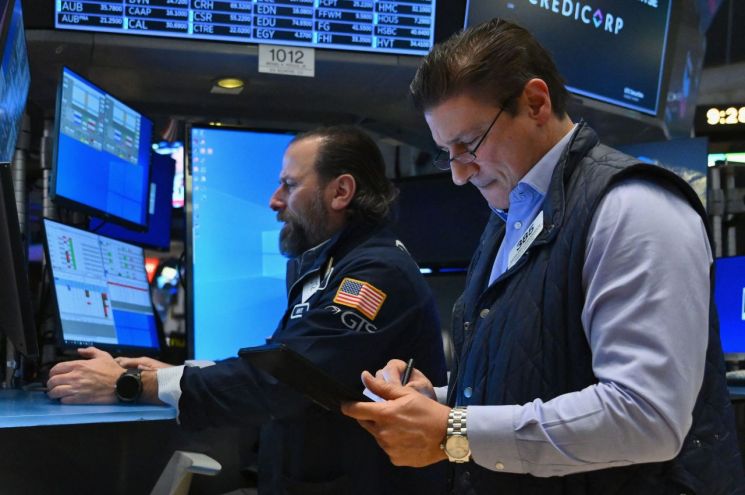
Investors are closely watching the fourth-quarter corporate earnings that started late last week led by major banks, as well as movements in Treasury yields and oil prices, while awaiting economic indicators such as retail sales to be released this week. Through this, they aim to gauge the direction of monetary policies of the Federal Reserve (Fed) and other major central banks.
In the New York bond market on this day, the benchmark 10-year U.S. Treasury yield is rising as investors await this week’s economic data. The 10-year yield is in the 4.0% range, and the 2-year yield, which is sensitive to monetary policy, has slightly increased to around 4.18%. This is analyzed as a result of remarks from European Central Bank (ECB) officials that weakened expectations for an early rate cut. Fran?ois Villeroy de Galhau, an ECB policymaker attending the World Economic Forum (WEF, Davos Forum) annual meeting in Davos, Switzerland, said, "It is too early to declare victory. It is not over yet."
While the market still holds expectations that the Fed may make its first rate cut as early as March, there are also increasing concerns that investors’ optimism is excessive. According to the Chicago Mercantile Exchange (CME) FedWatch, the interest rate futures market currently reflects more than a 72% chance that the Fed will keep rates steady in January and then cut rates by at least 0.25 percentage points at the March Federal Open Market Committee (FOMC) meeting. The consumer price index (CPI) for December, released last week, showed a rebound exceeding expectations, weakening early rate cut expectations; however, the producer price index (PPI) immediately afterward slowed more than expected, fueling renewed hopes for a March cut.
Efek Ozcardeskaya, chief analyst at Swissquote, said, "In the first quarter of this year, it will become clear that it is too early for central banks to cut rates," adding, "In the U.S., resilient growth, a strong labor market, and fiscal spending leading up to the presidential election mean there is no need for a Fed rate cut in March."
Accordingly, investors’ attention is focused on inflation indicators, as well as retail sales and the Fed’s Beige Book on economic conditions to be released this week. The retail sales indicator is considered a pillar accounting for two-thirds of the U.S. real economy and a comprehensive measure of economic health. If December consumer spending remains robust, it could strengthen hawkish voices advocating for maintaining high interest rates for the time being. Speeches by Fed officials ranked third in the hierarchy?John Williams, president of the New York Fed; Christopher Waller, a Fed governor; and Raphael Bostic, president of the Atlanta Fed?are also scheduled during the week. Earlier, President Bostic stated that rate cuts might only be possible in the third quarter.
Corporate earnings announcements continue. Late last week, JP Morgan Chase and Citi posted mixed results. Before the market opened on this day, Goldman Sachs and Morgan Stanley each released earnings that exceeded expectations. The Empire State Manufacturing Index, released by the New York Fed on this day, recorded -43.7, the lowest since May 2020.
The dollar index, which measures the value of the U.S. dollar against six major currencies, is trading above 103.1, up more than 0.7%. The Chicago Board Options Exchange (CBOE) Volatility Index (VIX), known as Wall Street’s fear gauge, rose more than 2% to 13.6. Along with this, investors are also monitoring the impact of Middle East risks, such as the Houthi threat in the Red Sea, on oil prices. West Texas Intermediate (WTI) crude oil prices are trading below $72 per barrel, down more than 0.8% from the previous session.
© The Asia Business Daily(www.asiae.co.kr). All rights reserved.
![Clutching a Stolen Dior Bag, Saying "I Hate Being Poor but Real"... The Grotesque Con of a "Human Knockoff" [Slate]](https://cwcontent.asiae.co.kr/asiaresize/183/2026021902243444107_1771435474.jpg)















