Yongin City Expects Employment Impact to Increase from 1.6 Million to 1.92 Million
"Industrial Complex Land Use Plan to Reflect Expanded Investment"
On the 16th, Yongin City in Gyeonggi Province announced that Samsung Electronics' investment in the advanced system semiconductor national industrial complex being developed in the I-dong and Namsa-eup areas of Cheoin-gu will increase from 300 trillion won to 360 trillion won.
The city explained that as the number of semiconductor production lines (fabs) Samsung Electronics will establish here increases from 5 to 6, the investment amount has also increased by 60 trillion won.
The city estimated that with Samsung's expanded investment, the production inducement effect of the industrial complex will increase from 400 trillion won to 480 trillion won, and the direct and indirect employment effect will also rise from 1.6 million to 1.92 million people.
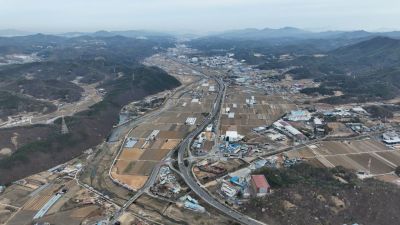 Aerial view of Idong and Namsa-eup areas in Cheoin-gu, Yongin-si, where the advanced system semiconductor national industrial complex will be established.
 [Photo by Yongin-si]
Samsung Electronics' intention to increase investment in the Yongin I-dong and Namsa-eup advanced system semiconductor national industrial complex appears to be a determination to maintain a super-gap in the increasingly fierce semiconductor competition and to strengthen competitiveness in future semiconductor fields such as system semiconductors beyond memory.
The city is preparing to allocate all six fabs in the industrial complex land use plan in line with the expanded investment scale. In particular, since President Yoon Seok-yeol emphasized a 'speed race' to maintain the super-gap in the semiconductor industry at the livelihood discussion held the day before, the city plans to make every effort to advance the groundbreaking schedule of the industrial complex by more than six months from the originally planned end of 2026.
The city will closely coordinate with central government ministries such as the Ministry of Land, Infrastructure and Transport and the Ministry of Trade, Industry and Energy, as well as the project implementer Korea Land and Housing Corporation (LH), to focus administrative power to ensure that essential power and water supply for semiconductor production proceed without disruption.
The system semiconductor industrial complex will be developed on a total area of 7.1 million square meters. With the addition of a 36,000 square meter relocation housing site designated in November last year on the southern site of the complex, the total area reaches 7.47 million square meters.
LH is currently establishing the industrial complex plan and plans to apply for approval from the Ministry of Land, Infrastructure and Transport within the quarter. LH aims to obtain approval for the complex plan by early next year, start construction of the complex in 2026, and operate the first fab in 2030.
Yongin City has also designated the Semiconductor Division 2 as a dedicated organization to support the project and plans to open a field communication office at the planned industrial complex site in the first quarter to actively communicate with residents.
Mayor Lee Sang-il said, "With semiconductor anchor companies such as Samsung Electronics and SK Hynix, as well as about 150 materials, parts, and equipment companies in I-dong and Namsa-eup and about 50 in Wonsam-myeon, along with fabless (design) companies moving in, Yongin will form the world's largest semiconductor ecosystem," adding, "The city will do its best to support the successful progress of the project."
© The Asia Business Daily(www.asiae.co.kr). All rights reserved.
![Clutching a Stolen Dior Bag, Saying "I Hate Being Poor but Real"... The Grotesque Con of a "Human Knockoff" [Slate]](https://cwcontent.asiae.co.kr/asiaresize/183/2026021902243444107_1771435474.jpg)















