Samsung Welstory Implements 18 Types of Advanced Automation Equipment Across All Processes
Ourhome Introduces 3 Automation Systems Including Frying-Dedicated System in First Half
Enhancing Operational Efficiency... Improving Quality Consistency
A strong wave of automation is sweeping through the group catering industry in the new year. The plan is to maximize operational efficiency by introducing automated equipment in various processes, including cooking processes that form the basis of catering business, as well as serving and cleaning, thereby increasing profitability.
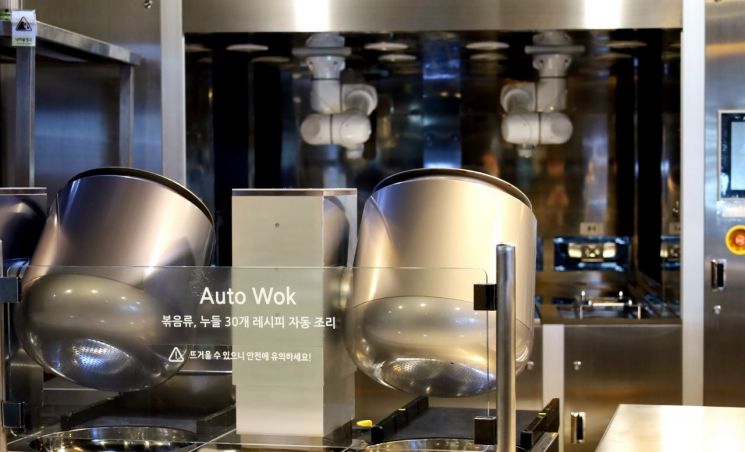
According to the industry on the 17th, Samsung Welstory announced that it has established 18 types of advanced automated equipment applicable to the entire catering industry process. Samsung Welstory, which introduced the cooking robot ‘Wellybot’ last year as the first in the group catering industry, has increased the diversity of automated equipment that can be applied according to the size and characteristics of business sites, not only for cooking but also for preprocessing, serving, and cleaning through the newly established automation solution lineup.
Samsung Welstory plans to present a future-oriented operating model for the catering business through new automated equipment this year and expand it to various business sites. The equipment at the forefront of the automation solution is a compact cooking robot designed for small and medium-sized businesses where it is difficult to introduce large-scale equipment or where the amount cooked at one time is relatively small. The lightweight cooking robot consists of AutoWok, which automatically cooks various stir-fried dishes according to a set recipe algorithm, and a frying robot composed of a fryer and a robotic arm. It applies robotics technology optimized for group catering to help reduce cooking time.
CJ Freshway has also applied the hamburger patty cooking robot ‘Alpha Grill’ from the startup ‘AnyAI’ at the food court inside Severance Hospital in Seodaemun-gu, Seoul since last year. The robot applied to the hamburger specialty corner ‘Burger Station’ automates the patty grilling process and can cook eight patties simultaneously. When an employee places patties on the robot and presses the start button, the robot’s grill moves vertically to cook both sides of the patties simultaneously, doubling the cooking speed by eliminating the need to flip the patties.
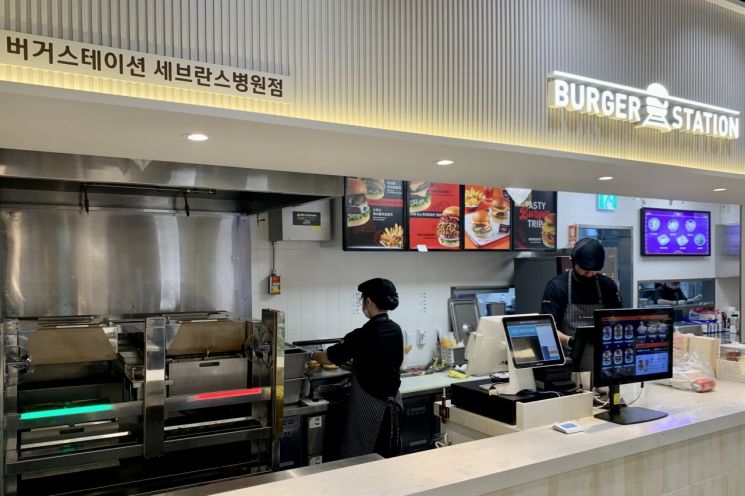 CJ Freshway, the hamburger patty cooking robot 'Alpha Grill' installed at the hamburger store 'Burger Station' in the Severance Hospital food court.
Ourhome is also accelerating the introduction of automated equipment. Last year, Ourhome signed a development agreement for a ‘group catering collaborative robot’ with Doosan Robotics. Through the development of automated cooking, serving, and cleaning systems for catering facilities, Ourhome plans to apply collaborative robot solutions to its franchise, including future automation of food distribution processes. It plans to introduce three systems on-site in the first half of this year: an all-in-one unmanned robot cooking system, an unmanned delivery system applied to a barista robot, and an automated system dedicated to frying.
Ourhome Vice Chairman Gu Ji-eun visited the International Consumer Electronics Show (CES) held in Las Vegas, USA, earlier this month to explore related booths, showing an active stance on adopting food tech as a future growth engine. An Ourhome official explained, “We are researching and developing in a direction that improves practical aspects such as increasing work efficiency and innovating processes for catering and dining establishments,” adding, “We plan to introduce digital platforms such as strengthening the food waste monitoring system to minimize food loss rates, developing AI-based unmanned convenience stores, and building smart services for new automated cooking equipment.”
The reason catering companies are all accelerating the expansion of automated processes is ultimately to maximize operational efficiency at business sites. By automating repetitive tasks and improving convenience in cooking and other areas, operational efficiency is increased, which helps alleviate labor shortages in the catering industry and provides the advantage of delivering food services with consistent quality. Additionally, it is expected to help qualitatively by reducing workers’ workload from repetitive tasks, preventing musculoskeletal disorders and safety accidents.
Experts judge that automation is now an inevitable trend in the labor-short catering and dining industry. Yang Seung-yoon, a researcher at Eugene Investment & Securities, explained, “A trend of introducing various robots is being confirmed mainly in fields with labor shortages,” adding, “In particular, many tests are being conducted to introduce robots for cooking foods such as chicken using collaborative robots, and with the standardization of cooking solutions, the application trend is expected to expand after this year.”
© The Asia Business Daily(www.asiae.co.kr). All rights reserved.


















