‘Leading the Hyperconnected Era, Aspiring to Become a Global Comprehensive Port Service Leader’
Presenting Six Future Development Visions Including Becoming the World's Second Largest Transshipment Hub by 2040
Busan Port Authority (President Kang Jun-seok, BPA) declared a new vision, "Global Integrated Port Service Leader Leading the Hyperconnected Era," at its 20th anniversary ceremony on the 16th, reflecting on its major achievements so far and pledging to leap forward as one of the world's top three ports by 2040.
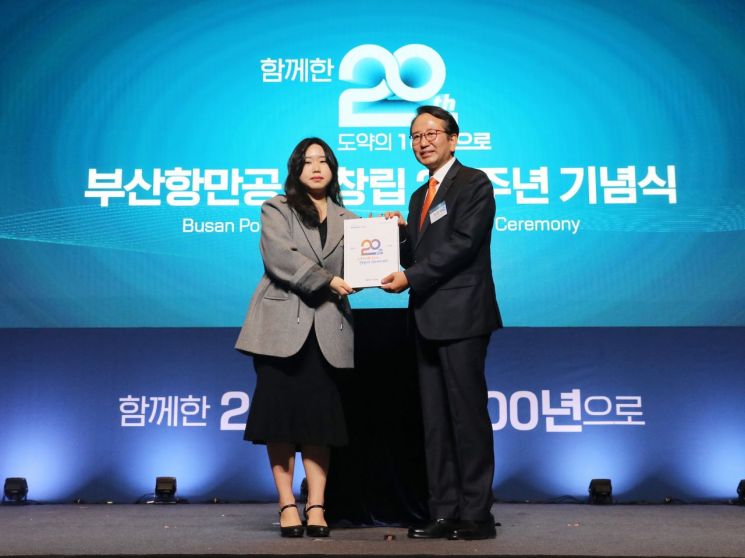 Busan Port Authority President Kang Jun-seok is awarding the 20-year service plaque to employee Bae Ji-min, who was born in 2004 and turned 20 this year.
The new vision signifies leading the paradigm shift of ports in the hyperconnected era that connects industries and people through Fourth Industrial Revolution technologies such as artificial intelligence, the Internet of Things, and big data, and developing into a global integrated port company by expanding service areas including fostering related industries through the establishment of a one-stop total service system.
BPA also presented six future visions for Busan Port by 2040: ▲ Completion of the development of Busan New Port and Jinhae New Port and becoming the world's second-largest transshipment hub with a cargo volume of 37 million TEU ▲ A tri-port hub complex logistics port linking Busan Port, Gadeok New Airport, and inland transportation ▲ A high-quality eco-friendly integrated service port providing total services in response to changes in the shipping environment such as AI, autonomous navigation, and eco-friendly fuels ▲ A smart port maximizing efficiency, accuracy, and stability of port operations based on Fourth Industrial Revolution technologies ▲ A value-creating urban port through revitalization of the new marine economy via North Port redevelopment and creation of business and marine tourism spaces at Gamcheon Port and Dadaepo Port ▲ A leading port in port logistics industry growth through training port professionals, strengthening the industrial ecosystem, and supporting research and development.
Four major management goals to realize the new vision were set as ▲ Port Connectivity Index ▲ Added Value of Busan Port ▲ Port Ecosystem Growth Index ▲ ESG Management.
Four strategic directions including ▲ Leading the future port paradigm ▲ Maximizing port added value ▲ Fostering the port industry ecosystem ▲ Institution innovation focused on efficiency and performance, along with 12 strategic tasks, were also presented.
Since BPA’s establishment in 2004, Busan Port has overcome numerous crises and hardships such as the global economic crisis (2008), Hanjin Shipping bankruptcy (2016), and the COVID-19 pandemic (2020?22), continuously advancing.
Total cargo volume increased from 10.41 million TEU in 2004 to a record high of 22.75 million TEU in 2023.
In particular, transshipment volume tripled from 4.25 million TEU in 2004 to 12.14 million TEU last year, solidifying its status as the world’s second-largest global transshipment port and the seventh-largest container port.
The number of container berths, which was 21 at the time of BPA’s establishment, increased to 44 by the end of last year with the completion of the fully automated terminal phases 2-5 at New Port West Container Terminal, the first of its kind in Korea. The length of container ship berthing facilities also expanded from 6 km in 2004 to 14.1 km in 2023.
Notably, the New Port West Container Terminal phases 2-5, symbolizing Busan Port’s innovative growth, differs from existing piers in that all cargo handling equipment was manufactured using domestic technology by Korean companies and operates on electricity, presenting a new model for next-generation ports.
The first phase of the North Port redevelopment project, aimed at transforming North Port into a waterfront space for citizens and a tourism and leisure area to develop it into one of the world’s most beautiful port cities, completed its 15-year journey since the project’s inception in 2008 by fully opening the waterfront park infrastructure to the public last year.
BPA, Korea’s first port public enterprise, has seen its workforce grow from 77 employees at its establishment in January 2004 to 272 currently; its budget increased from 143.4 billion KRW to 1.4952 trillion KRW; and its assets soared from 3.4556 trillion KRW to 7.8798 trillion KRW.
The organization expanded from 3 headquarters and 15 departments to 3 headquarters, 2 business units, and 23 departments.
Especially, BPA operates five representative offices and three logistics warehouses in overseas strategic locations including Japan, China, Europe, the United States, and Indonesia, playing a significant role in attracting transshipment cargo and securing competitiveness for domestic companies’ overseas expansion.
The 20th anniversary ceremony was attended by distinguished guests including Vice Minister Song Myung-dal of the Ministry of Oceans and Fisheries, Mayor Park Hyung-joon of Busan, Vice Governor Choi Man-rim of Gyeongnam Province, and Deputy Mayor Jo Myung-rae of Changwon City, who offered congratulatory remarks.
In addition, 18 individuals who contributed to the development of the port logistics industry and infrastructure expansion were awarded, and plaques of appreciation were presented to nine organizations including the Busan Port Development Council.
Following the ceremony, BPA labor and management jointly conducted a social contribution activity by donating 10,000 briquettes to the Busan Briquette Bank for vulnerable groups near Busan Port and personally delivering some of them to elderly households to deepen the significance of the 20th anniversary.
In his commemorative speech, BPA President Kang Jun-seok expressed gratitude for the interest and encouragement from the public, government, local governments, and the shipping and port logistics industry for the development of Busan Port, stating, “We will not be complacent with the achievements of the past 20 years. We will promptly establish advanced smart port infrastructure such as automated cargo handling equipment and foster and develop Busan Port into the world’s best transshipment hub through business diversification including eco-friendly energy and overseas projects.”
© The Asia Business Daily(www.asiae.co.kr). All rights reserved.
![Clutching a Stolen Dior Bag, Saying "I Hate Being Poor but Real"... The Grotesque Con of a "Human Knockoff" [Slate]](https://cwcontent.asiae.co.kr/asiaresize/183/2026021902243444107_1771435474.jpg)
















