The 4th Basic Plan for Intelligent Robots Confirmed
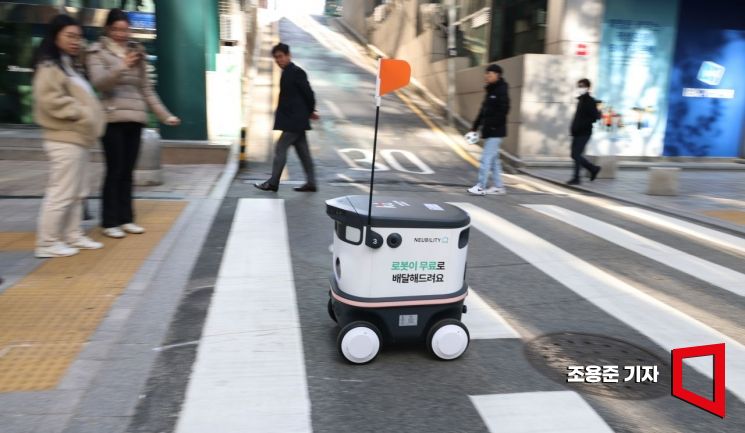 A self-driving robot developed independently by Newbility is providing delivery services among the crowds around Seolleung Station in Gangnam, Seoul. Photo by Yongjun Cho jun21@
The government has decided to increase the localization rate of advanced robots to 80% by 2030. To foster the robotics industry, it will also nurture 15,000 talents skilled in the convergence of hardware (HW) and software (SW). Through this, the plan is to expand the domestic robotics industry scale to over 20 trillion won by 2030.
On the 16th, the Ministry of Trade, Industry and Energy announced that it finalized the "4th Basic Plan for Intelligent Robots (2024?2028)" at the Robot Industry Policy Council meeting. This plan is established and implemented every five years by the ministry under the Intelligent Robot Development and Distribution Promotion Act. It also serves as a concrete blueprint of the "Vision and Strategy for the Advanced Robot Industry" announced in December last year.
The government aims to strengthen the three core competencies of technology, workforce, and enterprises, and expand domestic and international markets to grow the domestic robotics industry, which was valued at about 5.6 trillion won in 2021, to over 20 trillion won by 2030. To create a robot-friendly environment, the Intelligent Robot Act will be fully revised, and market entry regulations will be lowered.
First, the government plans to focus investment on technology development to raise the technological self-reliance rate of five key components?reducers, servomotors, gripper sensors, controllers, and others?from 44% in 2021 to 80% by 2030. After reviewing industry demands and expert groups, this year the government will prepare a company-led "Advanced Robot R&D Roadmap" to secure more than 30 detailed technologies.
Additionally, to secure over 15,000 core robotics personnel, the government will open robotics convergence courses centered on graduate schools of robotics and expand industry-academia projects. Besides the existing Robot Vocational Innovation Center in Gumi, one more Robot Practical Workforce Training Center will be newly established. The plan also includes nurturing 150 specialized robotics companies by discovering an average of more than 20 advanced robotics companies annually in three major fields: manufacturing robots, service robots, and core components.
The government will concentrate the capabilities of all ministries to distribute one million advanced robots by 2030. It will revise the current Intelligent Robot Act system in line with technological progress and industrial changes and push for legislation within this year. Furthermore, it plans to complete 20 tasks such as permitting outdoor mobile robots to use sidewalks and parks and allowing delivery businesses, focusing on improving 51 regulations within the year.
Moreover, to enable robotics companies to build sufficient track records in the domestic market and expand overseas, the government will expand intergovernmental cooperation channels and actively support promotion, networking, and overseas certification.
To coexist with robots, the government will also promote the construction of robot-friendly infrastructure. It will establish robot ethics guidelines to ensure robots are developed and utilized in the right direction. About 200 billion won will be invested to build a "National Robot Test Field" to enable robots in the development stage to undergo verification of safety and reliability and to facilitate rapid commercialization.
© The Asia Business Daily(www.asiae.co.kr). All rights reserved.
![Clutching a Stolen Dior Bag, Saying "I Hate Being Poor but Real"... The Grotesque Con of a "Human Knockoff" [Slate]](https://cwcontent.asiae.co.kr/asiaresize/183/2026021902243444107_1771435474.jpg)
















