Davos Forum January Report
69% Say "Geopolitical Divisions Accelerating"
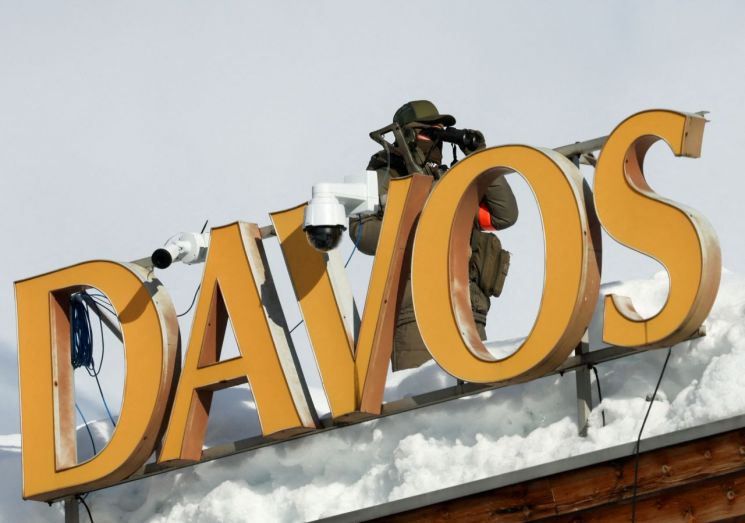
The annual meeting of the World Economic Forum (WEF, Davos Forum), where prominent figures from politics, business, and academia around the world gather to discuss international issues, opened on the 15th (local time). The forum presented a somewhat gloomy economic outlook. More than half of the economists predicted that global growth would weaken this year, and 7 out of 10 anticipated that geopolitical divisions would accelerate further.
In the 'Chief Economists Outlook: January 2024' report released by the Davos Forum on the same day, it was announced that "the global economic outlook remains uncertain and full of unpredictability." According to the report, 56% of the chief economists surveyed expected global growth to weaken further this year. Those who believed growth would remain at a similar level to last year accounted for 20%, while only 23% anticipated stronger growth.
The report highlighted that "such a somewhat divided outlook underscores that the uncertainties dominating economic forecasts over the past year persist," and diagnosed that "uncertainty will continue to be a key theme for the economy in 2024." It also stated, "Global economic activity is slowing, financial conditions remain tight, and geopolitical tensions are escalating," adding that "businesses and policymakers face ongoing headwinds and volatility."
Regionally, concerns about low growth around Europe have intensified. 77% of economists predicted that the European economy would show very weak (10%) or weak (67%) growth this year. This figure is nearly double that of the survey conducted in September last year. The outlook for the United States also turned somewhat negative. In the previous survey, 78% expected moderate or higher growth this year, but this figure dropped to 56% in the current survey.
The outlook for South Asia, East Asia, and the Pacific region remained relatively positive with little change from before. However, a more cautious stance was observed regarding China. In the previous survey, 19% expected strong growth and 38% moderate growth, but this year, 69%?about 7 out of 10 respondents?forecast moderate growth. Economic forecasts for individual countries other than the U.S. and China were not disclosed.
Notably, economists expressed concerns about geopolitical conflicts such as the U.S.-China hegemonic competition and wars and armed clashes worldwide. 69% of respondents, or about 7 out of 10, predicted that the pace of geopolitical division would accelerate further this year. Only 10% believed it would not, while 21% were uncertain.
Additionally, 87% of respondents worried that these geopolitical situations would trigger volatility in the global economy over the next three years. Responses indicating that these tensions would impact stock markets or expand economic bloc formation each reached 80%. This assessment draws particular attention amid the prolonged Russian invasion of Ukraine and rising tensions in the Middle East. Moreover, this year is an unprecedented 'super election year,' with at least 70 countries, including the United States, holding elections.
The only positive result in this survey was on inflation. 70% of respondents answered that inflation would ease this year. Additionally, 70% forecasted that financial conditions would stabilize.
© The Asia Business Daily(www.asiae.co.kr). All rights reserved.
![Clutching a Stolen Dior Bag, Saying "I Hate Being Poor but Real"... The Grotesque Con of a "Human Knockoff" [Slate]](https://cwcontent.asiae.co.kr/asiaresize/183/2026021902243444107_1771435474.jpg)















