No Criminal Punishment Even If Caught Under Current Law
Ministry of Health and Welfare to Strengthen Punishment Within This Year
KMA Demands Voluntary Disciplinary Authority Over Legislation
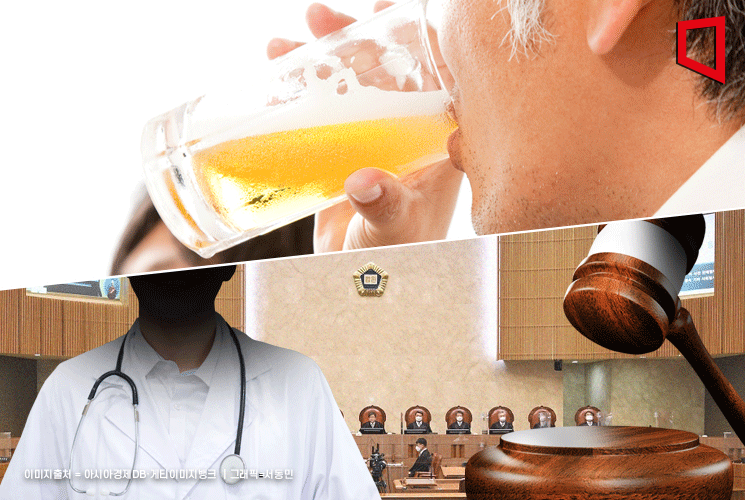
Recently, doctors who treated patients while intoxicated have been repeatedly caught, but all received only a light punishment of a one-month license suspension. Although intoxicated medical treatment is an unethical act that endangers patients, it is not subject to criminal punishment under current law. This is why calls to strengthen penalties for doctors' intoxicated medical practices are growing.
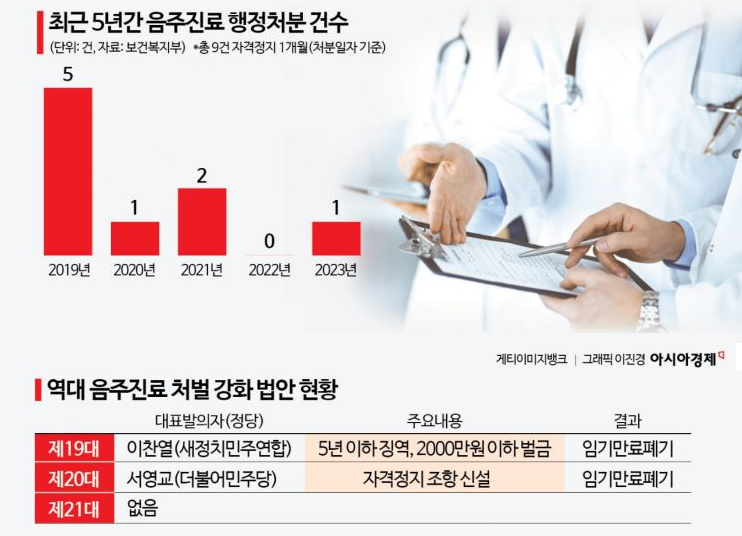
According to the Ministry of Health and Welfare on the 16th, from 2019 to last year, there were a total of nine cases where medical practice was conducted under the influence of alcohol, all resulting in administrative sanctions of a one-month license suspension. By year, there were five cases in 2019, one in 2020, two in 2021, zero in 2022, and one in 2023. These cases mainly involved doctors drinking alcohol during night shifts or on-call duty and being caught after patients reported them.
Under the current Medical Service Act, there are no penalty provisions for intoxicated medical practice, and criminal punishment is impossible unless a serious medical accident occurs. Even if intoxication is detected, only the clause stating that "if a medical professional severely damages the dignity of the profession, their license may be suspended" applies.
In December 2020, the Anti-Corruption and Civil Rights Commission recommended strengthening the administrative sanctions for intoxicated medical practice beyond a one-month license suspension, but no improvements have been made. A Ministry of Health and Welfare official said, "We plan to strengthen penalties for intoxicated medical treatment within this year," but added, "legislative support is necessary."
Intoxicated medical treatment incidents keep recurring from time to time. Doctor A, working at a general hospital in Gangdong-gu, Seoul, performed facial suturing surgery on a patient in their 60s while intoxicated around 11 p.m. on the 12th. The patient reported to the police, saying, "The doctor who performed the surgery is suspected of being intoxicated," and Doctor A admitted, "I drank beer during dinner." However, due to the lack of penalty provisions, no formal charges were filed.
Earlier, in October 2020, Doctor B at an obstetrics and gynecology clinic in Cheongju, Chungbuk, performed a cesarean section while intoxicated. At that time, Doctor B was not scheduled to work on the holiday but returned to the hospital after being contacted by the on-call doctor about an emergency surgery. The patient's family reported to the police after noticing the smell of alcohol on Doctor B while inquiring about the surgery's progress.
Legislation to punish doctors for intoxicated medical treatment has not passed the National Assembly so far. No bills regarding penalties for intoxicated medical treatment were proposed in the 21st National Assembly. Bills were discarded due to term expiration in the 19th and 20th National Assemblies.
In 2014, then Lee Chan-yeol of the New Politics Alliance for Democracy proposed a bill to impose up to five years imprisonment or a fine of up to 20 million won. A 2015 National Assembly review report on the bill pointed out, "Even a single incident of intoxicated medical treatment or surgery by medical staff is directly related to the patient's life, so it cannot rely solely on internal ethical guidelines or individual moral consciousness," and emphasized "the great necessity for legal regulation."
Later, in 2019, Seo Young-kyo of the Democratic Party of Korea submitted a bill to introduce a license suspension clause for intoxicated medical practice. However, both bills naturally expired due to term expiration.
Regarding this, the Korean Medical Association holds the position that disciplinary authority should be transferred to medical professional organizations rather than legislating penalties for intoxicated medical practice. Kim Yi-yeon, spokesperson for the KMA, said, "There is a misunderstanding among the public, but all authority lies with the Ministry of Health and Welfare," adding, "Advanced countries grant autonomous disciplinary authority. If the KMA gains investigative authority in Korea, it will be possible to respond swiftly to the deviant acts of a few doctors, minimizing harm to the public."
© The Asia Business Daily(www.asiae.co.kr). All rights reserved.
![Clutching a Stolen Dior Bag, Saying "I Hate Being Poor but Real"... The Grotesque Con of a "Human Knockoff" [Slate]](https://cwcontent.asiae.co.kr/asiaresize/183/2026021902243444107_1771435474.jpg)
















