Aircraft Unveiled Developed in Collaboration with Lockheed Martin
The National Aeronautics and Space Administration (NASA) of the United States, together with Lockheed Martin, unveiled the supersonic aircraft X-59 and announced plans for its demonstration flight.
NASA and Lockheed Martin's 'Supersonic Aircraft' Scheduled for Demonstration Flight Within This Year
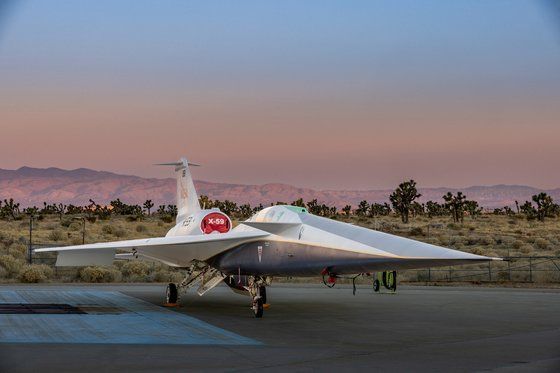
On the 14th (local time), NASA reported that Lockheed Martin showcased the X-59, which has been under development, to stakeholders at an event held on the 12th in Palmdale, California, and announced future test flight plans.
The aircraft being developed by NASA and Lockheed Martin is a 'supersonic aircraft' capable of flying faster than the speed of sound while significantly reducing noise. Its speed is 1.4 times the speed of sound, approximately 925 miles per hour (about 1489 km/h). NASA expressed confidence that the X-59, which was unveiled this time, measures 99.7 feet (30.4 m) in length and 29.5 feet (9 m) in wingspan, and incorporates advanced technology to enable quiet supersonic flight.
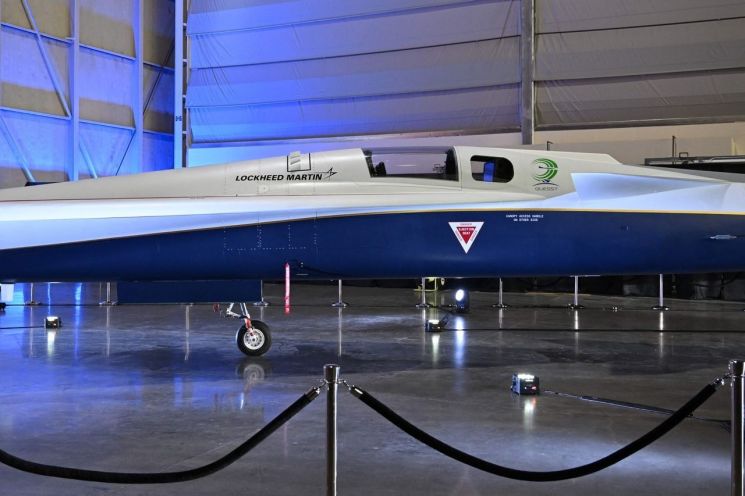 On January 12, 2024, at a public event held in Palmdale, California, USA, the experimental supersonic jet X-59, jointly developed by NASA and Lockheed Martin, was unveiled.
 [Image source=AFP·Yonhap News]
Pam Melroy, Deputy Administrator of NASA, emphasized, "In just a few years, we have turned an ambitious vision into reality," adding, "The X-59 will change the way we travel."
The X-59 development team stated that after conducting ground tests for additional adjustments, they plan to attempt the first demonstration flight within this year. The aircraft will fly over several cities across the United States to measure the sounds generated by the X-59 and the degree of noise perception by people, and then submit this data to the Federal Aviation Administration (FAA) and international regulatory agencies. However, the specific schedule has not yet been determined.
Have They Tamed the Explosive Sonic Boom? Latest Systems Including External Vision System Integrated
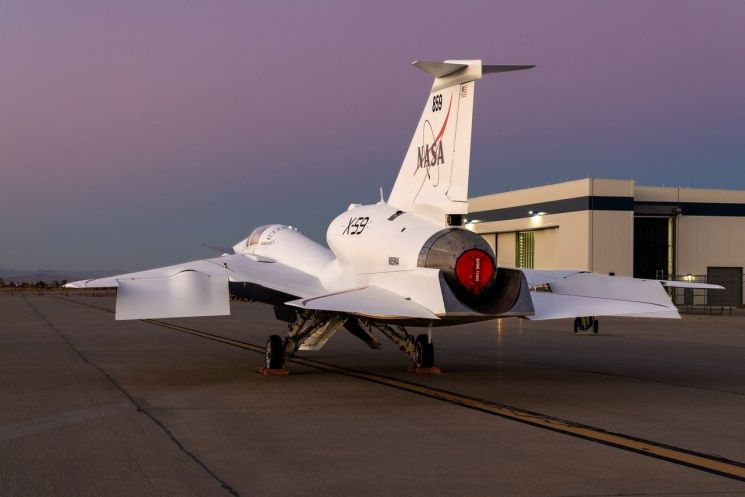 The experimental low-noise supersonic aircraft X-59, a joint project between Lockheed Martin's Skunk Works and NASA, stands on the runway in Palmdale, California, USA, on December 12, 2023.
 [Image source=Reuters·Yonhap News]
The key issue is how much noise can be reduced compared to existing supersonic aircraft. In 1947, NASA’s predecessor, the National Advisory Committee for Aeronautics (NACA), together with the Air Force and Bell, jointly developed the 'Bell X-1' rocket aircraft, which achieved supersonic flight at an altitude of 13.9 km, but it produced a thunderous explosive sound. Because of this, the United States banned supersonic flight at low altitudes in 1973.
The supersonic passenger jet 'Concorde,' jointly developed by the United Kingdom and France, entered service in 1976 and operated at twice the speed of sound, but it failed to become popular due to noise during takeoff and landing and excessively high fares, and its operation was discontinued in May 2003.
However, NASA explained that the newly developed X-59 has a thin and slender nose section that accounts for about one-third of the total length, which blocks the shock waves that typically cause the 'sonic boom' in supersonic aircraft.
To achieve this structure, the cockpit is positioned nearly halfway along the length of the aircraft, and the forward-facing windows were removed. Instead, an External Vision System composed of high-resolution cameras was installed on the cockpit monitors. Additionally, the engine is mounted on top, and the underside of the aircraft is smoothly designed so that shock waves merge at the rear, preventing the generation of sonic booms. Because of this, although the speed is slower than the Concorde, the noise level was greatly reduced to 75 dB (decibels), comparable to the sound of a car door closing.
Once the ban on supersonic passenger flights is lifted and the X-59 begins actual flights, flight times will be reduced by about half compared to existing times. The flight time from Seoul to New York will decrease from an average of 14 hours to 7 hours, and the flight time from Seoul to Paris, France, which used to take about 13 hours, will be shortened by nearly 6 hours. Applied to domestic routes, it would take only 16 minutes to travel from Seoul to Busan.
© The Asia Business Daily(www.asiae.co.kr). All rights reserved.
![Clutching a Stolen Dior Bag, Saying "I Hate Being Poor but Real"... The Grotesque Con of a "Human Knockoff" [Slate]](https://cwcontent.asiae.co.kr/asiaresize/183/2026021902243444107_1771435474.jpg)

















