President Yoon Unveils Government Support Plan to Foster Semiconductor Industry
"622 Trillion Won Investment in Mega Cluster... 3 Million Jobs"
"Semiconductor Factory Construction to Accompany Jobs and Infrastructure Investment"
Yoon: "Nuclear Power Essential... Phasing Out Means Giving Up Advanced Industries"
Need for High-Quality Stable Power Supply... "Nuclear Power for Public Welfare"
President Yoon Suk-yeol announced on the 15th that he will invest 622 trillion won in the world's largest 'semiconductor mega cluster' running through southern Gyeonggi Province. The plan is to start with the establishment and investment in semiconductor factories to create an ecosystem, and based on this, spread warmth throughout the domestic economy, including job creation. In particular, as a support measure for this, he mentioned the expansion of nuclear power plants to supply high-quality electricity. President Yoon emphasized, "If we abandon nuclear power, we must give up not only semiconductors but also advanced industries."
On the same day, President Yoon held the third 'Public Livelihood Forum' under the theme of 'Semiconductor Industry Enriching People's Livelihoods' at the Semiconductor Hall of Sungkyunkwan University Natural Science Campus in Suwon, Gyeonggi Province. He said, "The semiconductor industry enriches people's livelihoods and creates quality jobs more than any other industry." This forum was organized to listen to the voices of companies, local residents, and students regarding the semiconductor mega cluster development plan, following price and housing management, and to find solutions without bureaucratic barriers among related ministries.
The reason President Yoon chose the 'semiconductor field' as his first industrial sector visit reflects his conviction to stake the nation's fate on fostering the semiconductor industry. Since his presidential candidacy, including visits to Seoul National University Semiconductor Joint Research Center, President Yoon designated semiconductors as a future strategic industry even before the government was launched. His goal during his term is to increase semiconductor exports by 30% by 2027 and to become the number one in the global battery market share. The core plan is to increase semiconductor exports from $128 billion (about 163 trillion won) in 2021, the year before his inauguration, to $170 billion.
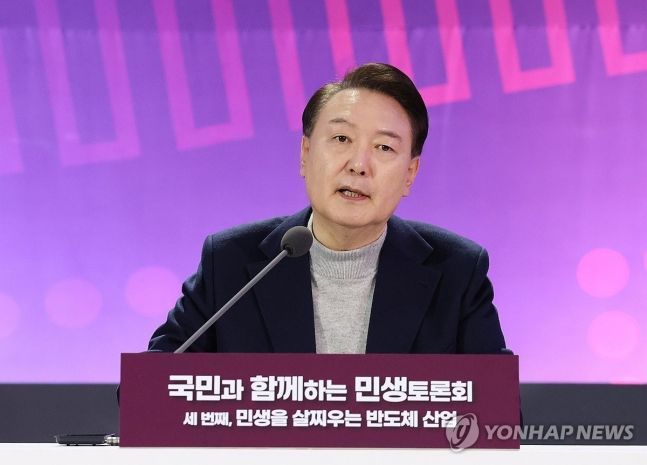 President Yoon Suk-yeol is speaking at the "Third Public Discussion on Livelihoods - Enriching Livelihoods through the Semiconductor Industry" held on the 15th at the Semiconductor Hall of the Natural Science Campus, Sungkyunkwan University, Jangan-gu, Suwon-si, Gyeonggi-do.
 [Photo by Yonhap News]
Yoon: "The Semiconductor Industry is a War... Total Human and Material Support Must Be Mobilized"
On this day, President Yoon described fostering and competing in the semiconductor industry as a 'war' and promised that the government would spare no material or human support. Since semiconductors are the core of not only current industries but also the three major future industries of quantum, advanced bio, and artificial intelligence (AI), the state must provide full support like in a war. He said, "To become the first mover in the scientific and technological revolution centered on semiconductors, we cannot proceed slowly and naturally; we must mobilize all national human, material, and strategic assets to fiercely accelerate."
Regarding the economic effects of the semiconductor mega cluster being established in southern Gyeonggi, President Yoon said, "We are initially expecting an investment of about 622 trillion won," and "The semiconductor mega cluster formation has already begun, and over about 20 years, at least 3 million quality jobs are expected to be newly created."
He added, "From this year onward, 158 trillion won will be invested over the next five years alone, creating 950,000 direct and indirect new jobs." He also predicted, "Currently, there are about 180,000 jobs in the semiconductor sector, and once the mega cluster is completed, 70,000 more jobs will be created in fabs alone," and "Sales of partner companies in design, post-processing, and materials sectors are expected to increase by more than 200 trillion won."
He also emphasized the importance of various policies to induce corporate semiconductor industry investment activation, infrastructure establishment, and talent development to win the global semiconductor war. Regarding the semiconductor investment tax credit expiring this year, President Yoon introduced, "We plan to extend the legal effect and continue the investment tax credit."
He actively rebutted criticisms that the semiconductor investment tax credit is a giveaway to large corporations, calling it "nonsense." President Yoon said, "If semiconductor company investments expand due to the tax credit, the profits and jobs of the entire related ecosystem companies will increase tremendously, and national tax revenue will also increase," emphasizing, "The claim that helping large companies harms the vulnerable is nothing but false agitation and must be clearly understood."
The government’s plan to nurture semiconductor industry talent was also presented. President Yoon mentioned investment in human resources, saying, "Not only semiconductor majors but also internationally competitive talents must be produced in various fields such as engineering, physics, and chemistry to maintain the super-gap," adding, "Research and development (R&D) investment is ultimately an investment in people." He further explained, "Only when our industrial structure produces very expensive, high value-added products that others cannot make can all our people live better than other countries."
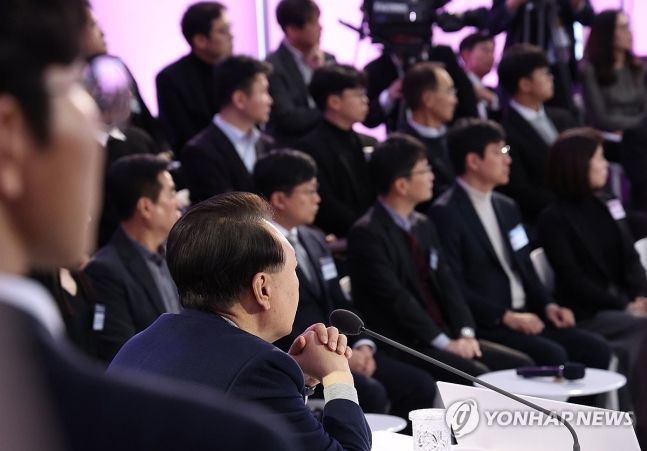 President Yoon Suk-yeol is listening to presentations by Minister Lee Jong-ho of the Ministry of Science and ICT and Minister Ahn Deok-geun of the Ministry of Trade, Industry and Energy at the "Third Public Discussion on Livelihoods - Semiconductor Industry Enriching Livelihoods" held on the 15th at the Semiconductor Hall of the Natural Science Campus, Sungkyunkwan University, Jangan-gu, Suwon-si, Gyeonggi-do.
 [Photo by Yonhap News]
Criticizing 'Nuclear Phase-Out,' Identifies 'Nuclear Power' as Essential Support for Semiconductor Industry Growth
President Yoon’s repeated indication of the government's intention to strengthen nuclear power by criticizing the 'nuclear phase-out' policy stood out. He said, "Nuclear power is essential for fostering the semiconductor industry," and "If we abandon nuclear power, we must give up not only semiconductors but also advanced industries." This reflects the judgment that nuclear power plants, which supply high-quality electricity stably, must be expanded for the smooth operation of semiconductor factories. This also reflects the government's intention to expand power supply capacity, including reviewing new nuclear power plants.
In particular, President Yoon pointed out, "Installing one semiconductor foundry line requires one 1.3GW nuclear power plant," mentioning the Giheung Samsung Electronics site, and criticized, "It took more than 10 years just to build the power transmission system." This implies the need for high-quality, stable power supply to build data centers and promote electric vehicle distribution, emphasizing, "Nuclear power is now essential." He reiterated, "If we abandon nuclear power, we must give up advanced industries as well." President Yoon added, "Although this is beyond semiconductors, the nuclear power industry must continue to develop to enrich our people's livelihoods."
The background to President Yoon’s condition of 'nuclear power expansion' for focused semiconductor industry growth includes a plan to strengthen the nuclear power industry to solve power supply and demand issues across industries. The Yoon administration has reviewed nuclear power since its inception due to the rapidly increasing power demand from semiconductor investments and electric vehicle expansion. The specialized complex in Yongin, where Samsung Electronics and SK Hynix are establishing the world's largest system semiconductor cluster, is expected to require more than 10GW of power, about 25% of the entire metropolitan area demand.
Moreover, the government must fulfill its 2050 carbon neutrality pledge. China plans to build 10 additional nuclear power plants to achieve carbon neutrality by 2060. The French government is also increasing the number of new nuclear plants from six to eight and is considering further construction.
President Yoon has also repeatedly expressed his will to expand nuclear power. One month after the government was launched, he visited Doosan Enerbility, a leading nuclear power company in Changwon, Gyeongnam, criticizing the Moon Jae-in administration's nuclear phase-out policy, saying, "If we had not done foolish things for five years and had built a stronger nuclear ecosystem, there would probably be no competitors now." Regarding the current nuclear power industry, he described it as "on the verge of extinction" and urged related ministries for active government support such as early orders. He also mentioned resuming construction of Shin Hanul Units 3 and 4, stating, "We will proceed efficiently by shortening the time as much as possible."
Government support measures for nuclear power expansion will also be in full swing this year. It is known that the government is strongly considering including the construction of more than four nuclear power plants in the working draft of the '11th Basic Plan for Electricity Supply and Demand (Jeon-Gibon)' applicable until 2038. The key point of Jeon-Gibon is whether to include new nuclear power plant construction, which disappeared during the previous administration that pursued a nuclear phase-out policy. If the 11th Jeon-Gibon includes plans for new nuclear power plants, it will be the first such plan in nine years since the 7th Jeon-Gibon in July 2015, which included Shin Hanul Units 3 and 4.
Earlier, President Yoon also urged government-level support, saying, "The nuclear power industry is like a battlefield devastated by the bomb of nuclear phase-out," and "With extraordinary determination, please boldly place orders and lead. Otherwise, the nuclear power industry cannot survive. In wartime, bureaucratic thinking that prioritizes safety must be abandoned."
© The Asia Business Daily(www.asiae.co.kr). All rights reserved.
![Clutching a Stolen Dior Bag, Saying "I Hate Being Poor but Real"... The Grotesque Con of a "Human Knockoff" [Slate]](https://cwcontent.asiae.co.kr/asiaresize/183/2026021902243444107_1771435474.jpg)

















