Global Security and Economic Concerns Rise
Conflicts with China Escalate,
Global Inflationary Pressures Expected to Intensify
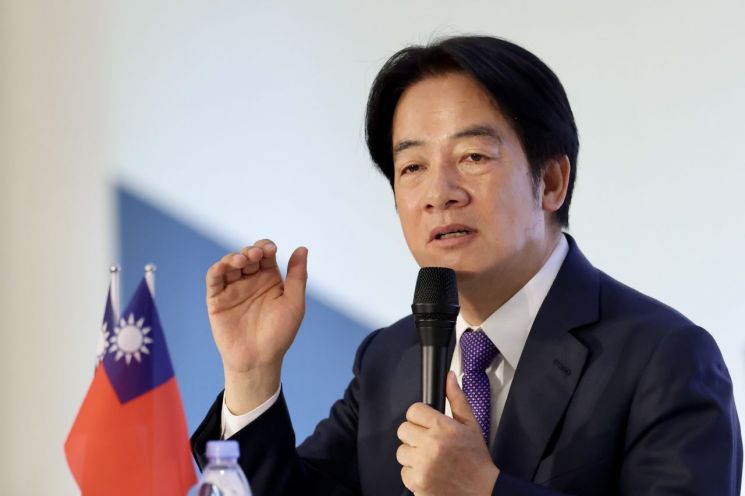
Concerns are rising that the election of Lai Ching-te, the Democratic Progressive Party (DPP) candidate with a strong anti-China stance, in Taiwan's presidential election could unsettle global financial markets. There are also forecasts that the election results could deepen conflicts between China and Taiwan, as well as between the U.S. and China, potentially reigniting worries about inflation.
According to Taiwan's Central Election Commission on the 15th, Lai Ching-te of the DPP won the presidential election held on the 13th with 40.05% of the vote, surpassing Hou Yu-ih of the Kuomintang (KMT), who received 33.49%, becoming the new president.
Lai's victory marks the first time in Taiwan's history that the DPP has secured three consecutive terms in power. The DPP is strongly pro-American and anti-China, while the KMT is anti-American and pro-China. Notably, Lai has repeatedly expressed Taiwan's desire for independence, demonstrating a strong anti-China stance.
Lai's election is expected to further escalate tensions between Taiwan and China. Immediately after the election, China's Taiwan Affairs Office of the State Council expressed displeasure, stating, "The election results show that the DPP does not represent the mainstream public opinion on the island (Taiwan)" and asserting that "Taiwan is 'China's Taiwan.'"
In response, The New York Times described the situation as "a confirmation that brinkmanship and tensions will continue and likely intensify."
The U.S.-based Independent Strategy warned that the confrontation surrounding Taiwan "will have enormous economic consequences not just regionally but globally." It also noted, "The type of conflict likely to occur will not be a D-Day-style landing operation on Taiwan but rather chaos and blockade," emphasizing that "Taiwan is highly vulnerable to disruptions in energy imports."
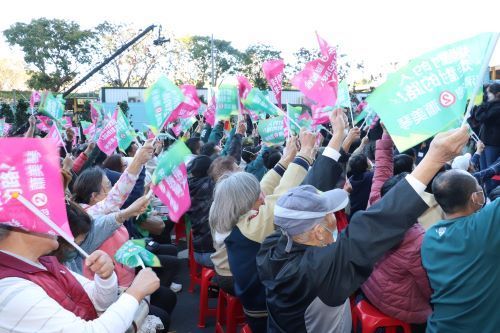 Supporters gathered in front of the election campaign office of Lai Ching-te, the ruling Democratic Progressive Party candidate, located in Taipei City, the capital, cheering as the presidential election was held in Taiwan on the 13th.
 [Image source=Yonhap News]
There are projections that China's economic pressure on Taiwan, and in the worst case, military conflict, could have a massive impact on the global economy.
Earlier, on the 9th, China announced the suspension of the "Economic Cooperation Framework Agreement (ECFA)" between the two sides. Signed in 2011, the ECFA is a tariff preferential treaty akin to a free trade agreement between China and Taiwan. If the ECFA is suspended, Taiwan's exports to mainland China will face tariffs amounting to billions of dollars annually, which could lead to a contraction in exports to China and worsen Taiwan's economic situation. China has also signaled additional economic pressure measures.
If China initiates a full-scale economic blockade against Taiwan, it would be an additional negative factor for the global economy. Taiwan is a key manufacturing hub for semiconductors worldwide, producing over 60% of the world's semiconductor chips.
Bloomberg Economics assessed on the 9th that if China imposes a blockade on Taiwan without war, the global economy's gross domestic product (GDP) could shrink by 5%, and if China invades Taiwan, the global GDP could decline by more than 10.2% (over $10 trillion). According to Bloomberg's estimates, the economic damage Taiwan could suffer from a cross-strait war would be 40% of its GDP, South Korea 23.3%, China 16.7%, and the U.S. 6.7%.
The cross-strait conflict also risks reigniting global inflation, which had been stabilizing. China's economic blockade of Taiwan could disrupt global supply chains, leading to price increases in semiconductors, machinery, and petrochemical products, which would translate into inflation. Inflation, in turn, could affect interest rates and destabilize global financial markets.
Professor Heo Yoon of Sogang University's Graduate School of International Studies said, "With the prolonged Russia-Ukraine war and the Middle East conflict escalating, the election results in Taiwan could increase tensions with China, potentially fueling global inflation. While the likelihood of the cross-strait conflict escalating to war is low, it is unlikely that U.S. pressure on China will ease."
Jung Hae-young, senior researcher at the Korea International Trade Association's Trade Support Center, stated, "With Lai Ching-te's election, China is expected to intensify military, economic, and diplomatic pressure on Taiwan. It is necessary to prepare for the entrenched geopolitical risks in Northeast Asia by pre-inspecting supply chains and reviewing response strategies for various scenarios."
Roche, chairman of Independent Strategy, noted, "Seventy percent of global trade passes through the Taiwan Strait between Taiwan and China," warning that even a blockade, without an invasion, could cause demand reduction and rising inflation, severely impacting the global economy.
Concerns have also been raised that increased U.S. military spending due to U.S.-China tensions could stimulate inflation. Kang Hyun-ki, a researcher at DB Financial Investment, explained, "If the U.S. increases military-related expenditures, global liquidity will rise, potentially fueling inflation. It is important to closely monitor whether the U.S. will expand its military-related fiscal spending in the future."
© The Asia Business Daily(www.asiae.co.kr). All rights reserved.
![Clutching a Stolen Dior Bag, Saying "I Hate Being Poor but Real"... The Grotesque Con of a "Human Knockoff" [Slate]](https://cwcontent.asiae.co.kr/asiaresize/183/2026021902243444107_1771435474.jpg)
















