"Interpretation of the Deep-Rooted Division Between Russia and Georgia"
In Georgia (known as Gruziya in Russian), a woman threw paint on a religious icon depicting Joseph Stalin, the former Soviet Communist Party Secretary. The woman's age and the reason for defacing the icon were not disclosed.
On the 13th (local time), the American CNN reported that a woman threw paint on the Stalin icon at the Holy Trinity Cathedral in the capital city of Tbilisi on the 9th of this month.
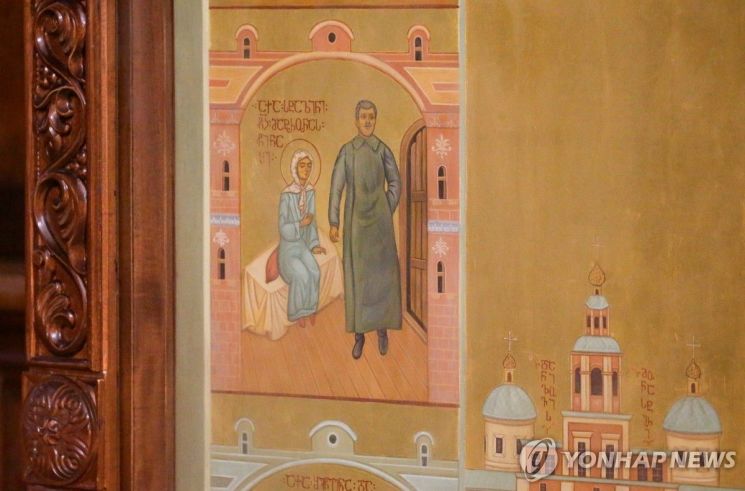 Stalin icon painting in the Holy Trinity Cathedral in Tbilisi, the capital of Georgia. The appearance before being damaged by paint.
 [Photo by Yonhap News/Reuters]
The icon depicts Stalin being blessed by Saint Matrona Nikonova of the Russian Orthodox Church during World War II. Joseph Stalin was the figure who helped Lenin lead the Russian Revolution and established the Soviet Union. After Lenin, he ruled the Soviet Union for 30 years from 1924, establishing a one-man dictatorship and purging over ten million of his own people in the process.
Because of this, he is also nicknamed the "Human Butcher of Georgia." However, Stalin was born in 1878 in the Gori region of the Russian Empire, which is now part of Georgia. Georgians regard Stalin as a figure whose dictatorship was wrong, but at the same time, they highly appreciate the fact that he revitalized the country during the Soviet era, so Stalin frequently appears in Georgian religious icons.
Moreover, Georgians view Stalin as a figure whose dictatorship was wrong, but simultaneously praise him for revitalizing the country during the Soviet period.
Including this background, CNN pointed out that the defacement of the icon symbolizes the deep-rooted division between Georgia and Russia. In 2008, Russia launched a full-scale invasion of Georgia, using the Georgian government's crackdown on the pro-Russian separatist regions of South Ossetia and Abkhazia as a pretext to stop Georgia's pro-Western policies.
Georgian police applied charges of disorderly conduct against the woman who defaced the icon and began an investigation, but some Orthodox believers demanded stronger measures such as detention. On the 13th, thousands of Orthodox believers and pro-Russian conservative residents gathered in front of the parliament and marched toward the cathedral, calling for punishment of the woman who defaced the icon.
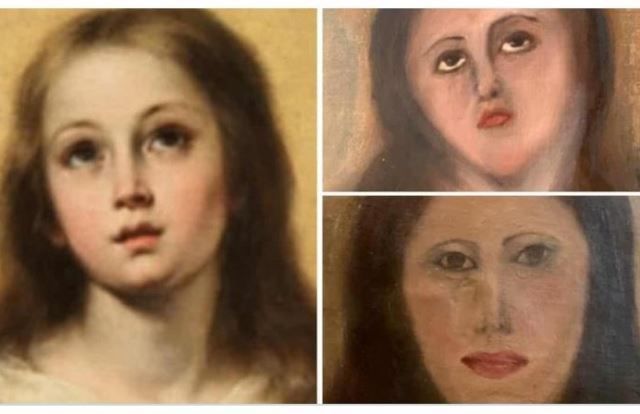 The reproduction of the original Virgin Mary painting by Muriyo (left) shows further damage after two restoration attempts (right).
 [Photo source = X capture]
Meanwhile, in 2020, a major disaster occurred during the restoration of an artwork in Spain. The work "Immaculate Conception" by Bartolom? Esteban Murillo (1617?1682), a representative painter of Spanish Baroque painting, was turned into a grotesque "abstract painting" by an unqualified restorer, causing controversy.
Earlier, in 2012, in Borja, Spain, an 80-year-old hobbyist painter who was a churchgoer altered a 100-year-old mural of Jesus, transforming it into a figure resembling a monkey, which also caused an incident.
© The Asia Business Daily(www.asiae.co.kr). All rights reserved.


















