U.S. President Joe Biden is facing criticism from both parties for not obtaining congressional approval before the U.S. military airstrike against Yemen's Iran-aligned Houthi rebels.
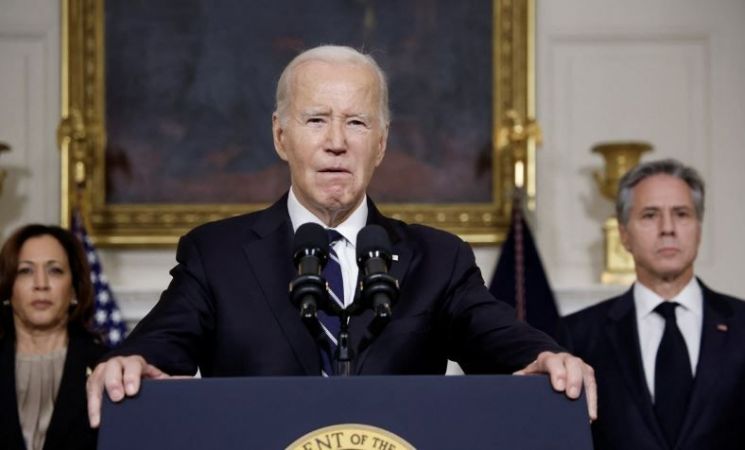
On the 12th (local time), according to U.S. daily The Washington Post (WP) and political media outlet Politico, voices of criticism have emerged among lawmakers from both parties, stating that congressional approval should have been obtained prior to the U.S. military airstrike on the Houthi rebels' bases. The U.S., along with the United Kingdom, conducted airstrikes on Houthi rebel bases that have been attacking civilian vessels in the Red Sea.
Democratic Representative Ro Khanna pointed out on X (formerly Twitter) that any president must request congressional approval before military attacks. He also referenced Article 1 of the Constitution, which grants Congress the power to declare war, stating that whether the president is a Democrat or Republican, this should be upheld.
In agreement with this, Democratic Representatives Pramila Jayapal, Val Hoyle, and Mark Pocan, as well as Republican Senator Mike Lee and Representative Chip Roy, also expressed support.
However, in response to such criticism, President Biden reportedly sent letters to House Speaker Mike Johnson and Senate President pro tempore Patty Murray, stating that this attack was an act of self-defense and therefore did not require congressional approval, according to the British daily The Guardian.
This is said to differ from the War Powers Act, which requires the president to notify Congress within 48 hours when engaging in military action.
WP reported that according to Article 2 of the U.S. Constitution, the president, as commander-in-chief, is authorized to use the military for defensive purposes.
In his letter, President Biden stated that he ordered this military action under his constitutional authority as commander-in-chief and head of the executive branch, with the responsibility to protect U.S. citizens domestically and abroad and to promote U.S. national security and foreign policy.
He also added that the action was taken in exercise of the right to self-defense under international law and Article 51 of the United Nations Charter.
© The Asia Business Daily(www.asiae.co.kr). All rights reserved.
![Clutching a Stolen Dior Bag, Saying "I Hate Being Poor but Real"... The Grotesque Con of a "Human Knockoff" [Slate]](https://cwcontent.asiae.co.kr/asiaresize/183/2026021902243444107_1771435474.jpg)















