Reconstruction Regulations Eased, but Remodeling Becomes More Difficult
Increasing Number of Remodeling Abandonments in Seoul and 1st Generation New Towns
Construction Companies Winning Remodeling Projects Also Facing Difficulties
"This basically means they are telling us not to do remodeling."
Apartment complexes in Seoul and the metropolitan area that were pushing forward or considering remodeling projects have been thrown into confusion due to a series of policy risks. Since the second half of last year, regulations such as the second safety inspection for remodeling have been tightened, while the "Housing Supply Expansion and Construction Industry Support Plan" announced on the 10th allows reconstruction to proceed without safety inspections. As a result, the maintenance industry is speculating that many complexes may switch to reconstruction.
According to the Ministry of Land, Infrastructure and Transport on the 11th, apartment complexes over 30 years old can start reconstruction without safety inspections. This is expected to shorten reconstruction project periods by up to 5 to 6 years and enable reconstruction and redevelopment of approximately 950,000 households nationwide.
On the other hand, remodeling projects are inevitably shrinking. According to the "2030 Seoul Metropolitan Area Apartment Remodeling Basic Plan" announced in the second half of last year, horizontal extensions, which previously only required the first safety inspection, will now require a second safety inspection similar to vertical extensions, tightening regulations.
Given this situation, complexes currently pursuing or planning remodeling are in turmoil. Complexes that had no choice but to select remodeling because they failed safety inspections no longer have justification to proceed with their projects. Conflicts with owners demanding redevelopment are unavoidable.
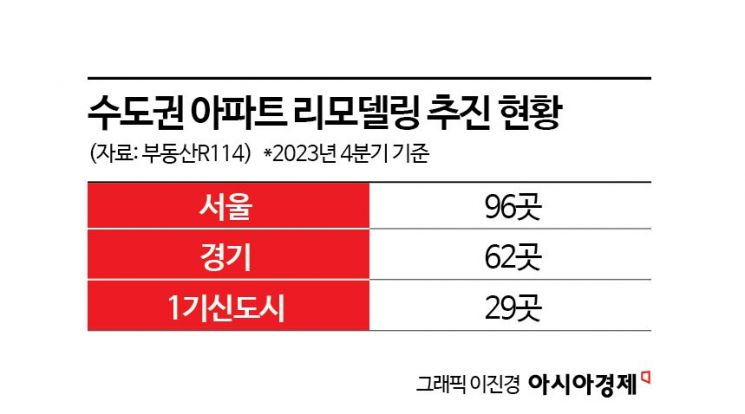
Immediately, a wave of remodeling project abandonments is expected in Seoul. According to Seoul city and the maintenance industry, there are a total of 76 complexes pursuing remodeling in Seoul, of which 22 must change their project plans or conduct additional safety reviews. Many of these complexes are highly likely to switch to reconstruction.
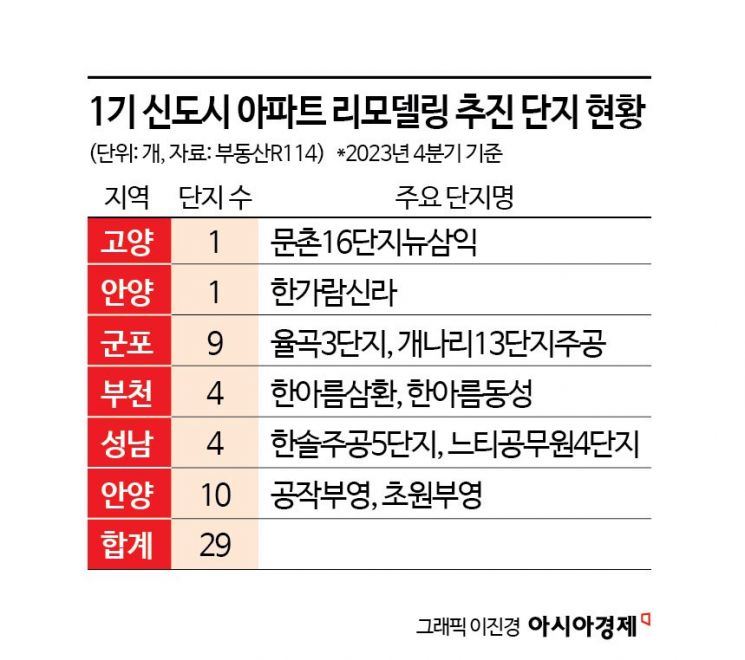
In the first-generation new towns, where many remodeling projects are underway, complexes switching to reconstruction are expected to follow in succession. As of the end of last year, according to the status of first-generation new town maintenance projects (compiled by Real Estate R114), out of 353 complexes in five cities (Bundang, Ilsan, Jungdong, Pyeongchon, Sanbon), 29 are pursuing remodeling, but many are clashing with union members who want redevelopment.
In fact, Hansol Village 5 Complex in Bundang-gu, Seongnam City, which has received remodeling project approval, is in a tense atmosphere. This complex had previous conflicts with owners demanding a switch to reconstruction, so the recent government announcement is expected to deepen the conflict.
A union official from a complex undergoing remodeling said, "If the government opens up reconstruction like this, who would want to do remodeling?" He added, "Requests to dissolve the remodeling union are already pouring in, and some union members are moving to form reconstruction promotion committees."
A construction company official who won the remodeling project contract said, "I cannot understand how the idea of proceeding with reconstruction without safety inspections came about," adding, "There are about 300,000 apartments over 30 years old in the first-generation new towns alone, so it's absurd to think about how to reconstruct all of them." He continued, "Since the first-generation new towns have become bed towns due to apartment density, if large-scale reconstruction is to proceed, it is necessary to redesign all infrastructure such as water and sewage, power supply, and transportation. In other words, the entire city must be completely overhauled."
Lee Eun-hyung, a research fellow at the Korea Construction Policy Research Institute, explained, "Apartments built before the 1990s require a lot of remodeling construction costs due to securing underground parking lots, so remodeling does not have a significant price advantage compared to reconstruction," adding, "If reconstruction permits become easier under the current government policy, there will be no reason to remodel."
Meanwhile, some experts advise caution in having vague expectations because it is still uncertain how much the reconstruction floor area ratio incentives will be applied regionally. They also pointed out that the easing of safety inspections is part of the Urban Maintenance Act amendment, and without bipartisan agreement in the National Assembly, it could fail like the repeal of the actual residence obligation.
© The Asia Business Daily(www.asiae.co.kr). All rights reserved.
![Clutching a Stolen Dior Bag, Saying "I Hate Being Poor but Real"... The Grotesque Con of a "Human Knockoff" [Slate]](https://cwcontent.asiae.co.kr/asiaresize/183/2026021902243444107_1771435474.jpg)

















