Net Subscriber Growth of Top 3 Telecoms Declines Since 2021
5G-A, 6G Uncertain... Telecom Revenue Growth Challenging
Industry Seeks Telecom Breakthrough... AI Featured in New Year Messages
Since the launch of 5G wireless communication services in 2019 and entering the maturity stage, the net increase in subscribers has been declining, casting a red light on revenue growth through the communication services of the three major mobile carriers. With the commercialization of 5G-Advanced (5G-A) and 6G services still uncertain, the industry has set its breakthrough this year in the non-communication sector, specifically artificial intelligence (AI).
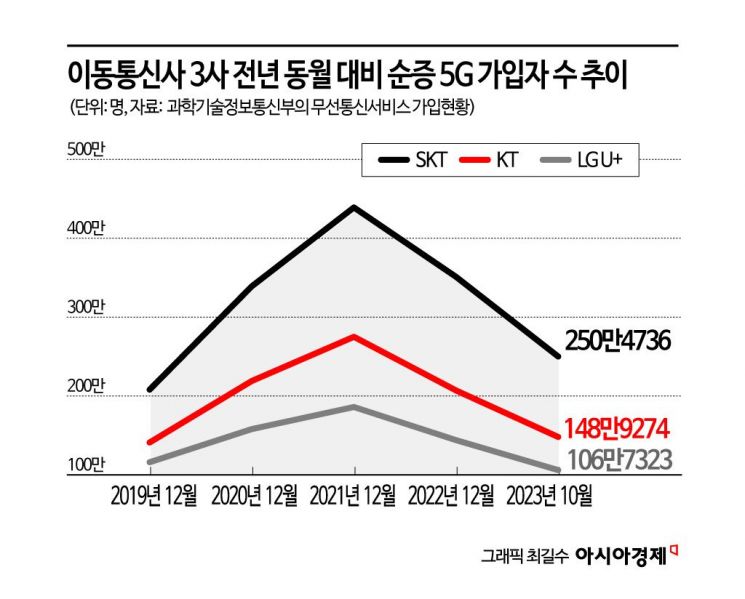
According to the wireless communication service subscription status from the Ministry of Science and ICT on the 10th, the net increase in 5G subscribers of the three mobile carriers is showing a downward trend. In December 2019, compared to the same month the previous year, SKT had a net increase of 2,084,238 subscribers, KT had 1,419,338, and LG U+ had 1,164,391. However, in December 2021, the net increase peaked at 4,398,016 for SKT, 2,755,423 for KT, and 1,861,454 for LG U+, but the following year, these numbers decreased to 3,518,869, 2,076,364, and 1,446,290 respectively.
With the net increase in 5G subscribers shrinking, it is difficult to expect immediate revenue growth from subscriber numbers. Typically, the initial launch of faster communication services with expensive plans contributes to the carriers' revenue. However, the commercialization timing of 5G-A, the next stage after 5G, has not been clearly set. Known as an intermediate stage between 5G and 6G, 5G-A offers download speeds ten times faster than 5G. It improves services by upgrading existing 5G equipment. The industry expects commercialization to be no earlier than around 2025.
The securities industry also views the outlook for the telecommunications sector somewhat negatively this month. Kim Hong-sik, an analyst at Hana Securities, stated in the ‘January Investment Strategy for Telecommunications Services’ report, “Investors’ attention in the new year focuses on stocks with improved performance and those with catalysts (factors causing stock price changes). However, in the telecommunications sector, as the 5G maturity phase progresses, it is difficult to classify stocks as performance improvement stocks, and regulatory conditions are unfavorable. The only catalyst, the 5G-A issue, considering the timing of commercialization and tariff discussions, is expected to emerge only by the end of 2024, implying a long waiting period.” Some also predict that since the speed difference between 5G and 5G-A is not dramatic, revenue changes will not be significant until 6G is introduced.
The three mobile carriers are seeking breakthroughs this year outside of telecommunications. KT CEO Kim Young-seop held a town hall meeting for communication with employees, stating, “The world will be divided into two kinds of people: those who dominate AI and those who know nothing about AI,” and added, “The entire organization, beyond the individual currently working, must innovate with AI.” SKT CEO Yoo Young-sang said in his New Year’s address, “In 2024, let’s realize the tangible and rapid changes and innovations of the AI company we have been pursuing.” LG U+ CEO Hwang Hyun-sik invested approximately 10 billion KRW in FortyTwoMaru, a domestic language AI specialized startup, chosen as the first investment target after his reappointment.
© The Asia Business Daily(www.asiae.co.kr). All rights reserved.
![Clutching a Stolen Dior Bag, Saying "I Hate Being Poor but Real"... The Grotesque Con of a "Human Knockoff" [Slate]](https://cwcontent.asiae.co.kr/asiaresize/183/2026021902243444107_1771435474.jpg)

















