Democratic Party's Min Byung-deok Holds Policy Forum
Raises Need for Integrated Market Surveillance System
Calls for Enhancing Effectiveness of Sanctions on Unfair Practices
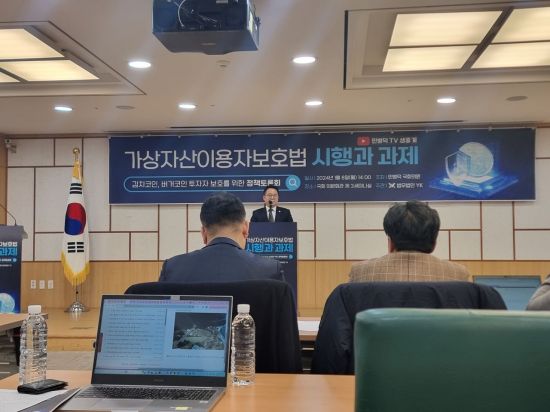 Min Byung-deok, a member of the Democratic Party of Korea, is delivering the opening remarks at the policy forum titled "Enforcement and Challenges of the Virtual Asset User Protection Act," held on the afternoon of the 8th at the National Assembly Members' Office Building in Yeongdeungpo-gu, Seoul. Photo by Cha Min-young
With the Virtual Asset User Protection Act set to be enforced this July, there are calls for separating market surveillance functions from virtual asset exchanges and establishing an integrated market surveillance system. Financial authorities also agreed that legal amendments are necessary to enhance the effectiveness of sanctions against operators under the current law.
On the afternoon of the 8th, attorney Choi Jin-hong from YK Law Firm attended the policy forum titled "Enforcement and Challenges of the Virtual Asset User Protection Act," hosted by Min Byung-duk, a member of the Democratic Party of Korea, at the National Assembly Members' Office Building in Yeongdeungpo-gu, Seoul, where he made these remarks.
Although the first phase of the Virtual Asset User Protection Act will be enforced on July 19 this year, there are criticisms that the scope of operators is limited and user protection is insufficient. There are demands that the second phase of the law should include broader regulations on issuance, distribution, and unfair practices.
Attorney Choi stated, "The Virtual Asset User Protection Act imposes market surveillance obligations on virtual asset exchanges, but there are issues such as insufficient capability to respond to unfair trading and increased burdens on operators," adding, "An integrated market surveillance system should be established to separate the market surveillance function from virtual asset exchanges."
He further explained, "This would enable objective and uniform detection of unfair trading, improve cooperation efficiency with financial authorities, and allow market surveillance of all virtual assets conducted domestically, thereby reducing surveillance gaps."
He emphasized, "The currently promulgated Virtual Asset User Protection Act alone has limitations in establishing a transparent and stable virtual asset market," and stressed, "Particularly, the separation of virtual asset business functions such as trading support, the establishment of an integrated market surveillance system, and the creation of a statutory association should be prioritized."
Financial Supervisory Service Announces Virtual Asset Guidelines to Fill 'Regulatory Gaps'
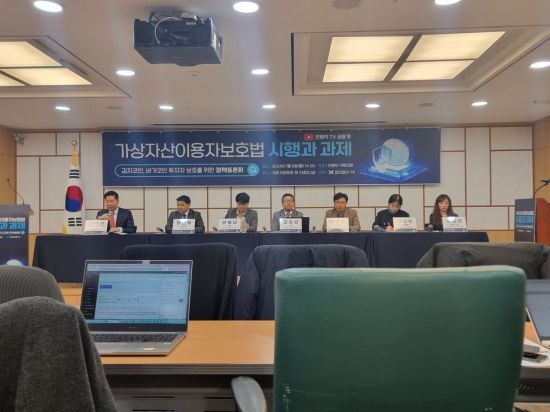 On the 8th, a discussion is underway at the policy forum titled 'Enforcement and Challenges of the Virtual Asset User Protection Act.' Photo by Cha Min-young
Financial authorities are expected to announce virtual asset-related guidelines soon, ahead of the law's enforcement in July. At the end of last year, the Financial Supervisory Service (FSS) formed a task force (TF) on virtual asset listings and began discussions on the "Standard Regulations for Listing, Listing Maintenance, and Delisting." The focus was on resolving controversies arising from frequent listings, delistings, and relistings of virtual assets. A representative case is Wemade's "Wemix," which caused controversy due to more tokens being circulated than initially planned. Confusion arose as exchanges showed differing stances on Wemix's relisting.
An Byung-nam, head of the Digital Asset Research Team at the Financial Supervisory Service, said, "We are creating guidelines to set standards related to issuance and circulation volumes and to support industry self-regulation," adding, "We expect to announce guidelines related to listings or trading support, developed in collaboration with exchanges, soon."
It is unlikely that virtual assets will be regulated under the same framework as financial companies. This is due to the characteristics of the virtual asset market, such as the indistinguishable domestic and global markets and the existence of multiple exchanges domestically, which clearly differentiate it from the financial market.
An said, "The first phase of the law includes only the essential content, so there are clearly areas that need supplementation to fill regulatory gaps," and added, "Contents related to operator rights or conflicts of interest could be very meaningful or serve as useful references."
He also noted, "Regarding the scope of virtual asset businesses, the types of operators from the Special Act on Reporting and Using Specified Financial Transaction Information (Special Act) were directly adopted, so it is difficult to expand the scope of operators without legal amendments," and added, "Other contents related to conflicts of interest or unfair trading surveillance systems are also difficult for supervisory authorities to handle through orders or model standards under the current first phase."
The forum was also attended by Kim Yoo-sung, professor at Yonsei University Law School; Lee Jung-doo, senior researcher at the Korea Institute of Finance; Lee Jung-min, research fellow at the Korea Financial Consumer Protection Foundation; and Lee Yoon-ah, Ph.D. at the National Assembly Legislative Research Office.
© The Asia Business Daily(www.asiae.co.kr). All rights reserved.
![Clutching a Stolen Dior Bag, Saying "I Hate Being Poor but Real"... The Grotesque Con of a "Human Knockoff" [Slate]](https://cwcontent.asiae.co.kr/asiaresize/183/2026021902243444107_1771435474.jpg)
















