BAI Up 15% Compared to Previous Delivery
Rapid Delivery Demand Concentrated on Air Due to Red Sea Pirate Impact
Sea Freight Rates Also Soaring... Demand Expansion Inevitable for the Time Being
As Yemeni Houthi rebels attacked civilian vessels passing through the Red Sea, blocking the Suez Canal waterway, not only maritime but also air cargo freight rates have risen accordingly. The transportation industry expects to enjoy a 'special boom' for the time being.
According to the Hong Kong TAC Index on the 8th, the average freight rate for the Hong Kong-North America route of the Baltic Air Freight Index (BAI) in December last year was recorded at $7.10 per kg. This is the highest since October 2022, a 51.4% increase compared to $4.69 in July last year. It also surged 15.4% compared to the previous month. During the same period, the Hong Kong-Europe route and the Frankfurt-North America route also rose by 15.5% and 18.7%, respectively.
This is attributed to the blockage of maritime transport routes caused by the Yemeni Houthi rebels attacking container ships near the Red Sea and the Suez Canal. As ships detour via the Cape of Good Hope route in South Africa, both freight rates and transit times have increased, leading to a rise in demand for 'air routes' even at higher costs.
According to the industry, the Cape of Good Hope route takes about 7 to 8 days longer one way than the route through the Suez Canal. For round trips, it takes about 15 days longer, inevitably causing disruptions to various schedules. A representative from an airline explained, "It seems that cargo demand that needs to meet delivery deadlines chooses air transport over maritime transport, even at higher freight rates."
There are forecasts that both maritime and air freight rates will continue to rise for the time being. Maritime freight rates have already surged sharply. The Shanghai Containerized Freight Index (SCFI), a representative global maritime freight indicator announced weekly, recorded 1896.65 as of the 5th. This is a 7.8% increase compared to the previous week. It has skyrocketed 87.6% over the past month since December 1 last year. There are even concerns that it could surpass the 2000 mark again for the first time since September 2022, when logistics boomed due to the COVID-19 pandemic.
However, some view that it will be difficult to reproduce the super-boom seen during the COVID-19 period. This is because it is not easy for cargo volumes to rebound amid the global economic recession. Nevertheless, freight rate increases are expected to be inevitable for the time being. Jeong Yeon-seung, a researcher at NH Investment & Securities, explained, "Compared to the freight rate increases caused by severe container ship congestion during the COVID period, the intensity may be weaker, but freight rate increases due to unexpected issues will appear across logistics, including containers and air cargo, in the first quarter of this year," adding, "There is a possibility of increased logistics costs for companies and increased demand for air transport for urgent logistics."
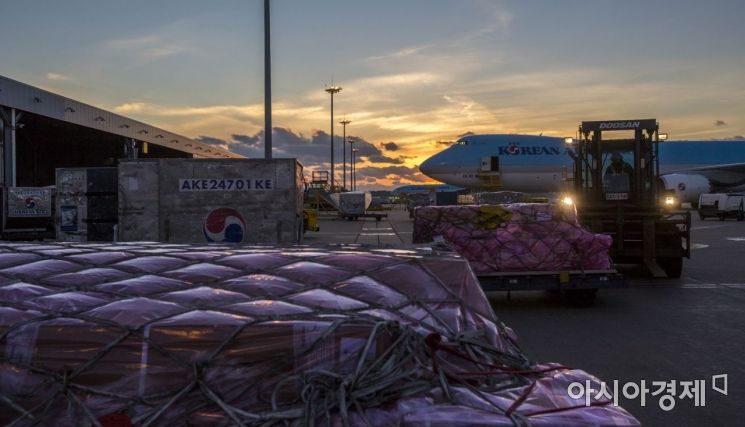 On the 27th, employees at the Korean Air Cargo Terminal of Incheon International Airport are busily moving to load air cargo in subzero weather. / Yeongjongdo - Photo by Jinhyung Kang aymsdream@
© The Asia Business Daily(www.asiae.co.kr). All rights reserved.
![Clutching a Stolen Dior Bag, Saying "I Hate Being Poor but Real"... The Grotesque Con of a "Human Knockoff" [Slate]](https://cwcontent.asiae.co.kr/asiaresize/183/2026021902243444107_1771435474.jpg)















