North Korea Fires Artillery Three Times in One Week Since New Year
Signals to China, Russia, and Japan... Rejects South Korea
Displays Itself as a Normal State While Driving Wedge Between South Korea, US, and Japan
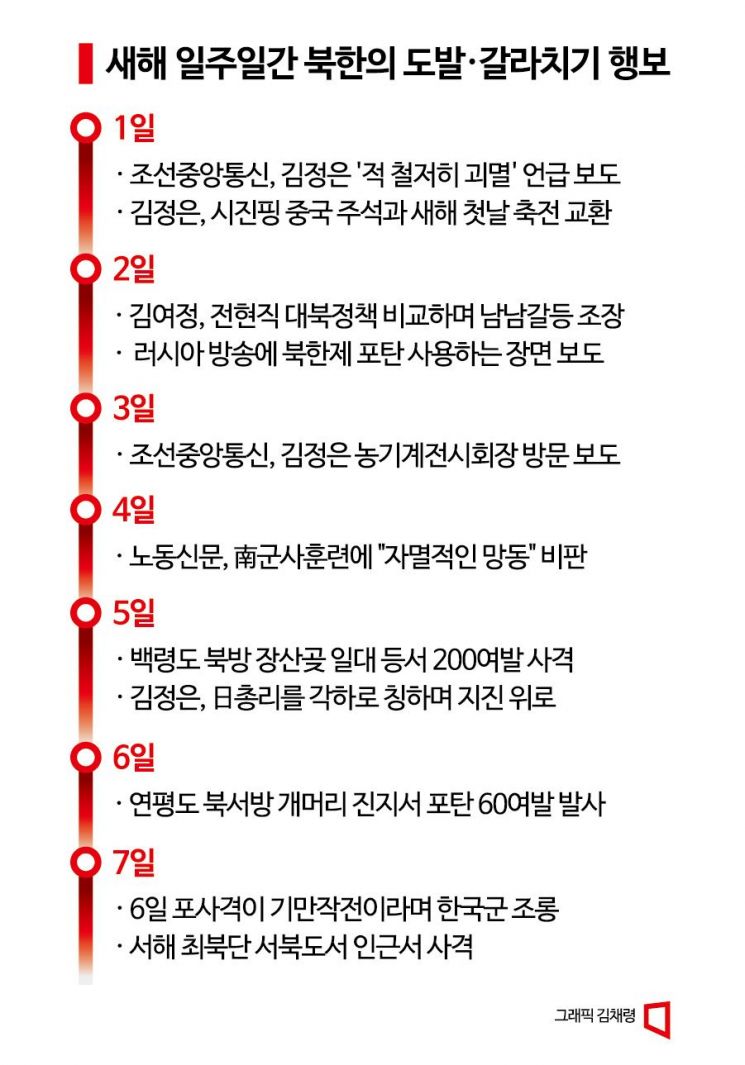
Since the beginning of the new year, North Korea's military provocations and psychological warfare against South Korea have accelerated. Within a week, it has already conducted artillery shelling provocations three times. Psychological warfare aimed at driving a wedge between South Korea and Japan, as well as between South Korean factions, has also continued multiple times. It has been revealed that North Korea is solidifying illegal arms transactions with Russia. Analysts believe that North Korea is actively exploiting the difficulty of imposing additional sanctions due to opposition from China and Russia to create a favorable situation for itself.
According to experts on the 8th, North Korea's level of provocation has significantly increased this year. After officially designating South Korea as an 'enemy state' at the year-end plenary meeting last year, it seems to have started taking concrete actions. The military provocations near the Northern Limit Line (NLL) in the West Sea conducted consecutively from the 5th to the 7th are representative examples. In particular, the day before, Kim Yo-jong, Vice Director of the North Korean Workers' Party, mocked by saying, "Although the artillery shelling in the northwestern island area on the 6th was a deception operation, our military was fooled." This is a typical psychological warfare tactic against South Korea.
Moon Sung-mook, head of the Unification Strategy Center at the Korea Institute for National Strategy, pointed out, "It is not new for North Korea to provoke, such as the 2010 Cheonan sinking incident, and then deny responsibility," adding, "This is a kind of deception and psychological warfare aimed at directing the anger of the South Korean people toward the Yoon Suk-yeol administration and the military." Earlier, on the 2nd, Kim Yo-jong also induced internal conflict by comparing former President Moon Jae-in as cunning and President Yoon Suk-yeol as brave.
Externally, North Korea continues efforts to strengthen relations with China and Russia while trying to divide South Korea, the United States, and Japan. Unusually, North Korea exchanged congratulatory messages with China, the core of the anti-American alliance, at the very beginning of the new year. This is the result of aligned interests between Chinese President Xi Jinping, who needs to use North Korea as leverage to check the United States, and North Korean Supreme Leader Kim Jong-un, who seeks to enhance his international presence. Some speculate that this year, marking the 75th anniversary of North Korea-China diplomatic relations, Kim may visit Beijing or Xi may visit Pyongyang.
Relations with Russia are deepening, centered on the 'weapons connection.' Following the U.S. announcement on the 4th that it has information indicating North Korea provided ballistic missiles to Russia, Ukraine also raised the possibility the day before that missiles supplied by North Korea to Russia may have been used in the war. If arms transactions between North Korea and Russia are ongoing, in addition to strengthening solidarity with Russia, there are effects such as real-world weapons testing and increased arms exports. For Kim Jong-un, this is a triple benefit.
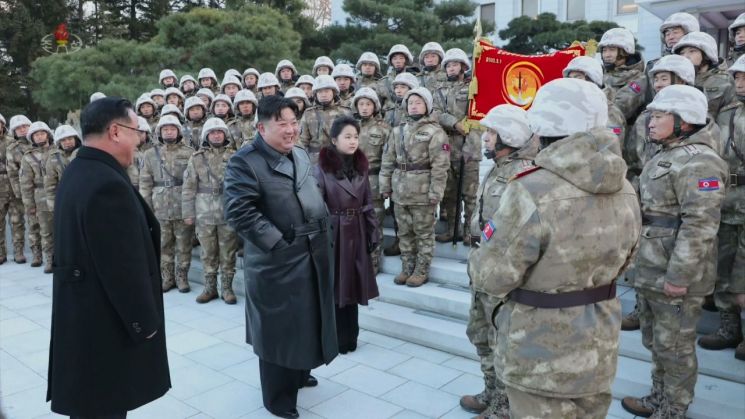 A screen capture from Korean Central TV showing Kim Jong Un, Chairman of the State Affairs Commission of North Korea, calling in the soldiers of the Missile General Bureau's 2nd Red Flag Battalion who participated in the ICBM Hwasong-18 launch training conducted on December 18 last year, to the Central Committee headquarters building on the 20th of the same month to congratulate and encourage them. [Image source=Yonhap News]
Regarding Japan, on the 6th, in a very unusual move, Kim Jong-un personally sent a message of condolence addressing Japanese Prime Minister Fumio Kishida as 'Your Excellency' to express sympathy for the earthquake. While condolences were sent in the name of the Prime Minister during the 1995 Kobe earthquake and in the name of the Standing Committee of the Supreme People's Assembly during the 2011 Great East Japan Earthquake, this is the first time a message has been sent in the name of the supreme leader. This action somewhat differs from North Korea's recent moves to solidify a new Cold War structure of 'South Korea-U.S.-Japan versus North Korea-China-Russia.'
Kim Yeol-su, head of the Security Strategy Office at the Korea Institute for Military Affairs, explained, "By sending a condolence message when humanitarian issues arise in other countries, North Korea likely wanted to show that it is a normal, ordinary state," adding, "Also, by continuing working-level talks with Japan last year, it seems there was an intention to drive a wedge in South Korea-U.S.-Japan security cooperation."
Moon Sung-mook said, "Despite existing sanctions, China and Russia continue to support and trade with North Korea. It is difficult to impose additional sanctions," adding, "For Kim Jong-un, this is an opportunity." However, he added, "Since these actions do not solve North Korea's fundamental needs, Kim Jong-un must have many concerns as well."
© The Asia Business Daily(www.asiae.co.kr). All rights reserved.
![Clutching a Stolen Dior Bag, Saying "I Hate Being Poor but Real"... The Grotesque Con of a "Human Knockoff" [Slate]](https://cwcontent.asiae.co.kr/asiaresize/183/2026021902243444107_1771435474.jpg)
















