The 5th Innovative SMR National Assembly Forum
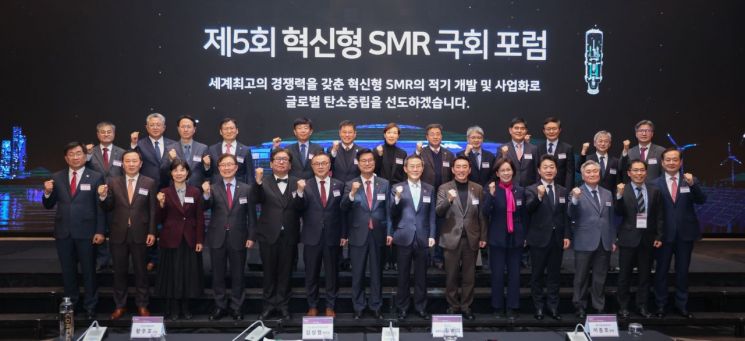 On the 5th, key attendees are taking a commemorative photo at the 5th Innovative SMR National Assembly Forum held at the Conrad Hotel in Yeouido, Seoul. (From the third person from the left in the first row) Yang Jeong-suk, Member of the National Assembly (Independent), Choi Jae-hyung, Member of the National Assembly (People Power Party), Kim Sang-hyeop, Chairman of the Carbon Neutral Green Growth Committee, Hwang Ju-ho, President of Korea Hydro & Nuclear Power, Kim Young-sik, Member of the National Assembly (Co-Chairman, People Power Party), Lee Jong-ho, Minister of Science and ICT, Kim Seok-ki, Member of the National Assembly (People Power Party), Lee In-seon, Member of the National Assembly (People Power Party), Lee Ho-hyun, Director of Energy Policy at the Ministry of Trade, Industry and Energy. Photo by Korea Hydro & Nuclear Power
The government has set a goal to achieve a global 'Top 3' position in the small modular reactor (SMR) sector, which is gaining attention as the next-generation nuclear power technology, by 2030 and beyond.
Kim Han-gon, head of the Innovative Small Modular Reactor (i-SMR) Development Project Group, stated at the '5th i-SMR National Assembly Forum' held on the 5th at the Conrad Hotel in Yeouido, Seoul, "The global SMR market is expected to grow to an annual scale of 146 trillion won between 2030 and 2040."
SMRs refer to small-scale nuclear reactors with integrated major equipment such as the reactor, steam generator, and coolant pumps, with a capacity of 300 megawatts (MW) or less. Being less than one-hundredth the size of large nuclear reactors, they reduce construction time and costs. Additionally, since piping facilities are unnecessary, they can fundamentally prevent radioactive material leakage during natural disasters such as earthquakes, making them a promising next-generation nuclear power technology.
Globally, advanced nuclear power countries such as the United States and the United Kingdom are competing in SMR development. Korea has set a goal to secure competitiveness in the global nuclear power market through the development of the i-SMR, which significantly enhances economic feasibility, safety, and flexibility. To this end, the government operates the i-SMR Development Project Group.
Kim outlined the i-SMR project schedule as starting the standard design in April this year, passing the preliminary safety review and preparing for SMR construction next year, and completing construction by 2029. He added, "To dominate the global SMR market, it is important to adhere to the planned development schedule," and stated, "We will also expedite overseas design certifications, such as Canada's vendor design review, to achieve export results."
On the same day, Professor Jung Beom-jin of Kyung Hee University's Department of Nuclear Engineering said, "There are pessimistic views regarding SMRs, such as lack of economic feasibility or large amounts of spent nuclear fuel, but SMRs remain more economical than other energy sources and possess both security and environmental advantages." Professor Jung emphasized, "The pessimism stems from a lack of understanding of research and development (R&D)," and added, "Due to the speed competition in development, only a few of the approximately 90 SMR types currently under development worldwide will survive," stressing the urgency of securing competitiveness.
GS Construction announced that it is currently planning an i-SMR demonstration project domestically and intends to propose joint promotion with Korea Hydro & Nuclear Power after finalizing the project plan. Kim Young-shin, GS Construction's Chief Technology Officer (CTO), emphasized that timely progress of the i-SMR project requires improvements to the existing licensing system centered on large nuclear reactors and the prompt enactment of the SMR-related promotion law currently pending in the National Assembly.
The event was co-hosted by Lee Won-wook of the Democratic Party and Kim Young-sik of the People Power Party, who serve as co-chairs of the forum, and jointly organized by Korea Hydro & Nuclear Power, Korea Atomic Energy Research Institute, the Innovative Small Modular Reactor Technology Development Project Group, and the Korea Nuclear Industry Association. At the National Assembly, five lawmakers attended, including co-chair Kim Young-sik, Kim Seok-ki, Lee In-seon, Choi Jae-hyung of the People Power Party, and independent lawmaker Yang Jeong-sook. Co-chair Lee Won-wook and People Power Party lawmaker Ahn Cheol-soo sent congratulatory video messages, demonstrating strong interest in SMRs.
Also in attendance were key figures from related government ministries, including Lee Jong-ho, Minister of Science and ICT, and Kim Sang-hyup, Chairman of the Carbon Neutral Green Growth Committee, as well as representatives from industry, academia, and research sectors.
In his congratulatory remarks, Minister Lee Jong-ho of the Ministry of Science and ICT said, "We will actively support the development of innovative SMRs by significantly increasing the budget this year, initiate next-generation nuclear fuel technology development this year to strengthen the competitiveness of innovative SMRs, and newly promote innovative operation and maintenance technology development."
Kim Sang-hyup, Chairman of the Carbon Neutral Green Growth Committee, stated, "It is internationally recognized that nuclear power is an important means for carbon neutrality," and added, "With the High-Level Radioactive Waste Special Act and the Offshore Wind Power Special Act currently pending in the National Assembly, it is time to overcome the exhausting conflicts and confrontations in the energy sector."
© The Asia Business Daily(www.asiae.co.kr). All rights reserved.
![Clutching a Stolen Dior Bag, Saying "I Hate Being Poor but Real"... The Grotesque Con of a "Human Knockoff" [Slate]](https://cwcontent.asiae.co.kr/asiaresize/183/2026021902243444107_1771435474.jpg)















