Polarization Centered on Large Companies with Strong Financial Power and Credit Amid PF Crisis
Top 10 Construction Companies Account for 36.9% of Metropolitan Area Pre-Sale Volume
Liquidity Crisis Inevitable for Financially Vulnerable Small and Medium Construction Firms
With Taeyoung Construction, ranked 16th in construction capability, filing for workout, concerns over the insolvency risk of real estate project financing (PF) across the construction industry have emerged, leading to forecasts of intensified polarization between large and small-to-medium construction companies. Large construction firms are expected to find it easier to secure orders due to their strong financial power and creditworthiness, whereas smaller firms are anticipated to face difficulties in winning contracts due to worsening liquidity.
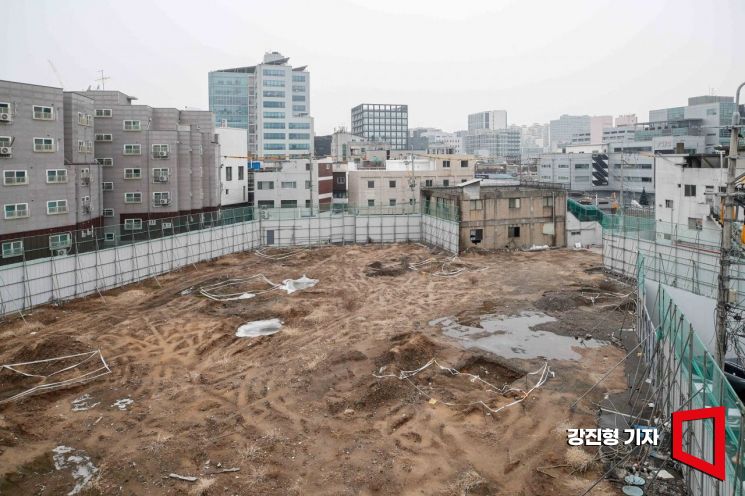 Taeyoung Construction, which is experiencing a liquidity crisis due to real estate project financing (PF), has applied for a workout. On the 5th, the construction site of Taeyoung Construction's Seongsu-dong development project located in Seongdong-gu, Seoul, has come to a halt. Photo by Jinhyung Kang aymsdream@
According to Hana Financial Management Research Institute on the 5th, the share of the top 10 construction companies in apartment pre-sale volumes in the metropolitan area is expected to rise to 36.9% this year, up from 25.4% in 2022 and 32.7% in 2023. In particular, a significant portion of pre-sale volumes in large cities consists of reconstruction and redevelopment projects, most of which are won by large construction firms, further intensifying the concentration of pre-sales among major builders.
Due to sluggish housing markets, rising construction costs, and increased financial expenses, risks related to completion and pre-sales have become more prominent. Project financing tends to be secured mainly for projects involving large construction companies with strong financial power and credit ratings. The scale of PF guarantees by 16 major construction companies rated by Korea Credit Rating has increased from 21.9 trillion KRW in 2021 to 26.1 trillion KRW in 2022, reaching 28.3 trillion KRW as of the end of September 2023.
According to Real Estate R114, the planned apartment pre-sale volume this year is 265,439 units (including private rental housing), with the top 10 construction companies accounting for 149,195 units (56%). The non-residential market, such as knowledge industry centers mainly participated in by mid-sized construction firms, is showing signs of contraction.
Projects requiring upfront capital investment by construction companies for guaranteed completion are expected to increase gradually due to rising construction costs and poor pre-sale performance. Hana Financial Research Institute explained, "Upfront capital invested due to increased construction costs is usually repaid as subordinated debt after PF loans, increasing the risk of bad debt for construction companies. Companies with lower credit ratings tend to have a higher proportion of projects outside the metropolitan or major city areas, making upfront construction cost investment more likely."
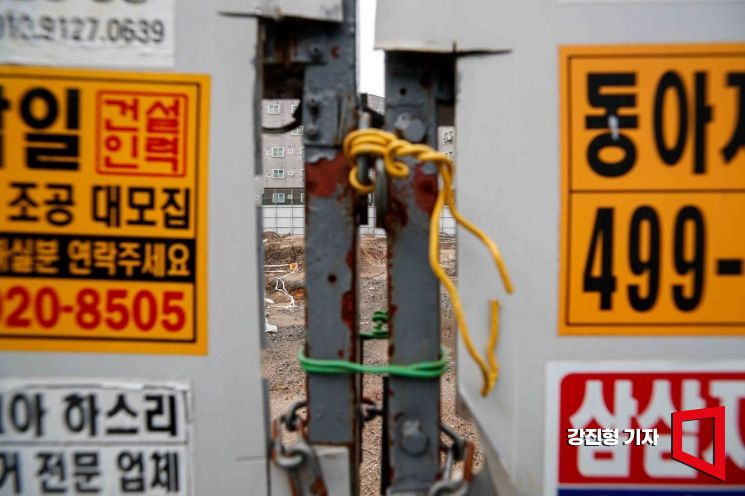 Taeyoung Construction, which is experiencing a liquidity crisis due to real estate project financing (PF), has applied for a workout. On the 5th, the construction site of Taeyoung Construction's Seongsu-dong development project located in Seongdong-gu, Seoul, has come to a halt. Photo by Jinhyung Kang aymsdream@
As the construction market deteriorates, increasing bad debt risks and decreasing new orders inevitably raise liquidity concerns for financially vulnerable small and medium-sized construction companies. According to Korea Credit Rating's analysis as of June last year, the net debt dependency ratio for construction companies with BBB ratings reached 26%. Among the projects held by BBB-rated construction firms, 45.4% are located in non-metropolitan provincial areas.
Korea Credit Rating mentioned the need to monitor the financial response levels of construction companies rated 'BBB' or below, as well as some 'A' rated firms, naming Lotte Construction (A+, negative), GS Construction (A+, negative), Shinsegae Construction (A, negative), HDC Hyundai Development Company (A, negative), and Hanshin Engineering & Construction (BBB-, stable) as key monitoring targets. The agency stated, "If a full-scale economic recovery does not accompany, there is a possibility that liquidity risks will spread to top-tier construction companies."
Furthermore, with uncertainty over the timing of interest rate cuts and the continuation of high interest rates, PF delinquency rates are expected to rise, increasing the likelihood of insolvency. According to the Construction Industry Research Institute, the scale of real estate PF loans in the financial sector is 133 trillion KRW, with 152 projects currently negotiating with creditors for normalization and soft landing.
Although the government is making efforts to restructure PF projects with high insolvency risks, the economic policy direction announced the day before public fund injections includes measures to dispose of non-viable PF projects through auctions and for LH to purchase projects that are viable but experiencing temporary liquidity issues.
There are also calls for construction companies to urgently devise response strategies such as clearing unsold projects and revising their business portfolios to overcome difficult challenges.
Park Cheol-han, a research fellow at the Construction Industry Research Institute, explained, "Since the financing environment is expected to remain challenging, companies should secure cash liquidity and prepare accordingly. They should minimize uncertainty variables by reducing portfolios concentrated in building construction, increasing the share of public construction projects, and modifying and supplementing business portfolios through overseas construction expansion."
© The Asia Business Daily(www.asiae.co.kr). All rights reserved.
![Clutching a Stolen Dior Bag, Saying "I Hate Being Poor but Real"... The Grotesque Con of a "Human Knockoff" [Slate]](https://cwcontent.asiae.co.kr/asiaresize/183/2026021902243444107_1771435474.jpg)
















