Korea-Japan Relations Recovering Trust Face Risk from Kishida
If Approval Rating Falls Further, Diplomacy May Weaken
Successor PM Likely to Be a 'Short-Lived Prime Minister' if Replaced
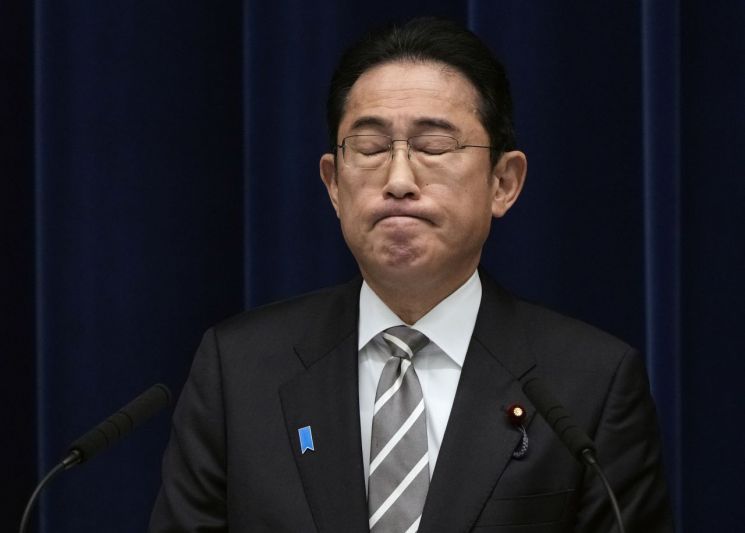 Japanese Prime Minister Fumio Kishida tightly closes his eyes while holding a press conference at the Prime Minister's Office in Tokyo on December 13 last year, after the temporary session of the National Diet ended.
 [Image source=Yonhap News]
Japanese Prime Minister Fumio Kishida has been pushed to the brink. Amid a plunge in approval ratings to the 10% range due to the Liberal Democratic Party's slush fund scandal, a major earthquake disaster has compounded the difficulties. The uncertainty surrounding the recovering Japan-South Korea relations has also increased. Experts predict that if Prime Minister Kishida resigns early, Japan may once again enter a 'short-lived prime minister' system or see the rise of an 'ultra-right cabinet.' In such a case, cracks are inevitable not only in Japan-South Korea relations but also in trilateral cooperation among South Korea, the U.S., and Japan.
Kishida's Approval Rating Plummets, Caught Between a Rock and a Hard Place
According to domestic Japanese experts and major foreign media on the 4th, the Kishida Cabinet has effectively become a 'caretaker cabinet' due to a series of setbacks. It lost public trust as it wavered between tax increases and tax cuts, and the ruling Liberal Democratic Party's slush fund scandal caused approval ratings to fall to the 'regime distrust' level of around 16%. On top of this, a magnitude 7.6 earthquake struck on the 1st. Although earthquakes are natural disasters, they typically have a negative impact on administrations as they test the government's crisis management capabilities. The Japanese opposition Democratic Party also lost power to the Liberal Democratic Party the following year after failing to handle the 2011 Great East Japan Earthquake properly.
Yang Ki-ho, a professor in the Department of Japanese Studies at Sungkonghoe University, said, "Since Prime Minister Kishida's approval rating has fallen below 20%, he is basically in a situation where he should step down himself. Because he served as foreign minister for a long time, it seems he is trying to overcome the crisis through diplomatic events such as the South Korea-China-Japan summit in February or the state visit to Washington, D.C. in March, but it looks difficult."
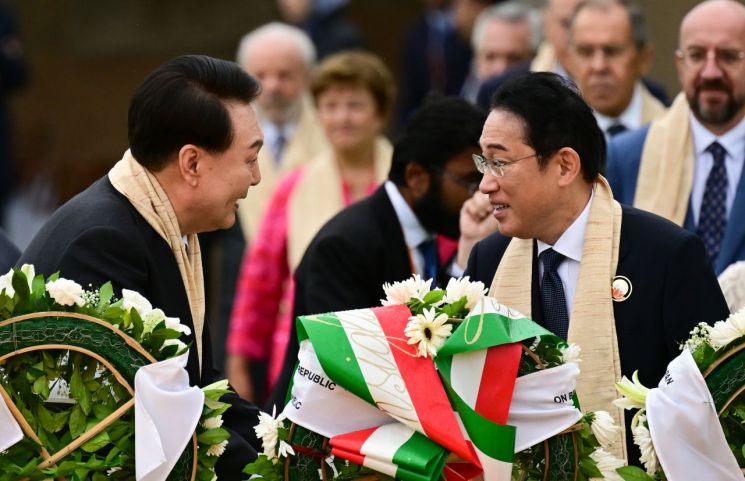 President Yoon Suk-yeol is seen conversing with Japanese Prime Minister Fumio Kishida while laying a wreath alongside the leaders of the Group of Twenty (G20) at Gandhi Smriti in New Delhi, India, on September 10 last year (local time).
 [Image source=Yonhap News]
Kishida Cornered... Difficult to Strengthen Japan-South Korea Diplomacy
Experts predict that if Prime Minister Kishida's approval rating continues to decline without a rebound, it will negatively affect Japan-South Korea cooperation. Since March last year, Kishida has held seven summits with South Korean President Yoon Suk-yeol, striving to restore Japan-South Korea relations. However, with his approval rating low, it is analyzed that it will be difficult to focus on diplomacy as before.
Choi Eun-mi, a research fellow at the Asan Institute for Policy Studies, said, "Diplomacy is possible when the regime's power is strong domestically, but the Kishida Cabinet does not seem to have the stamina to exert power externally. The South Korea-China-Japan summit was also scheduled for early in the year, but with China being passive and Japan facing domestic issues like the earthquake, it seems difficult."
If an Ultra-Right Prime Minister Succeeds Kishida... Risks to Japan-South Korea Relations
Prime Minister Kishida's early resignation could also act as a negative factor. Within Japan, there is already a widespread view that it will be difficult to hold the next general election under the Kishida regime. There are also speculations that he might resign before the Liberal Democratic Party presidential election scheduled for September. Since Japan has a strong one-party dominance by the Liberal Democratic Party, it is highly likely that the next prime minister after Kishida will also come from the LDP. The overall policy stance toward South Korea is not expected to change significantly. However, if an ultra-right figure, rather than the moderate conservative Kishida, emerges, it could negatively impact Japan-South Korea relations.
Lee Ji-pyung, a special professor at Hankuk University of Foreign Studies, explained, "The Abe faction (Seiwa Policy Research Council), the largest ultra-right faction in the LDP, has been hit by allegations of slush fund creation, so it seems unlikely that the next prime minister will come from the Abe faction. However, there are other ultra-right figures within the LDP. If an ultra-right faction member becomes prime minister, Japan-South Korea relations could become strained."
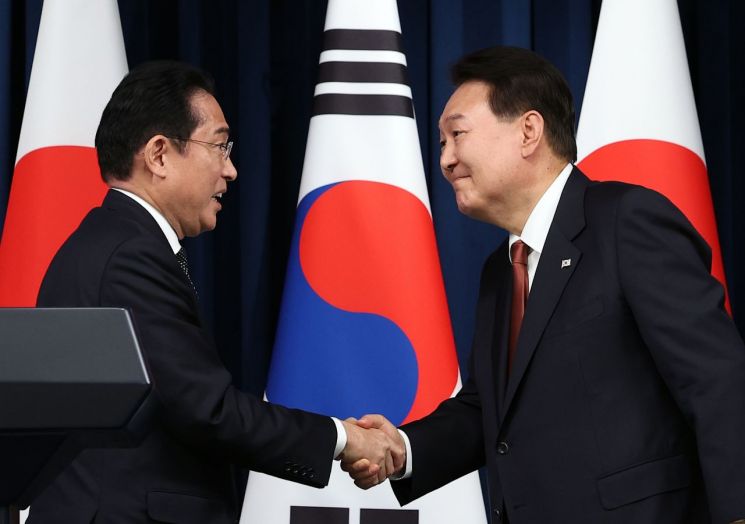 President Yoon Suk-yeol and Japanese Prime Minister Fumio Kishida, who visited Korea for a 2-day, 1-night schedule, shake hands after a joint press conference held at the Yongsan Presidential Office building in Seoul on May 7 last year.
 [Image source=Yonhap News]
No Suitable Successor... Another Series of 'Short-Lived Prime Ministers'?
The unclear succession structure to follow Prime Minister Kishida is also a problem. Current candidates include Shigeru Ishiba, former LDP secretary-general popular among the public; Shinjiro Koizumi, former environment minister and son of former Prime Minister Junichiro Koizumi; and Taro Kono, digital minister and son of Yohei Kono, former House of Representatives speaker who issued the Kono Statement. However, these figures are reportedly not solidly supported enough within the party to replace the Kishida Cabinet.
Since there is no charismatic figure comparable to former Prime Minister Shinzo Abe, who served the longest term in history, there is an analysis that Japan's prime minister could change almost every year as in the past. In fact, Japan experienced a dark period from 2005 to 2012 when prime ministers were replaced almost annually until Abe took power after Junichiro Koizumi stepped down.
Professor Yang Ki-ho pointed out, "There is still no suitable figure, so there is a possibility that prime ministers will change once a year in the short term after Kishida. In that case, Japan-South Korea relations could become unstable." There was also a forecast that if former President Trump is elected in the U.S. presidential election this November, the U.S.-Japan alliance network would be shaken significantly, weakening trilateral security cooperation among South Korea, the U.S., and Japan.
Intense Internal Competition May Increase 'Korea-Bashing'
Even if the Japanese prime minister does not change immediately, internal competition to aim for the next leadership could intensify, leading to increased 'Korea-bashing.' This is because successors of former Prime Minister Abe, who maintained a hardline stance on historical issues, need to show similar positions. Although Japan-South Korea relations are currently good, there are many variables such as the Sado mine and Dokdo. Professor Yang Ki-ho said, "Within Japanese politics, it is an established view that there can be no compromise with South Korea on historical issues. If such variables can be used as political and diplomatic tools, there will be many figures who engage in Korea-bashing."
© The Asia Business Daily(www.asiae.co.kr). All rights reserved.













![The Special Connection Between the Statue of Martyr Lee Jun in Jangchungdan Park and Mayor Oh Sehoon ③ [Current Affairs Show]](https://cwcontent.asiae.co.kr/asiaresize/319/2026012110001599450_1768957215.jpg)


