$420.15 billion at the end of December
$3.07 billion increase from the end of the previous month
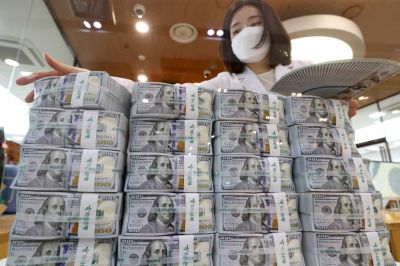
With expectations that the US Federal Reserve may accelerate interest rate cuts, the dollar weakened, leading to South Korea's foreign exchange reserves increasing for the second consecutive month last month.
The Bank of Korea announced on the 4th that South Korea's foreign exchange reserves stood at $420.15 billion at the end of December last year, up $3.07 billion from the end of the previous month.
The foreign exchange reserves had shown a decline for three consecutive months in August, September, and October last year. In October, due to measures to ease volatility in the foreign exchange market, the reserves hit their lowest level in 40 months, but with the weak dollar trend, they increased in November for the first time in four months. At the December meeting of the US Federal Open Market Committee (FOMC), the Fed hinted at the possibility of interest rate cuts, continuing the weak dollar trend.
The Bank of Korea explained, "In December last year, the US dollar index fell by about 1.5%," adding, "The increase in foreign exchange reserves was mainly due to the rise in the US dollar equivalent of foreign currency assets in other currencies and the increase in foreign currency deposits of financial institutions."
Looking at the detailed breakdown, securities such as government bonds amounted to $373.67 billion, an increase of $1.6 billion from the previous month. Deposits also rose by $1.38 billion to $21.98 billion. The IMF position, which is the drawing right of exchangeable currency with the International Monetary Fund (IMF), increased by $110 million. Special Drawing Rights (SDR) with the IMF decreased by $20 million. Gold was maintained at $4.79 billion, reflecting the purchase price without considering market prices.
As of the end of November, South Korea ranked 9th in the world in terms of foreign exchange reserves, unchanged from the previous month. China had the largest reserves at $3.1718 trillion, followed by Japan ($1.2697 trillion), Switzerland ($816.4 billion), India ($604.2 billion), Russia ($592.4 billion), Taiwan ($567.5 billion), Saudi Arabia ($438 billion), and Hong Kong ($424.6 billion).
© The Asia Business Daily(www.asiae.co.kr). All rights reserved.
![Clutching a Stolen Dior Bag, Saying "I Hate Being Poor but Real"... The Grotesque Con of a "Human Knockoff" [Slate]](https://cwcontent.asiae.co.kr/asiaresize/183/2026021902243444107_1771435474.jpg)















