Financial Services Commission Announces 'Measures to Enhance Competitiveness of Public Offering Funds'
President Yoon Seok-yeol Attends Stock Market Opening Ceremony
Mention of Abolishing Financial Investment Tax and Computerizing Short Selling
Interpreted as Addressing Capital Market Issues Ahead of General Election
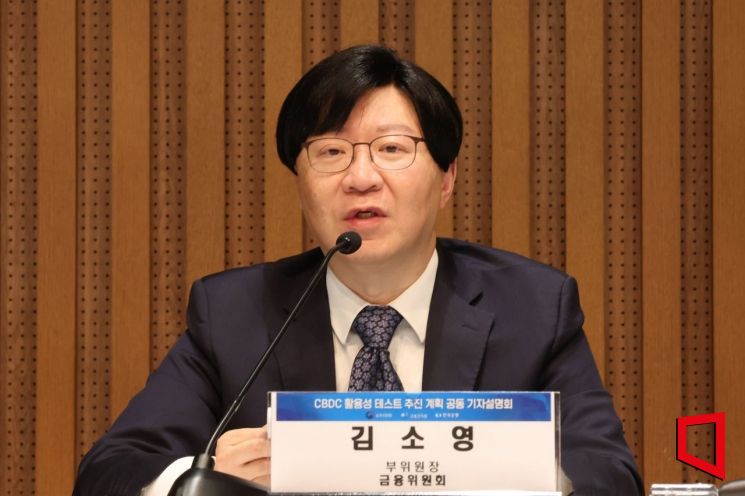 Kim So-young, Vice Chair of the Financial Services Commission, is speaking at the joint press briefing on the plan to promote the usability test of CBDC held on the afternoon of the 4th at the Integrated Annex of the Bank of Korea in Jung-gu, Seoul. Photo by Joint Press Corps
Kim So-young, Vice Chairman of the Financial Services Commission, stated on the 3rd, "We will diligently prepare plans to establish a computerized system to prevent naked short selling."
At the end of her remarks during the announcement of the "Measures to Enhance the Competitiveness of Public Offering Funds" held at the Government Seoul Office Building that day, Vice Chairman Kim said, "We will also firmly push forward improvements to the short selling system," adding, "We will pursue progressive reforms to restore fairness to the short selling system."
She continued, "Recently, we detected long-term illegal naked short selling by global investment banks and imposed the largest-ever fines. Repeated violations obstruct the achievement of our government's goal to advance the capital market, so we will respond with even greater strictness," she emphasized.
There is a reason Vice Chairman Kim specifically mentioned the computerization of short selling in her first policy announcement of the new year. It is one of President Yoon Suk-yeol's key interests in the capital market sector. On the previous day (the 2nd), President Yoon visited the Korea Exchange in Yeouido and attended the stock market opening ceremony. It is reported that at this event, President Yoon instructed to prepare the short selling reform measures without delay.
Except for his visit to the National Cemetery on the 1st, this was the president's first official external schedule of the new year, and it was also the first time a sitting president attended a stock market opening ceremony. This is a symbolic scene showing the current administration's strong interest in capital market issues.
There are also criticisms that the government's special attention to the short selling issue is aimed at winning votes for the April general election. The number of domestic stock investors reaches 14.41 million. As the voices of individual investors grow louder in the capital market through measures such as the computerization of short selling and amendments to the Commercial Act, cases pressuring government policy are increasing. The discussion on short selling computerization was also brought to public attention last October when individual investors posted a petition on the National Assembly's public consent petition platform. Within a week, the petition exceeded 50,000 supporters, prompting the National Assembly's standing committee to formally address the issue.
Accordingly, the financial authorities have banned all short selling until June 28 and are preparing improvement measures for the short selling system. One of the topics under discussion is the establishment of a computerized system to block illegal short selling.
Meanwhile, the Financial Services Commission announced the "Measures to Strengthen the Competitiveness of Public Offering Funds," which include strengthening the responsibilities of fund designers and sellers, and product innovations such as listing public offering funds. A new fund type (tentatively named Zero Class) will be introduced, allowing different sales fee rates per seller within the legal limit (1%), and sales fees linked to fund performance will be implemented.
Additionally, public offering funds will be able to be directly listed on the exchange like Exchange-Traded Funds (ETFs). The core of this is to introduce mechanisms used in ETF trading to existing over-the-counter public offering funds.
© The Asia Business Daily(www.asiae.co.kr). All rights reserved.
![Clutching a Stolen Dior Bag, Saying "I Hate Being Poor but Real"... The Grotesque Con of a "Human Knockoff" [Slate]](https://cwcontent.asiae.co.kr/asiaresize/183/2026021902243444107_1771435474.jpg)
















