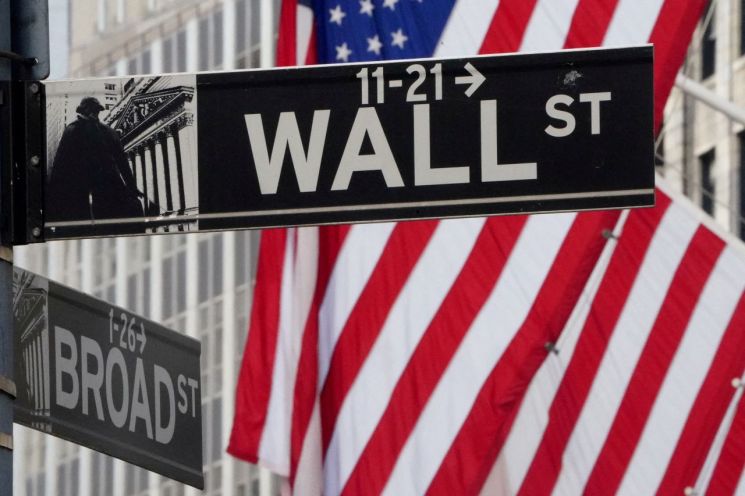
The U.S. Wall Street is brimming with rosy prospects as it welcomes the New Year 2024. Despite ongoing concerns about a recession, optimism is gaining momentum from the steady growth of the U.S. economy over the past year. Expectations that the Federal Reserve (Fed) will begin cutting interest rates in earnest within the year are further fueling this market sentiment.

The Wall Street Journal (WSJ) highlighted on the 1st (local time) that while recession forecasts dominated early last year, they did not materialize, shedding light on the optimistic outlook inside and outside Wall Street for the New Year.
WSJ noted, "A strong economy overturned the gloomy forecasts of 2023. The robust economy drove the stock market higher throughout the year, and the widely anticipated recession did not occur," pointing out that the large-cap-focused S&P 500 index is now approaching its all-time high of 4796.56. The 10-year U.S. Treasury yield, which once surpassed 5% in the New York bond market, has stabilized around 3.8%. The Chicago Board Options Exchange (CBOE) Volatility Index (VIX), known as Wall Street’s fear gauge, closed last year near a multi-year low around the 12 level.
The rapid spread of optimism on Wall Street is underpinned by expectations of a shift in the Fed’s monetary policy. Since the aggressive monetary tightening to combat inflation is expected to soon turn into easing, investor sentiment is generally favorable. The Fed already hinted at three rate cuts this year by projecting a year-end interest rate median of 4.6% at the last Federal Open Market Committee (FOMC) meeting last year. Market expectations exceed this. According to the Chicago Mercantile Exchange (CME) FedWatch tool, the futures market anticipates 6 to 7 rate cuts starting as early as March.
David Kostin, Chief U.S. Investment Strategist at Goldman Sachs, analyzed, "(The Fed) may implement rate cuts that are lower and sooner rather than maintaining a higher for longer stance." Mark Zandi, Chief Economist at Moody’s Analytics, also recently appeared on CNBC, saying, "A year ago, everyone was cautious, but now pessimism is fading," reflecting the mood. Along with expectations for rate cuts, the so-called soft landing scenario?lowering inflation without a recession?is gaining traction.
Of course, recession concerns have not been completely erased across the market. Signals of slowing consumer spending, which accounts for a significant portion of the U.S. economy, have been observed due to cumulative tightening. The Fed’s growth forecast for this year (1.4%) presented at the December FOMC is half of last year’s projection. However, CNBC analyzed that this aligns with the soft landing scenario the Fed forecasted when it began raising rates in March 2022. The economic magazine Economist also reported that financial markets welcome the soft landing outlook, citing economic forecast figures from the Philadelphia Federal Reserve Bank.
WSJ reported that most investors expect the New York stock market rally to continue for the time being. Goldman Sachs recently set its year-end S&P 500 target at 5100, implying about 7% upside potential. Deutsche Bank and Citigroup also share the same 5100 target. John Stoltzfus, Chief Investment Strategist (CIS) at Oppenheimer Asset Management, a prominent bull, forecasted an even higher target of 5200.
However, there are also warnings that this optimism may be excessive. If the Fed’s rate cuts do not occur as quickly as the market expects, it could immediately dampen investor sentiment. The fact that the New York stock market has already priced in expectations of Fed rate cuts is also a negative factor.
This is why JP Morgan Chase and Morgan Stanley have set more conservative year-end S&P 500 targets of 4200 and 4500, respectively. Matt O’Rourke, Chief Strategist at Raymond James, pointed out, "The market is moving faster than the Fed’s stance, so difficulties may arise." The upcoming U.S. presidential election and geopolitical risks are also cited as factors that could increase market volatility.
Meanwhile, the New York financial market was closed on this day for the New Year holiday. This week, a slew of employment-related economic indicators will be released, including the U.S. Labor Department’s Nonfarm Payroll report, ADP private employment report, and Job Openings and Labor Turnover Survey (JOLTs). The minutes of the December FOMC, which were seen as dovish (favoring monetary easing), will also be published.
© The Asia Business Daily(www.asiae.co.kr). All rights reserved.
![Clutching a Stolen Dior Bag, Saying "I Hate Being Poor but Real"... The Grotesque Con of a "Human Knockoff" [Slate]](https://cwcontent.asiae.co.kr/asiaresize/183/2026021902243444107_1771435474.jpg)
















