Gyeonggi Province will increase the monthly payment for opportunity income for persons with disabilities from 50,000 won to 100,000 won starting this year, and expand the number of beneficiaries from 7,000 to 10,000. Additionally, a new welfare policy called ‘360° Care’ will be introduced to address blind spots in caregiving. Furthermore, separate care allowances will be provided to families caring for persons with severe disabilities.
In May, the ‘The(The) Gyeonggi Pass’ will also be introduced. The The Gyeonggi Pass is a system that refunds 20-53% of fares when Gyeonggi residents aged 19 and older use public transportation at least 15 times a month anywhere nationwide. In addition, children and adolescents aged 6 to 18 will receive annual support for public transportation fares ranging from 120,000 to 240,000 won.
According to Gyeonggi Province on the 2nd, the province will increase the number of beneficiaries of the ‘Opportunity Income for Persons with Disabilities,’ which promotes social value creation activities such as health promotion and social activities for persons with disabilities, to 10,000 this year and raise the support amount to 100,000 won per month. The age range for the ‘Disability Nuri Account’ project, which supports asset formation for persons with disabilities, will be expanded from the previous 19-21 years to 19-23 years, and the number of beneficiaries will increase to 6,000. The Gyeonggi disability allowance for persons with severe disabilities, one of the pledges of the 8th elected administration, will also be raised from 40,000 won to 60,000 won.
Gyeonggi Province will newly provide opportunity income in four additional fields: athletes, farmers and fishermen, climate action, and child care communities, following persons with disabilities and artists.
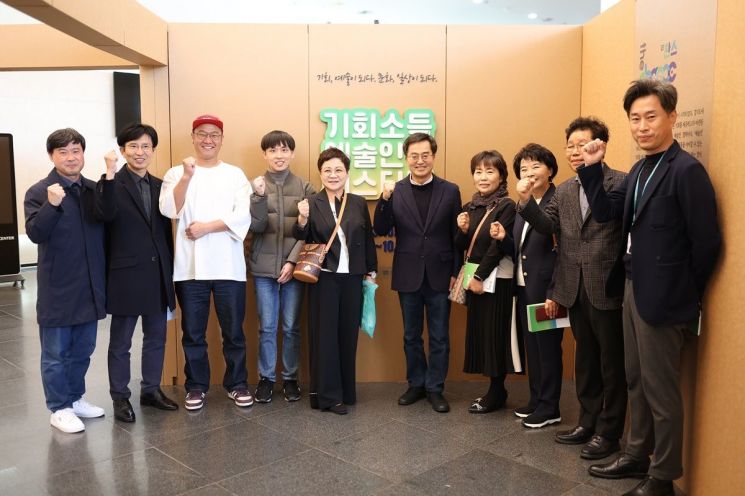 Gyeonggi Province Governor Kim Dong-yeon (fifth from the right) is attending an event for artists' opportunity income held last October at Suwon Gyeonggi Arts Center, taking a commemorative photo with officials.
Opportunity income for athletes targets professional athletes aged 19 or older residing in the province with a median income of 120% or less. Opportunity income for farmers and fishermen targets young people under 50, recent returnees to farming and fishing within the last five years, and environmentally friendly farmers and fishermen. Opportunity income for climate action is provided to those certified for 14 eco-friendly activities such as walking, cycling, and refusing single-use items when using delivery apps. Opportunity income for child care communities is given to workers in child care communities where village residents care for children on behalf of parents. Specific amounts and support targets will be announced later this month.
As part of the policy to eliminate blind spots in caregiving, Gyeonggi Province will implement ‘360° Care’ starting this year. The project is broadly divided into three categories: ‘Care for Everyone,’ which supports all residents in crisis regardless of age or income; ‘Care Anytime,’ which provides emergency care at any desired time for families needing child care; and ‘Care Anywhere,’ which offers customized care for persons with disabilities at institutions or homes, including nights and weekends.
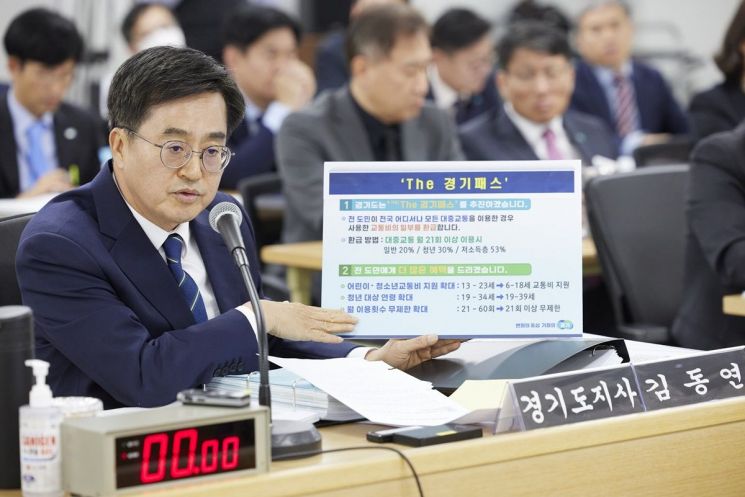 Gyeonggi Province Governor Kim Dong-yeon is explaining 'The Gyeonggi Pass,' scheduled to be implemented in May this year, during the National Assembly's inspection of Gyeonggi Province held at the Gyeonggi Provincial Government Office in October last year.
Gyeonggi Province will introduce ‘The(The) Gyeonggi Pass,’ a new transportation cost support policy for 14 million residents, in May. Residents aged 19 and older who use all public transportation nationwide at least 15 times a month will receive a refund of 20% for the general public, 30% for those aged 19-39, and 53% for low-income groups. Additionally, children and adolescents aged 6 to 18 will receive support for public transportation fares up to 240,000 won annually.
The province will increase the livelihood support amount for households facing sudden crises such as unemployment, business suspension or closure, death, or severe illness by 213,300 won to 1,833,500 won for a four-person household, and raise fuel costs by 40,000 won to 150,000 won.
Visiting medical services for residents with mobility difficulties will also be implemented. Medical care centers will be established and projects launched starting February this year in Suwon, Uijeongbu, Paju, Icheon, Anseong, and Pocheon, where Gyeonggi Provincial Medical Centers are located. Some other cities and counties will establish medical care centers and start projects in July after a public contest. When patients or caregivers apply for visiting medical care at these centers, visiting medical teams will provide medical and welfare services at their homes.
In addition, Gyeonggi Province will promote ▲free sports uniforms for new middle and high school students in Gyeonggi Province ▲support for out-of-pocket expenses for child care services ▲support for the establishment of a crisis animal acceptance system to prevent secondary abuse of animals in crisis such as abuse, abandonment, or relinquishment ▲full expansion of public management of city buses ▲and support for postpartum mothers with nutritious livestock product packages.
© The Asia Business Daily(www.asiae.co.kr). All rights reserved.


















