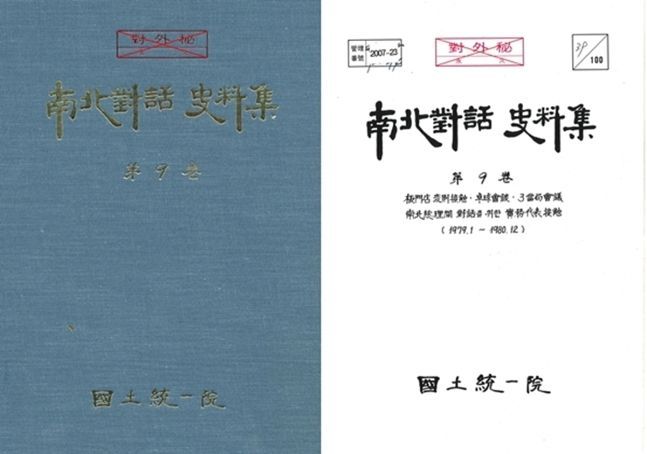
 Cover and inside cover of Volume 9 of the Inter-Korean Dialogue Archives (Photo by Ministry of Unification)
On the 28th, 965 pages of documents vividly depicting the inter-Korean talks held between South Korea and North Korea from 1979 to 1981 were released.
The Ministry of Unification disclosed volumes 9 and 10 of the "Inter-Korean Dialogue Archives," which include transcripts of talks related to political and sports fields from January 1979 to December 1981.
Specifically, the documents contain records of ▲ irregular contacts between the two Koreas ▲ meetings of the inter-Korean Table Tennis Association ▲ proposal for a "three authorities meeting" during U.S. President Carter's visit to South Korea ▲ contacts between working-level representatives of the inter-Korean Prime Ministers' talks ▲ proposals for talks between the highest authorities of the two Koreas ▲ and the progress and minutes related to proposals for inter-Korean sports talks.
The released documents show that North Korea made efforts to resume dialogue between the two Koreas at the time. Previously, South and North Korea had formed the Inter-Korean Coordination Committee in 1972 and held 10 meetings until 1975, but relations deteriorated afterward, leading to a suspension of talks.
In January 1980, around the time of the "Seoul Spring" following the December 12 military coup, North Korea sent letters proposing meetings to 12 figures including then Prime Minister Shin Hyun-hwak, unusually using the friendly term "Republic of Korea" to refer to South Korea.
Notably, North Korea also showed signs of attempting to resume the severed inter-Korean dialogue, which had been cut off after the August 1976 axe incident at Panmunjom, through a meeting of the Prime Ministers. This led to the reopening of the inter-Korean direct telephone line and an agreement to hold inter-Korean Prime Minister talks at Panmunjom, showing progress in improving relations.
This peace offensive stance by North Korea changed after the military coup by the new military regime and the May 18 Democratic Uprising.
At the 8th working-level representatives' meeting held shortly after May 18 for the inter-Korean Prime Minister talks, the North Korean representative condemned the military coup by the new regime and the massacre of civilians. In response, the South Korean representative protested, calling it "interference in internal affairs," and likened the emergency martial law measures to a minor illness such as a measles or a cold.
In fact, then-President Chun Doo-hwan proposed mutual visits and talks with Kim Il-sung in his 1981 New Year's policy speech, but North Korea dismissed it, saying, "Chun Doo-hwan daring to claim himself as the highest authority of South Korea and talk about mutual visits is the reckless behavior of a scoundrel who does not know his place."
This is interpreted as North Korea having launched a disguised peace offensive to create favorable public opinion for themselves in South Korea by exploiting the chaos during the "Seoul Spring," but after the new military regime seized power through a coup, North Korea reverted to a hardline stance.
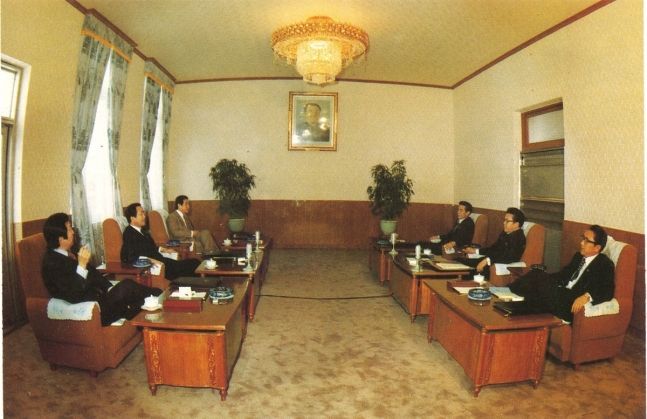 The second working-level representatives' meeting for the inter-Korean Prime Ministers' talks held at Panmungak, Panmunjom on February 19, 1980. (Photo by Ministry of Unification)
In the released inter-Korean dialogue archives, former President Chun Doo-hwan's name is often written as "Jeon○○," which is interpreted as the working-level staff handling the inter-Korean talks documents during the military regime finding it difficult to use the president's real name directly due to North Korea's explicit criticism.
Meanwhile, this release of inter-Korean talks documents is the fourth, following two releases last year (volumes 2 to 6, 4,680 pages) and earlier this year (volumes 7 and 8, 1,678 pages).
Among the 965 pages released this time, about 30% were classified as non-disclosable after review by the Talks Document Disclosure Review Committee. The non-disclosure rate is higher than the 14% in the first half of this year.
The original released inter-Korean talks documents can be viewed at the Ministry of Unification's Inter-Korean Talks Headquarters, the National Unification Education Institute, and the "Inter-Korean Talks Document Reading Room" set up within the North Korea Data Center. The list of disclosed inter-Korean talks documents, disclosure methods, and viewing procedures can be found on the Inter-Korean Talks Headquarters website.
© The Asia Business Daily(www.asiae.co.kr). All rights reserved.
![Clutching a Stolen Dior Bag, Saying "I Hate Being Poor but Real"... The Grotesque Con of a "Human Knockoff" [Slate]](https://cwcontent.asiae.co.kr/asiaresize/183/2026021902243444107_1771435474.jpg)
















