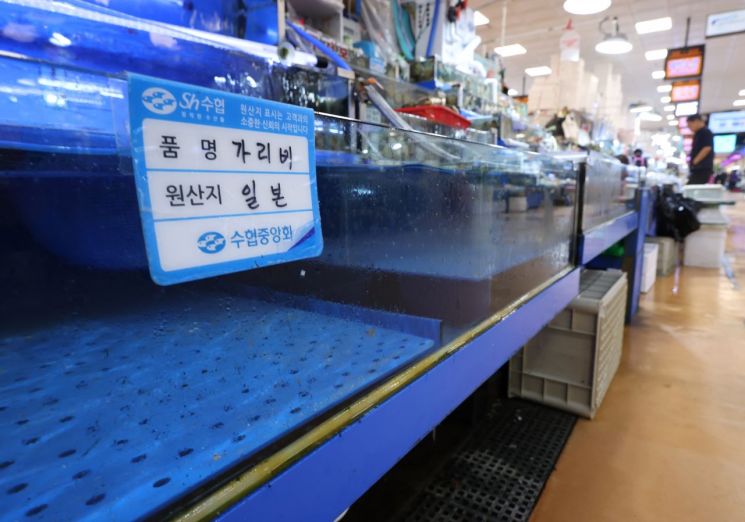
 On the afternoon of October 5th, when Tokyo Electric Power Company began the second phase of Fukushima contaminated water discharge into the ocean, a tank for Japanese scallops was empty at a store in Noryangjin Fisheries Wholesale Market, Dongjak-gu, Seoul. [Image source=Yonhap News]
The government has decided to further strengthen radiation inspections on seafood from Japan in response to Japan's plan to expand scallop exports to South Korea and other countries.
Song Myung-dal, Vice Minister of Oceans and Fisheries, stated at a briefing on the discharge of contaminated water from Fukushima held at the Government Seoul Office on the 28th, "There may be public concerns regarding Japan's plan to expand scallop exports to South Korea and the European Union (EU). Therefore, we will further strengthen the ongoing radiation inspections under import regulations on Japanese seafood."
Currently, the government bans the import of all seafood from eight prefectures near Fukushima. For Japanese seafood from other regions, radiation inspections are conducted with every import, and if any radiation is detected, even in trace amounts, additional radionuclide certificates are requested from Japan, effectively banning imports.
Vice Minister Song added, "Starting next year, the citizen-requested radiation inspection system, which currently operates for domestically produced seafood, will be expanded to include imported seafood."
The government explained that it has allocated a budget of 738 billion KRW for next year, which is approximately 210 billion KRW more than this year, to monitor radiation in our waters more closely and to further strengthen seafood safety management.
Along with this, support for revitalizing seafood consumption will also be significantly expanded.
Vice Minister Song said, "This year, we quickly supported the largest-ever consumption revitalization budget of 64 billion KRW, and next year, we have doubled the budget to a total of 133.8 billion KRW. Accordingly, next year, we will expand the scale of Onnuri gift certificate refund events and online and offline discount events."
To stabilize seafood supply and prices, a budget of 321.9 billion KRW has been allocated for next year. This amount exceeds this year's record-high purchase and stockpiling budget of 290.4 billion KRW.
Financial support will also be expanded to help the fisheries industry overcome management difficulties early.
First, the supply of fisheries policy funds will increase by about 700 billion KRW from 3.4 trillion KRW this year to 4.1 trillion KRW next year, and the loan limits per fisher and corporation will be uniformly raised by 500 million KRW.
Vice Minister Song explained, "The emergency management stabilization fund, which supports fishers temporarily facing management crises with low-interest loans up to 30 million KRW per person, has been expanded fivefold compared to this year to 100 billion KRW."
© The Asia Business Daily(www.asiae.co.kr). All rights reserved.
![Clutching a Stolen Dior Bag, Saying "I Hate Being Poor but Real"... The Grotesque Con of a "Human Knockoff" [Slate]](https://cwcontent.asiae.co.kr/asiaresize/183/2026021902243444107_1771435474.jpg)















