Statistics Korea Announces November Industrial Activity Trends
Last month, total industrial production increased by 0.5% compared to the previous month. This was due to semiconductor production rising by nearly 12%, despite sluggish performance in the construction and service sectors. Retail sales also turned upward. However, investment declined for the second consecutive month.
According to the 'November Industrial Activity Trends' released by Statistics Korea on the 28th, total industrial production rose 0.5% month-on-month.
Although service sector production decreased by 0.1%, manufacturing production increased significantly. Manufacturing production grew 3.3% month-on-month, driven by increases in semiconductors (12.8%) and machinery equipment (8.0%). In particular, semiconductor production rose 42.4% compared to the same month last year.
Manufacturing inventories decreased by 2.4% month-on-month, and the average operating rate of manufacturing was 71.9%, up 1.8 percentage points from the previous month.
In the service sector, production declined 0.1% month-on-month due to decreases in finance and insurance (-0.7%) and transportation and warehousing (-1.4%).
Retail sales increased 1.0% month-on-month, with durable goods sales such as passenger cars rising 2.6% and non-durable goods sales such as food and beverages increasing 0.6%. By retail type, sales at department stores (8.2%) and large discount stores (6.5%) increased, while sales at duty-free shops (-21.0%) and convenience stores (-7.9%) declined.
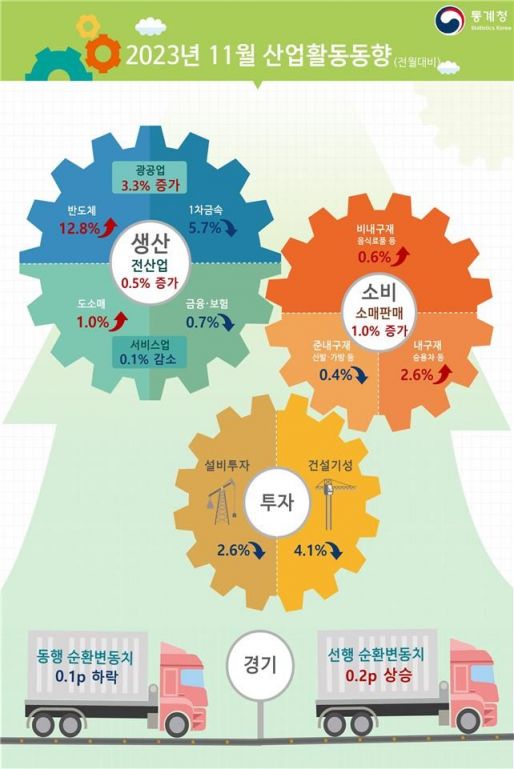
Compared to October, when production, consumption, and investment all recorded triple declines, November saw production and consumption turn to growth, but investment decreased for the second consecutive month. Facility investment fell 2.6% month-on-month as investments in transportation equipment such as aircraft (-5.7%) and machinery (-1.5%) both declined. Construction performance also dropped 4.1% month-on-month, with decreases in building (-3.0%) and civil engineering (-7.3%) construction results.
Construction orders decreased 29.5% year-on-year, with declines in building orders for factories and warehouses (-28.0%) and civil engineering orders such as land development (-33.9%).
The coincident composite index's cyclical component fell 0.1 points month-on-month due to decreases in construction performance and domestic demand-export indices, while the leading composite index's cyclical component rose 0.2 points month-on-month due to increases in inventory cycle indicators and machinery domestic demand-export indices.
© The Asia Business Daily(www.asiae.co.kr). All rights reserved.
![Clutching a Stolen Dior Bag, Saying "I Hate Being Poor but Real"... The Grotesque Con of a "Human Knockoff" [Slate]](https://cwcontent.asiae.co.kr/asiaresize/183/2026021902243444107_1771435474.jpg)















