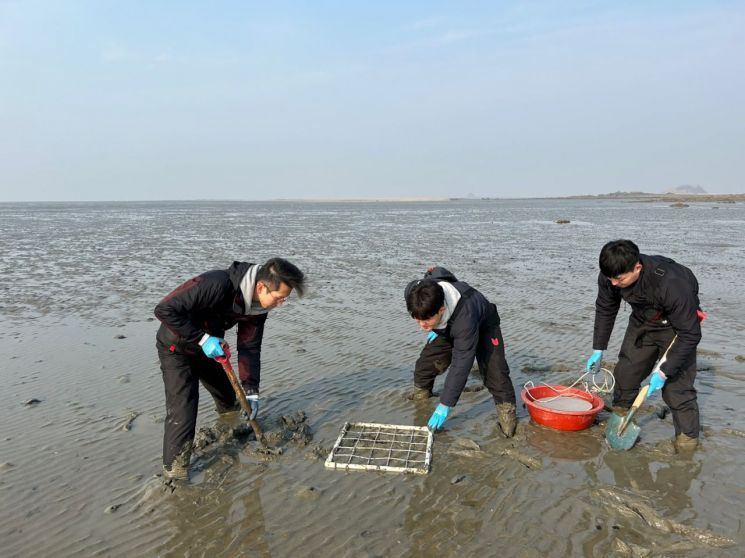
The pollution levels of the Gyeonggi Sea and tidal flats were found to be favorable.
The Gyeonggi-do Marine Fisheries Resources Research Institute announced on the 28th that, as a result of this year's investigation into the pollution levels of the Gyeonggi Sea and tidal flats, 70% of the sea water quality was grade 2 or higher, and the tidal flat pollution was in a good condition.
The institute previously analyzed the Water Quality Index (WQI) and the Eutrophication Restoration and Purification Index (CIET) at 10 sea sites and 10 tidal flat sites in three cities/counties?Hwaseong, Ansan, and Siheung?to evaluate the water quality and organic pollution of tidal flats in the province's waters.
The Water Quality Index (WQI) evaluates water quality by dividing it into grades 1 to 5 based on five factors: dissolved oxygen, phytoplankton concentration, transparency, nitrogen, and phosphorus.
The Eutrophication Restoration and Purification Index (CIET) uses three factors?loss on ignition, chemical oxygen demand, and acid-volatile sulfide?to distinguish between good and eutrophic conditions, assessing the restoration and purification status of tidal flats.
For this year's water quality survey, the institute conducted 24 sampling sessions annually, collecting and analyzing a total of 214 samples, excluding 26 cases where sampling could not be performed normally due to weather and other factors.
Among the 214 samples, 150 cases, accounting for 70%, showed clean water quality of grade 2 or higher. Last year, 139 out of 175 cases, or 79%, were grade 2 or higher.
On the other hand, the proportion of grades 3 to 5 (moderate, poor, very poor) increased by 9 percentage points from 21% last year to 30% this year. The institute estimates that this is due to a temporary increase in phytoplankton in the shallow waters of the Gyeonggi Sea caused by this year's abnormal high temperatures.
The tidal flat pollution remained good with 30 cases this year, as in the previous year. However, although the condition is good without organic pollution, the institute explained that some areas exceeded the standard values in certain factors, requiring continuous monitoring.
Kim Bong-hyun, director of the Gyeonggi-do Marine Fisheries Resources Research Institute, stated, "The Gyeonggi Sea has a marine environment sensitive to climate change due to its shallow depth," and added, "We will establish scientific and systematic marine environment conservation policies through continuous surveys of the sea and tidal flats."
© The Asia Business Daily(www.asiae.co.kr). All rights reserved.
![Clutching a Stolen Dior Bag, Saying "I Hate Being Poor but Real"... The Grotesque Con of a "Human Knockoff" [Slate]](https://cwcontent.asiae.co.kr/asiaresize/183/2026021902243444107_1771435474.jpg)















