Announcement of the 2021 Survey Results on Startup Companies Status
It was found that 'startup companies' within 7 years of commencing business account for 59.0% of all small and medium enterprises (SMEs). The number of employees in startup companies approached 40% of the total SME workforce. The sales revenue of startup companies amounted to 36.8% of the total SME sales revenue.
The Ministry of SMEs and Startups (Minister Lee Young) and the Korea Institute of Startup & Entrepreneurship Development (President Kim Yong-moon) announced on the 28th the results of the 2021 'Startup Company Survey,' which investigates the characteristics of startup companies within 7 years of business commencement. The Startup Company Survey is a nationally approved statistic that is compiled and published annually. This survey analyzed the entire '2021 Enterprise Statistical Register' from Statistics Korea to prepare general status data such as the number of startup companies, sales revenue, and number of employees. Additionally, a sample of 8,000 startup companies was extracted to conduct a detailed characteristic survey.
Previous Startup Company Surveys faced difficulties in comparison with other statistics due to differences in population compilation criteria. The Ministry of SMEs and Startups explained that from this year, the population compilation criteria have been changed to the same method as the Basic Statistics on SMEs, enabling direct comparison between the overall SMEs and startup companies.
Number of Startup Companies 4,549,000 · Sales Revenue 1,108.8 Trillion KRW
According to the survey results, as of 2021, the total number of startup companies was 4,549,000, an increase of 5.8% compared to the previous year. They accounted for 59.0% of the total 7,714,000 SMEs and have shown an increase every year over the past three years.
Among all startup companies, technology-based startups numbered 903,000 (19.8%), while non-technology-based industries accounted for 3,647,000 (80.2%). The number of technology-based startup companies has steadily increased from 783,195 in 2019 to 848,036 in 2020, and 902,599 in 2021.
As of 2021, the total number of employees in startup companies was 7,322,000, an increase of 2.1% from the previous year. This represents 39.6% of the total SME workforce of 18,493,000. Among all startup company employees, 2,266,000 worked in technology-based startups, and 5,056,000 in non-technology-based startups.
The total sales revenue of all startup companies was 1,108.8 trillion KRW, a 10.4% increase from the previous year. This accounts for 36.8% of the total SME sales revenue of 3,017.1 trillion KRW. Among the total sales revenue of startup companies, technology-based startups accounted for 315.4 trillion KRW, and non-technology-based startups for 793.4 trillion KRW. Although technology-based startups represent 19.8% of all startup companies, their shares of employees and sales revenue are 30.9% and 28.4%, respectively. This indicates that technology-based startups achieve higher business performance than non-technology-based startups.
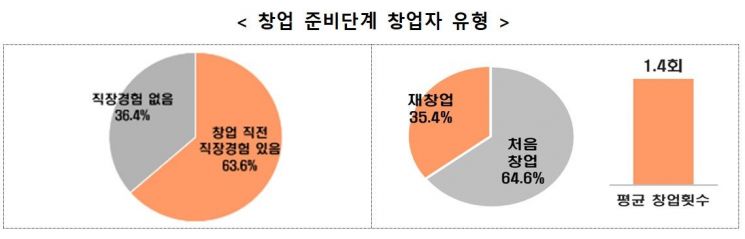
35.4% Are Re-startup Companies, Average Number of Startups 1.4 Times
Regarding the characteristics of startup companies, 63.6% of founders had prior work experience before starting their business, similar to 63.8% in the previous year, indicating that more than half leverage their work experience to challenge entrepreneurship. Re-startup companies with prior startup experience accounted for 35.4%, with an average number of startups of 1.4 times.
The biggest obstacle to starting a business was 'securing funds,' with 71.0% responding similarly to the previous year. This was followed by 'fear of failure' (37.9%) and 'lack of startup knowledge, skills, and experience' (30.1%). The proportions responding 'discouragement from acquaintances' (3.1%) and 'negative social atmosphere' (2.6%) were significantly lower.
The average capital required to start a business was 285 million KRW, lower than the previous year's 318 million KRW. The most common method of funding was 'personal funds,' accounting for 94.2%. Cases receiving government support or investment were at the 4.0% level.
The proportion of regular employees in startup companies was about 85.1% of the total workforce, with average assets of 550 million KRW (capital accounting for 32.9%, liabilities 67.1%), operating profit margin relative to sales at 5.3%, financial costs at 2.4%, and net profit margin at 3.5%. Additionally, they held an average of 3.79 industrial property rights, and 2.8% of companies had experience in overseas expansion (2.6% in the previous year).
Park Yong-soon, Director of Startup Policy at the Ministry of SMEs and Startups, said, "This Startup Company Survey applies the same standards as the Basic Statistics on SMEs, allowing direct comparison of the number of employees and sales between SMEs and startup companies, which is meaningful in confirming the proportion and importance of startup companies in our economy."
© The Asia Business Daily(www.asiae.co.kr). All rights reserved.
![Clutching a Stolen Dior Bag, Saying "I Hate Being Poor but Real"... The Grotesque Con of a "Human Knockoff" [Slate]](https://cwcontent.asiae.co.kr/asiaresize/183/2026021902243444107_1771435474.jpg)















