KCTA Explores Solutions for Home Shopping-Paid Broadcasting Disputes
Mobile and Online Payments Encouraged via QR Code Exposure
"Clear Standards Needed for Appropriate Revenue Reflection by Media"
Amid intense conflicts over transmission fees between home shopping companies and pay-TV broadcasters, there is a claim that internet and mobile payments by TV home shopping viewers, which account for 69%, should also be considered in the calculation of these fees.
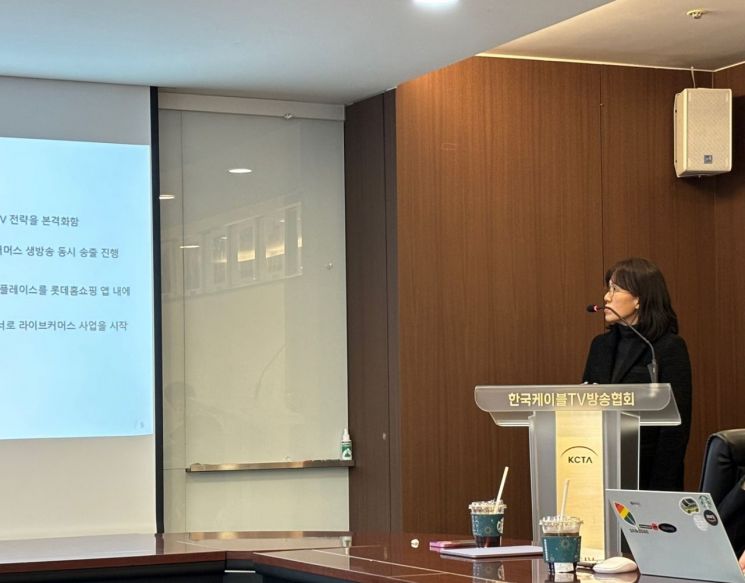 On the 27th at 4 PM, Professor Jung Yoon-jae from the Department of Media Communication at Hankuk University of Foreign Studies is presenting Session 2 in the main conference room of the Korea Cable Television Association (KCTA) in Seodaemun-gu, Seoul. Photo by Hwang Seo-yul chestnut@
On the 27th at 4 p.m., the Korea Cable TV Association (KCTA) held a press briefing titled "Seeking Rational Solutions to the Home Shopping-Pay TV Dispute" in the association's main conference room located in Seodaemun-gu, Seoul. Session 1, "Diagnosis of Disputes and Structural Issues between Pay TV and Home Shopping," was presented by Professor Yuseong Jin from the Business Administration Department at Kyung Hee University, while Professor Jung Yoonjae from the Media Communication Department at Hankuk University of Foreign Studies presented on "The Current Status of Internet and Mobile Payment Inducement in TV Home Shopping Broadcasts and Its Impact on Viewers' Payment Method Choices."
TV home shopping companies receive sales commissions from product suppliers and, when selling products on channels of pay-TV operators such as IPTV, satellite, and cable TV, they must pay transmission fees to the pay-TV operators based on the sales amount.
Professor Jung argued that as home shopping companies have recently been encouraging internet and mobile payments instead of traditional broadcasts, a new standard for calculating sales revenue is necessary for the rational determination of transmission fees. According to Professor Jung, a survey of 350 men and women aged 20 to 59 who have purchased products after watching TV home shopping revealed that about 69% made payments via mobile apps, internet sites, or KakaoTalk rather than through phone consultations or ARS payments. When asked on a 7-point scale whether consumers exposed to internet and mobile payment inducement types intended to choose internet as a payment method, the average scores were 4.51 and 4.87 respectively, indicating a tendency above neutral.
There is also a phenomenon of inducing payments through other media during home shopping broadcasts. A survey conducted from July 31 to August 6 this year on 1,341 broadcasts across seven TV home shopping channels found that 1,168 broadcasts, or 87.1%, induced payments via QR codes. The next most common types were immediate discount, discount coupons, and reward point banners (80.7%), internet and mobile order recommendation banners (68.5%), and screens providing information on discounts, rewards, and coupons (67%).
The exposure time and frequency of each payment inducement type were also considerable. For QR codes, six home shopping companies showed a mode of exposure time proportion between 91% and 100%, dedicating most of the broadcast time to exposure. Immediate discount, discount coupon, and reward point banners appeared with similar figures on three media outlets, while KakaoTalk channel additions and order banners showed the same figures on one shopping mall.
Professor Jung stated, "The phenomenon of internet and mobile payment inducement in TV home shopping stems from the lack of standards reflecting sales generated via phone and internet/mobile during broadcasts in the calculation of transmission fees," adding, "It is necessary to establish a credible transmission fee standard that reflects the increasing reality of mobile and internet payments to prevent disputes during negotiations." According to the "Home Shopping Broadcast Channel Usage Contract Guidelines" revised by the government in March, the level of reflecting mobile and internet sales is determined by agreement between operators.
The industry also called for guidelines to resolve information asymmetry. Kim Jin-kyung, head of public relations at KCTA, said, "In negotiations between operators, some claim that tracking (mobile and online sales) is possible, while others say it is unclear," adding, "It would be good if home shopping companies transparently disclosed information for mutual growth, but currently that is not the case, so negotiations between operators contain elements of dispute."
However, the government stated that it needs to hear both sides. Koo Bonjun, director of the Broadcasting Promotion Planning Division at the Ministry of Science and ICT, said, "We will review it," but added, "We need to consider not only one side but also the other side."
© The Asia Business Daily(www.asiae.co.kr). All rights reserved.


















