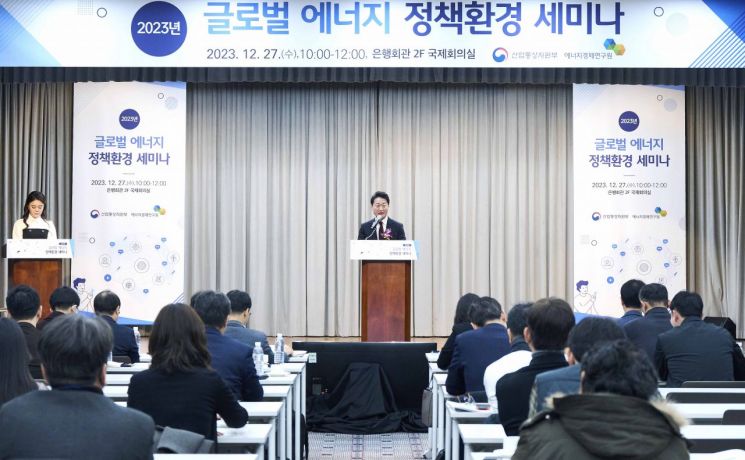
 Lee Ho-yeon, Director of Energy Policy at the Ministry of Trade, Industry and Energy, is delivering a congratulatory speech at the "2023 Global Energy Policy Environment Seminar" held at the Seoul Federation of Banks Building on the 27th. Photo by Ministry of Trade, Industry and Energy.
The government plans to actively discuss making the Electricity Commission an independent body next year. Currently under the Ministry of Trade, Industry and Energy, the Electricity Commission would be made independent like the Financial Services Commission, allowing it to determine electricity rates free from political or governmental pressure. The Ministry of Trade, Industry and Energy also plans to promote exploration of critical minerals to strengthen energy security.
Choi Yeon-woo, Director of Energy Policy at the Ministry of Trade, Industry and Energy, stated on the 27th at the '2023 Global Energy Policy Environment Seminar' held at the Seoul Banking Hall, "The plan to make the Electricity Commission independent is included in the Yoon Seok-yeol administration’s national agenda and the energy policy direction announced in July 2022, so we will begin full discussions starting next year."
Last July, the government announced plans in the new administration’s energy policy direction to strengthen the independence of regulatory governance, including enhancing the authority of the Electricity Commission related to the electricity market and rates, and to reorganize the Electricity Commission’s secretariat to strengthen expertise in system supervision, market monitoring, and dispute resolution.
To this end, in October last year, the Ministry commissioned a research project titled "Measures to Strengthen the Independence and Expertise of Electricity Market and Rate Regulatory Governance" to the Korea Energy Economics Institute and the law firm Bae, Kim & Lee LLC. This project was originally scheduled to be completed by June this year but has been extended to the end of this year. Consequently, concerns have been raised that the reform of energy governance might fizzle out.
In the private sector and academia, there is a strong call for depoliticization of energy policies overall, including electricity rates. It is pointed out that reform of energy policy governance is necessary. An independent institution with expertise should determine electricity and gas rates based on cost principles. Experts suggest modeling such an organization after the Bank of Korea’s Financial Services Commission.
Typically, electricity rates are adjusted by Korea Electric Power Corporation (KEPCO) preparing a proposal under the Electricity Business Act, which is then reviewed and approved by the Electricity Commission under the Ministry of Trade, Industry and Energy, with the Ministry granting final approval. Under the Price Stabilization Act, the Ministry must also consult in advance with the Ministry of Economy and Finance, the price authority. The Electricity Commission only deliberates, but the government actually makes the decision. In this process, it inevitably has to consider political pressures.
Heo Yoon-ji, Associate Research Fellow at the Korea Energy Economics Institute, explained in her presentation on "Trends in Energy Prices and Consumer Protection Policies in Major Countries" that "temporary price freezes have short-term consumer protection effects but do not provide reasonable price signals in the long term," adding, "Appropriate pricing is the most fundamental policy tool for rationalizing consumer energy consumption." She emphasized that policies protecting vulnerable groups should be pursued simultaneously with rate normalization.
Director Choi said on the same day, "We have secured a budget for securing critical minerals, and related bills are pending in the Legislation and Judiciary Committee," adding, "We plan to announce exploration-related details next year." This comes in response to China recently weaponizing critical minerals, raising the need for overseas resource development from an energy security perspective. Lee Ho-yeon, Director of Energy Policy, also said in his congratulatory remarks, "We will focus our capabilities on revitalizing overseas resource development and establishing a national energy and resource security system."
Regarding this, Professor Kim Jin-su of Hanyang University emphasized in his presentation, "South Korea is a country where 'production adjustment,' a traditional resource security crisis response measure, is not possible," and stressed, "To compensate for this, overseas resource development, import diversification, and international cooperation must be utilized." Professor Kim explained, "It is difficult to avoid a crisis in the critical mineral supply chain," and "It is important to secure basic resilience to withstand the crisis and response capabilities to quickly recover from its impact."
Regarding overseas resource development methods, Professor Jeong Yeon-je of Seoul National University of Science and Technology proposed the Japanese model of the Japan Oil, Gas and Metals National Corporation (JOGMEC), where the private sector leads while the government invests, rather than the government and public institutions leading as in the past.
Researcher Jo Il-hyun of the Korea Energy Economics Institute predicted, "Oil demand will continue to increase until 2028 and peak before 2030," and "solar and wind power will continue to grow." Researcher Jo Joo-hyun reported that new nuclear power plants, which had been delayed in Finland and the United States, have started commercial operations, and continued operation of aging nuclear plants has been decided in Canada, France, Belgium, Hungary, Sweden, and Japan. Roh Dong-seok, Director of the Nuclear Communication Support Center at the Korea Energy Information Culture Foundation, said, "Focusing on a single energy source is like investing all your stocks in one company," emphasizing the need to review various energy sources.
© The Asia Business Daily(www.asiae.co.kr). All rights reserved.
![Clutching a Stolen Dior Bag, Saying "I Hate Being Poor but Real"... The Grotesque Con of a "Human Knockoff" [Slate]](https://cwcontent.asiae.co.kr/asiaresize/183/2026021902243444107_1771435474.jpg)















