Ministry of Environment (Korea Environment Corporation) and Korea Energy Agency Support Projects, Increasing Charging Infrastructure
Leading Paradigm for Eco-friendly Energy Infrastructure Construction and Climate Crisis Response New Industry Supp
Pohang City is rapidly expanding various charging infrastructures this year as well to swiftly transition to future mobility electric vehicles in response to climate change and carbon neutrality.
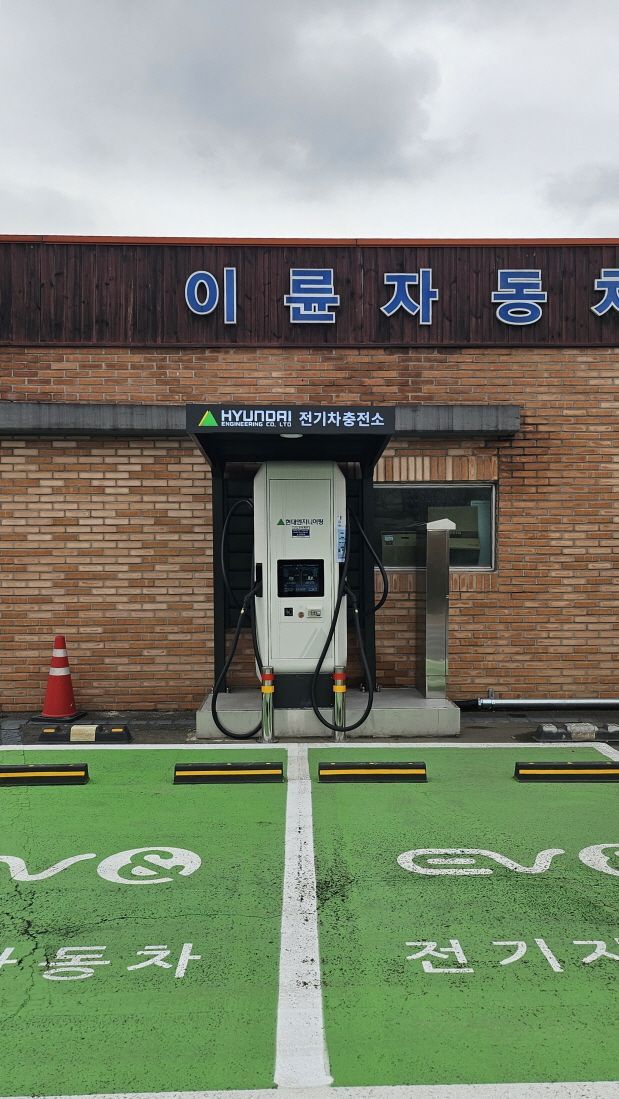 Electric vehicle charging station installed at Pohang Vehicle Inspection Office of Korea Transportation Safety Authority.
To this end, the Ministry of Environment (Korea Environment Corporation), Korea Energy Agency, and local government-led projects such as the Zero-Emission Vehicle Transition Brand Contest, electric vehicle charging service promotion, and support for slow charger installation are investing a total of 2.85 billion KRW this year to install 126 fast, medium, and slow charging facilities, diversifying the electric charging infrastructure.
First, two projects were selected in the Zero-Emission Vehicle Transition Brand Contest, investing a total of 2.6 billion KRW (1 billion KRW from the national government and 1.6 billion KRW from private investment) to establish 99 fast, medium, and slow chargers at 54 locations including public parking lots and public institutions.
This project, carried out by Humax EV and Tadi Technology (PM Grow Consortium), which are subsidy project executors under the Ministry of Environment, is building an electric vehicle charging infrastructure network focused on major living and transportation hubs through the ‘Pohang Secondary Battery Charging Infrastructure Ecosystem Creation’ and ‘Expansion of Charging Infrastructure in Charging-Vulnerable Areas within Residential Zones’ projects. The charging facilities are professionally operated and managed by the subsidy project operators for five years as a mandatory obligation.
Previously, last year, two project support initiatives were also applied for, and with a total project cost of 4.5 billion KRW (1.3 billion KRW national funds and 3.2 billion KRW private investment), 128 fast and slow chargers were installed at 34 locations including knowledge industry centers, and the charging infrastructure is currently operational.
Furthermore, the private fast charger distribution project, part of the Haeoreum Alliance cooperation project, is being implemented again this year. The Korea Energy Agency supports 50% of the installation cost per charger, and the city additionally provides an installation subsidy of up to 6 million KRW per charger (based on 50 kW). A total of 42 million KRW has been supported for installation and operation at three locations selected through a public contest by the agency, including the Korea Transportation Safety Authority Pohang Vehicle Inspection Office.
In addition, the city’s own project for installing slow chargers for electric vehicles is supporting the installation of 73 units (based on 11 kW) with a project budget of 140 million KRW, currently accepting applications for slow charger installation support and proceeding with construction and installation.
This project targets vulnerable groups in electric charging usage, including facilities subject to mandatory installation (under 500 households), vulnerable groups (disabled, low-income), disabled veterans and independent patriots, multi-child families, and corporations or individuals who have secured sites for charger installation within the city’s residential or business addresses. It supports the distribution of 73 slow chargers (Type C, AC), kiosk chargers, power distribution chargers, and metered outlets.
A Pohang City official stated, “By building eco-friendly energy infrastructure and supporting future new industries that respond to the climate crisis, we are changing the environmental welfare paradigm and additionally achieving a budget-saving effect of about 2.3 billion KRW in future energy infrastructure construction.” He added, “From charger installation to operation and management, private charging operators provide one-stop support, which will greatly help not only vulnerable groups but also citizens in using electric vehicles.”
As of November, a total of 18,930 electric vehicles and plug-in hybrids are registered in Pohang City, and the electric charging infrastructure consists of 320 ultra-fast chargers and 2,290 slow chargers, totaling 2,610 units installed and operational.
© The Asia Business Daily(www.asiae.co.kr). All rights reserved.
![Clutching a Stolen Dior Bag, Saying "I Hate Being Poor but Real"... The Grotesque Con of a "Human Knockoff" [Slate]](https://cwcontent.asiae.co.kr/asiaresize/183/2026021902243444107_1771435474.jpg)















