Gradual Increase... 25% in H1, 50% in H2
100% Applied from 2025
"Key Policy Measure for Household Debt Management"
The government will implement a 'Stress DSR' system that strengthens the total debt service ratio (DSR) regulation to manage the household debt burden, which is increasing. Starting with mortgage loans in the banking sector in February next year, the system will expand to cover all loans across the entire financial sector, and the loan limits will be reduced by up to 16%.
On the 27th, the Financial Services Commission announced that the Stress DSR system will be applied to all variable-rate, mixed-type, and periodic loans across the financial sector starting next year. The Stress DSR system is designed to reduce the amount of loanable funds by adding a certain level of interest rate margin when calculating the DSR. The stress interest rate is determined by comparing the highest household loan interest rate over the past five years with the benchmark interest rates in May and November each year. The lower limit is 1.5%, and the upper limit is 3.0%.
The Financial Services Commission will first apply the additional interest rate equal to the 'highest interest rate in the past five years minus the current interest rate' to variable-rate loans. For mixed-type and periodic loans, which have lower interest rate fluctuation risks, a reduced additional interest rate compared to variable-rate loans will be applied. For mixed-type loans, the stress interest rate applied will be lower the higher the proportion of the fixed-rate period within the total loan maturity.
For example, in the case of a 30-year maturity loan, if the fixed-rate period is 5 to 9 years, 60% of the stress interest rate applied to variable-rate loans will be added; for loans with fixed-rate periods of 9 to 15 years and 15 to 21 years, 40% and 20% of the stress interest rate will be added, respectively. For periodic loans with a 30-year maturity, if the interest rate fluctuation cycle is 5 to 9 years, 30% of the stress interest rate applied to variable-rate loans will be added; for 9 to 15 years, 20%; and for 15 to 21 years, 10% of the stress interest rate will be applied.
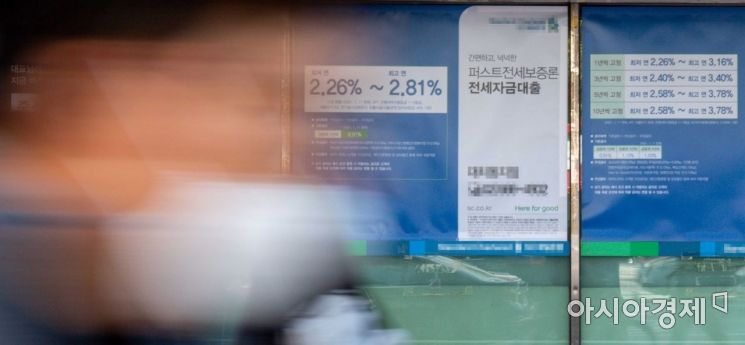 An announcement related to loans is posted in front of a commercial bank in Gangnam-gu, Seoul, on the 24th, where the government has eased regulations on jeonse loans for genuine demand from low-income households but plans to introduce strong supplementary measures for household debt, such as increasing the installment repayment ratio. Photo by Jinhyung Kang aymsdream@
However, to reduce market shocks, the strengthened system will be applied gradually. To ease the burden of reduced loan limits, the Financial Services Commission decided to apply only 25% of the stress interest rate in the first half of next year, and 50% in the second half. From 2025, 100% of the stress interest rate will be applied. For refinancing and contract renewals at private banks, the application of the stress interest rate will be deferred until 2025.
With the implementation of the system, loan limits are expected to decrease by 2-4% in the first half of next year, 3-9% in the second half, and 6-16% in 2025, depending on the product. For a borrower with an income of 50 million KRW taking out a 30-year maturity installment loan, the loan limit will shrink from 330 million KRW to 315 million KRW in the first half of next year, 300 million KRW in the second half, and 280 million KRW in 2025.
The system will first apply to mortgage loans in the banking sector starting February 26 next year. In June, it will extend to bank credit loans and mortgage loans in the secondary financial sector. The Financial Services Commission plans to gradually expand the scope to other loans in the second half of next year, considering the market conditions affected by the Stress DSR system.
Credit loans will only be subject to the system if the total balance exceeds 100 million KRW, with the scope expanded gradually. Stress interest rates will not be applied to fixed-rate loans with maturities of five years or more. For fixed-rate loans with maturities between three and five years, 60% of the stress interest rate will be applied, and other credit loans will be charged the stress interest rate as if they were variable-rate loans.
The Financial Services Commission stated that with the introduction of the system, users of variable-rate loans will borrow within limits that consider future interest rate fluctuation risks, preventing excessive debt burdens that exceed regulatory levels even if interest rates rise in the future. In particular, it is expected that preferences for mixed-type, periodic loans with relatively low future interest rate fluctuation risks, or purely fixed-rate loans, will increase, leading to a significant qualitative improvement in household debt.
A Financial Services Commission official said, "The DSR system, which has become a key policy tool for managing household debt, will advance to reflect borrowers' interest rate fluctuation risks through this system improvement," adding, "It will serve as an opportunity for the principle of managing household debt within repayment capacity to take deeper root." The official also added, "We plan to carefully monitor the implementation process to prevent excessive loan contraction and ensure the system is quickly established."
© The Asia Business Daily(www.asiae.co.kr). All rights reserved.
![Clutching a Stolen Dior Bag, Saying "I Hate Being Poor but Real"... The Grotesque Con of a "Human Knockoff" [Slate]](https://cwcontent.asiae.co.kr/asiaresize/183/2026021902243444107_1771435474.jpg)
















