Joint Public-Private Project Including Goyang-si K-Culture Valley
Recommendations for Cost Reduction and Public Contribution Measures
The Ministry of Land, Infrastructure and Transport held the 'Public-Private Joint Construction Investment Project Adjustment Committee' for the first time in 10 years and approved adjustment plans for project financing (PF) projects totaling 14 trillion won.
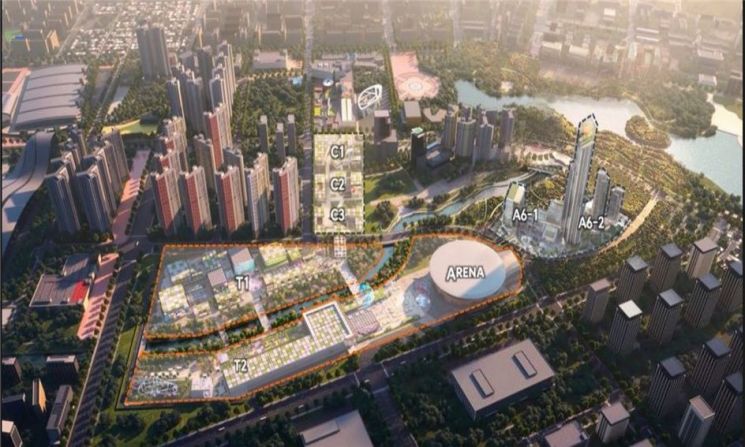 Aerial View of Goyang Tourism and Culture Complex (Hallyu World) K-Culture Valley / Image Courtesy of Ministry of Land, Infrastructure and Transport
Since October, the Ministry has operated the adjustment committee and received adjustment applications for 11 cases (34 projects). On the 27th, it announced that it had prepared project plan changes, liquidity securing, and administrative support measures for 7 cases (30 projects).
This decision was made based on the judgment that, amid deteriorating conditions for PF project promotion due to recent construction cost increases and high interest rates, public-private joint PF projects where the public sector provides land or acts as the client also require reasonable plan changes and financing measures.
Looking at the adjustment details by project, for the K-Culture Valley project in Goyang-si, Gyeonggi Province (approximately 3.2 trillion won), to promptly resume the halted construction, the Ministry recommended Gyeonggi Province support cost reduction and liquidity securing measures for the private developer, extend the completion deadline, and reduce delay penalties considering project conditions such as power supply. The private developer, CJ, was urged to quickly resume the project and prepare public contribution plans for regional development, taking into account the scale of delay penalty reductions.
For the Magok Landmark Site construction project (approximately 600 billion won), the mandatory 10-year lease period for office and commercial facilities was shortened to immediate sale upon development and 5 years for commercial facilities to facilitate financing. The private developer was adjusted to prepare public contribution plans such as rent reduction to revitalize the commercial area and expansion of public facility areas like the promotional observatory.
The Incheon Geomam Placia Complex Transfer Center project, building apartment complexes and a complex transfer center worth about 1.5 trillion won, was recommended to delay the establishment of the project finance investment company (PFV) by about one year to secure liquidity and adjust the order by prioritizing the start of sales facilities. Additional enforcement clauses such as delay penalties were also added to prevent delays in permits for the complex transfer center.
For the Gimpo Hangang Cinepolis General Industrial Complex (approximately 1.3 trillion won), there is a disagreement between Gimpo City and the private developer regarding the installation of a data center. The government recommended Gimpo City to specify reasons for opposition such as complaints and to start consultations with the private developer based on the existing data center cooperation memorandum of understanding (MOU). The private developer was asked to prepare public contribution plans to resolve complaints and benefit the region.
Additionally, for the Goyang Tourism and Culture Complex accommodation project (approximately 700 billion won), a 70% reduction in delay penalties was recommended considering existing precedents. However, conversion of residential-type accommodations to officetels was not allowed, considering that the land was acquired at cost for hotel construction. The Deoksan General Industrial Complex, being developed with a budget of 100 billion won, was ordered to have the local urban planning committee review the appropriateness of the planned restoration project for damaged areas and the conversion to conservation charges.
Furthermore, for public housing projects with private participation, the Ministry proposed a 'Construction Cost Adjustment Guideline' to allow Korea Land and Housing Corporation (LH), local urban corporations, and private developers to negotiate construction cost sharing. This project involves investing over 7 trillion won in 24 sites to supply about 24,000 public housing units. Due to recent construction cost increases, there is growing concern that losses may spread not only to large construction companies but also to local construction companies forming joint consortia.
Meanwhile, among the total 11 cases submitted to the adjustment committee, the remaining 4 cases were not adjusted due to reasons such as regulations prohibiting use changes, lawsuit conclusions, and ongoing audits by the Board of Audit and Inspection.
The adjustment plan will be finalized if the private and public project parties agree within 60 days after consultations, legal advice, and prior consulting with the Board of Audit and Inspection. If more detailed adjustments are needed during the consultation process, additional adjustments will be conducted at the committee level.
Kim Oh-jin, First Vice Minister of the Ministry of Land, Infrastructure and Transport and chair of the adjustment committee, said, "Through this adjustment, we expect to establish a foundation for normalizing PF projects by securing liquidity exceeding 100 billion won per project in some cases. It will also serve as a leading model of public-private coexistence by contributing to regional development through the public contributions of private developers."
© The Asia Business Daily(www.asiae.co.kr). All rights reserved.

















