Last month, the number of domestic movers in South Korea approached 500,000, marking an increase compared to the same month last year. This is the first time since 2020 that the population movement in November, which had previously declined due to the real estate market slowdown and population aging, has turned upward compared to the same month last year.
According to the "November 2023 Domestic Population Movement Statistics" released by Statistics Korea on the 27th, the number of movers last month was 496,000, an increase of 4.3% (20,000 people) compared to the same month last year.
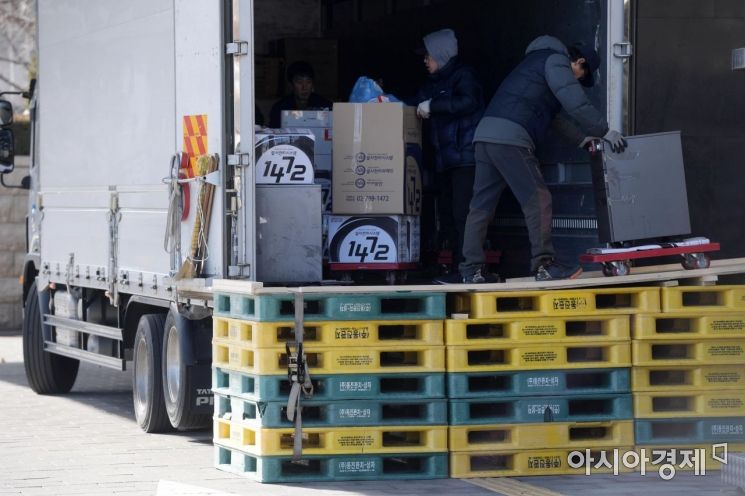 The Ministry of the Interior and Safety is ending its over 70-year era in Gwanghwamun, Seoul, since the establishment of the Ministry of Home Affairs and the Office of General Affairs in 1948, and will relocate to Sejong City over the next three weeks starting today. The relocation to Sejong City was confirmed as part of the Moon Jae-in administration's national agenda, following the amendment of the Happy City Act in 2017 and last year's "Notice of Change in the Relocation Plan of Central Administrative Agencies." On the 7th, officials are moving belongings at the Government Seoul Office Building. Photo by Mun Ho-nam munonam@
The rise in the number of domestic movers compared to the same month last year is the first in three years since November 2020, when it recorded 7.9%. It had recorded negative growth for two consecutive years with -7.1% in November 2021 and -16.0% in November 2022, before turning upward this November.
This appears to be related to the domestic real estate market, which had been repeatedly stagnant, bottoming out, and the sharp increase in housing sales in August and September. As a result, the number of domestic movers also exceeded 500,000 in October.
Among the total movers, 67.9% moved within the same city or province, while 32.1% moved between cities or provinces. Compared to the same month last year, intra-city/province moves increased by 6.9%, while inter-city/province moves decreased by 1.0%.
Looking at the net migration, which is the number of incoming residents minus outgoing residents by city/province, seven regions including Incheon (3,901 people), Gyeonggi (2,922 people), and Chungnam (1,909 people) experienced net inflows, while ten regions including Seoul (-6,239 people), Busan (-1,153 people), and Gwangju (-517 people) experienced net outflows. In particular, Seoul has seen net outflows for nine consecutive months since a net inflow of 3,500 people in February.
The population movement rate, which indicates the number of movers per 100 people, was 11.8%, an increase of 0.5 percentage points compared to the same month last year.
© The Asia Business Daily(www.asiae.co.kr). All rights reserved.

















