Highest Closing Price Since November 30 Based on WTI Closing Price
International oil prices rose more than 2%, reaching the highest level this month. Oil prices are fluctuating as tensions escalate in the Middle East due to the resumption of attacks by the Houthi rebels in the Red Sea.
On the 26th (local time), the price of West Texas Intermediate (WTI) crude oil for February delivery on the New York Mercantile Exchange closed at $75.57 per barrel, up $2.01 (2.73%) from the previous day. This is the highest closing price since November 30. Bloomberg reported that oil prices recorded the largest weekly gain since October as Houthi rebel attacks continued.
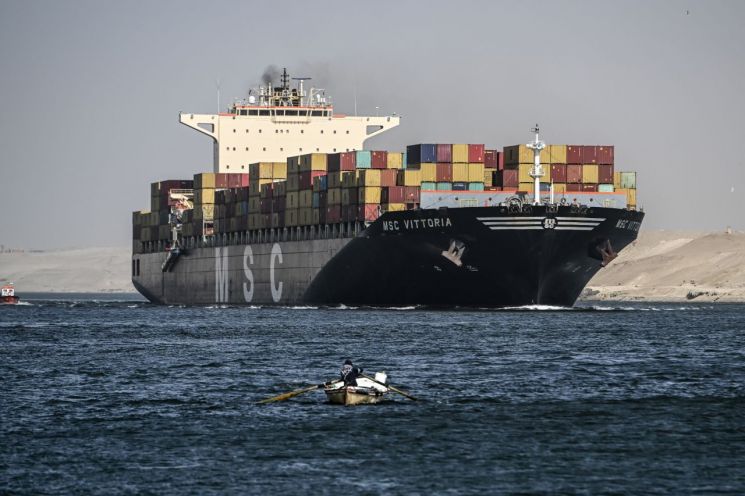
On the same day, the Houthi rebels resumed attacks on vessels in the Red Sea. The MSC United, operated by Swiss company MSC, was attacked while heading to Pakistan. Yahya Sari, spokesperson for the Houthi rebels, issued a statement saying that missiles were fired after the vessel ignored warnings three times. He also stated that drones were deployed targeting military facilities.
The U.S. Central Command reported that destroyers and F/A-18 fighter jets shot down 12 attack drones, 3 anti-ship ballistic missiles, and 2 ground-attack cruise missiles launched by the Houthi rebels. No damage to vessels or casualties have been confirmed.
In response to escalating conflicts in the area, a multinational fleet called the "Operation Prosperity Guardian" has been formed, led by the United States, to counter attacks in the Red Sea. In this context, Maersk, the world's second-largest shipping company based in Denmark, announced it is preparing to resume maritime shipments through the Red Sea. German shipping company Hapag-Lloyd, which had initially announced plans to reroute around the Red Sea, is scheduled to announce tomorrow whether it will resume transportation through the Red Sea.
The Red Sea is a strategic point connected to the Suez Canal, the shortest route linking Asia and Europe. It is especially critical for oil transportation. According to the U.S. Energy Information Administration, approximately 9.2 million barrels of oil per day passed through this area in the first half of this year, accounting for 9% of global demand. If vessels detour around the Cape of Good Hope in southern Africa to avoid Houthi attacks, the voyage duration will increase by more than a week, and costs such as fuel and insurance are expected to rise by 20-40%. This makes disruptions in crude oil transportation inevitable. Bloomberg forecasts that the additional costs and shipping delays will negatively impact the global economy.
The Houthi rebels have been attacking vessels passing through the Red Sea since last month, after announcing on the 14th that they would target Israeli ships amid the war with Hamas. Foreign media including Bloomberg have reported the risk of the Israel-Hamas war expanding broadly across the Middle East. Aaron David Miller, senior fellow at the Carnegie Endowment for International Peace, said, "The longer the war between Israel and Hamas continues, the more tensions will escalate," adding, "If there are American casualties, a strong response will be necessary."
© The Asia Business Daily(www.asiae.co.kr). All rights reserved.
![Clutching a Stolen Dior Bag, Saying "I Hate Being Poor but Real"... The Grotesque Con of a "Human Knockoff" [Slate]](https://cwcontent.asiae.co.kr/asiaresize/183/2026021902243444107_1771435474.jpg)















