7.4 Generals per 10,000 Korean Troops
"General Numbers Should Be Reduced in Line with Troop Decrease"
Although military personnel have decreased due to the population cliff, the government's plan to reduce the number of generals has been halted. If the current number of generals is maintained, the ratio of generals per 10,000 troops in South Korea will gradually increase. There are calls for the Ministry of National Defense to change its stance on maintaining the number of generals for the time being.
The Ministry of National Defense announced in March that the authorized number of generals under 'Defense Innovation 4.0' is 370. Based on this, the number of generals per 10,000 troops in South Korea is 7.4 (based on the current standing force of 500,000).
In 2018, the Ministry of National Defense announced 'Defense Reform 2.0' and decided to gradually reduce the number of generals. Accordingly, the authorized number of generals, which was 436 at the time, was gradually reduced to ▲430 in 2018 ▲405 in 2019 ▲390 in 2020 ▲375 in 2021, reaching the current scale of 370. However, unlike the previous 'Defense Reform 2.0' plan to reduce the number of generals to 360 by 2022, the 'Defense Innovation 4.0' plan no longer includes a reduction in the number of generals.
The problem is that the authorized number of generals is likely to remain unchanged going forward. When announcing 'Defense Innovation 4.0' in March, the Ministry of National Defense stated that it would maintain the number of generals at around 370 for the time being. This is due to the need for related legal amendments or the existence of positions requiring general officer ranks considering the military's unique characteristics.
The latest edition of the Defense White Paper (2022) also explains, "Considering the need to enhance crisis response capabilities to rapidly changing security situations such as North Korea's nuclear and missile threats, strengthening the Korean-style three-axis system, and securing momentum for Defense Innovation 4.0, the authorized number of generals was adjusted to 370."
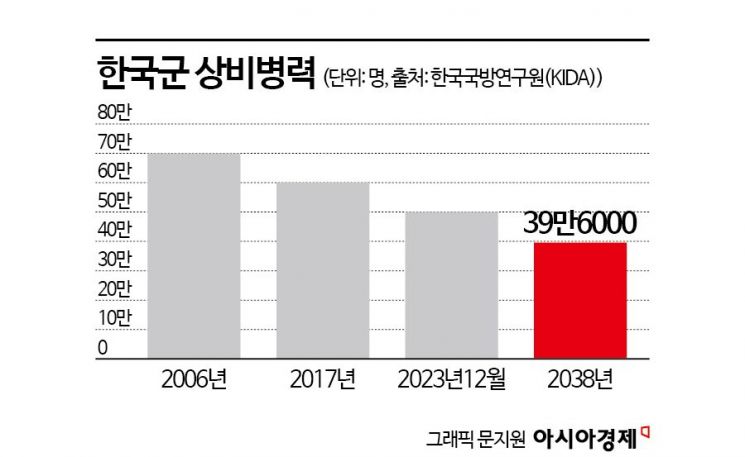
Criticism is emerging about whether it is appropriate to maintain the current number of generals while the overall military personnel is shrinking due to the population cliff. The current authorized number of generals, 370, is similar to the level in the mid-1970s. Compared to the target of 360 planned during the Moon Jae-in administration, the number has not decreased but rather increased. The continuous decrease in standing forces due to the population cliff has not been taken into account.
The decline in military service resources due to low birth rates is steep. To maintain a standing force of 500,000 as set in the Ministry of National Defense's '2023-2027 Defense Mid-term Plan,' 220,000 recruits must be enlisted annually. However, according to data from the Korea Institute for Defense Analyses (KIDA), which estimated the annual population of 20-year-old males based on resident registration population and survival rates, the population of 20-year-old males will fall below 220,000 starting in 2036, and by 2042, when boys born last year turn 20, it will sharply drop to 120,000.
If the Army maintains the service period at 18 months, and keeps the size of officers, active duty determination rates, and the number of full-time and supplementary service personnel the same as now, the year-end troop strength will be 396,000 in 2038, falling below 400,000.
As military personnel decrease, if the number of generals is not reduced accordingly, the ratio of generals will continue to rise.
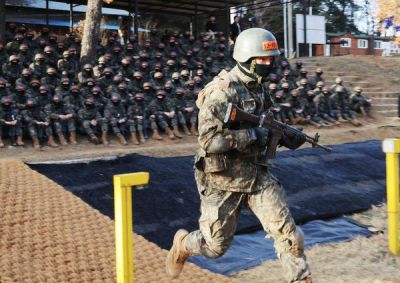 On the 7th, trainees are conducting individual combat training at the Army Training Center in Nonsan-si, Chungnam. [Image source=Yonhap News]
Reducing the authorized number of generals has been a consistent policy even under previous conservative governments. During the Lee Myung-bak administration in 2011, the military announced a plan under the 'Defense Reform 307 Plan' to reduce the total number of generals by 15% (60 at that time) by 2020, and during the Park Geun-hye administration, the 'Defense Reform 2014-2030' plan aimed to reduce the number of generals by 40. Although the scale of reductions varied with each government change, the commitment to reducing the number of generals has continued.
On the contrary, the number of generals may continue to increase. This is because generals are scheduled to be newly assigned to newly established units such as the Drone Operations Command, established last September, and the Strategic Command, scheduled to be established next year.
Regarding this, Professor Namgung Seungpil of the Department of Military Studies at Woosuk University emphasized, "Our military personnel will decrease from the current 500,000 to the 400,000 range. It is appropriate to proactively reduce the number of generals accordingly." Professor Namgung said, "Our society is demanding a reduction in the authorized number of generals," adding, "The number of generals should decrease in line with the overall reduction of our military personnel."
He continued, "There are units maintained at the one-star general (Brigadier General) level despite having only a few thousand troops," adding, "It is also necessary to boldly adjust general officer-level units to colonel-level units." However, he noted that adjustments to the number of generals should be applied differently depending on the military's unique characteristics and circumstances.
Professor Namgung said, "I do not agree with uniformly adjusting the number of generals across the Army, Navy, and Air Force," and added, "While the number of Army generals should be reduced, it is desirable to maintain the number of generals in the Navy, Air Force, and Marine Corps due to the unique characteristics of their units and because we need to advance as a science and technology military."
© The Asia Business Daily(www.asiae.co.kr). All rights reserved.
![Clutching a Stolen Dior Bag, Saying "I Hate Being Poor but Real"... The Grotesque Con of a "Human Knockoff" [Slate]](https://cwcontent.asiae.co.kr/asiaresize/183/2026021902243444107_1771435474.jpg)
















