Pilot Project for Roof Fall Industrial Accident Prevention
AI Risk Assessment After Drone Photo Input
Drones have been deployed in a project aimed at preventing 'fall' accidents by monitoring rooftops from the sky.
Over the past three years (2020?2022), there have been 125 fatalities due to roof construction accidents at construction sites such as livestock barns, factories, and warehouses. Notably, fatal accidents occur within a short construction period of 1 to 2 days at small-scale sites.
The Korea Occupational Safety and Health Agency (KOSHA), under the Ministry of Employment and Labor, piloted a fall accident prevention system for roof construction using digital twin technology from August to November 2023.
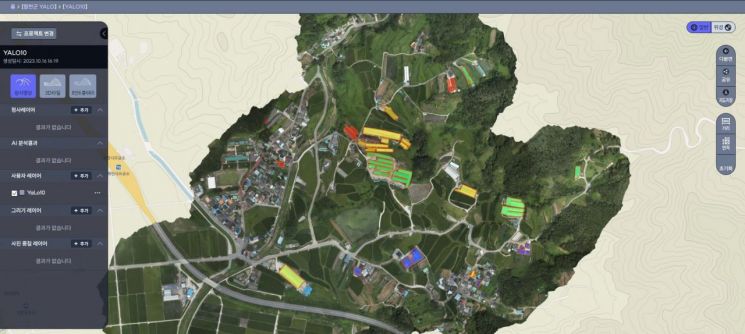
Using the established system, it is possible to check interpretive data on risk factors such as roof material and deterioration through drone photographs. As the project advances, it is expected that specialized industrial accident prevention efforts for high-risk roof sites will become feasible.
Digital twin refers to the virtual digital representation of real-world facilities or locations.
Through its own pilot project, the agency created digital maps targeting livestock barns that are difficult to access on-site.
First, in collaboration with Hapcheon-gun, Gyeongnam Province, 405 livestock barns were selected as targets for digital twin construction. After informing residents about the project, aerial photography was conducted using drones (resolution 5 cm/pixel).
To assess the risk level of the photographed barn roofs, experts derived risk assessment criteria reflecting area and quantity information for risk factors such as roof material, deterioration, damage, skylights/solar power generation/openings.
The finalized criteria were applied to all 405 barns to assess risk levels on a five-step scale (Danger - Severe - Warning - Caution - Good).
The agency produced a digital map visualizing the location and risk information of the barns and plans to carry out industrial accident prevention activities such as direct technical support for high-risk barns, distribution of safety and health materials like OPS, and joint inspections and campaigns with Hapcheon-gun.
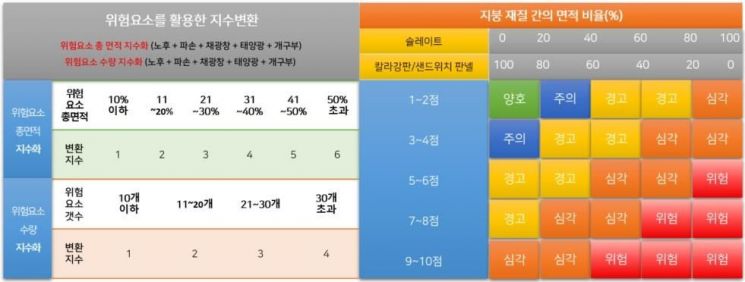
Starting next year, the digital map construction will expand beyond livestock barns to include factories, industrial complexes, and other roof construction sites with risks. Additionally, an automatic recognition system using AI technology will be developed to identify roof material types and risk factors.
To this end, satellite and aerial photography data collection and datasets will also be established. Furthermore, protective measures for roof construction workers will be piloted, including the installation of sensors capable of detecting fall risks (such as displacement/proximity sensors; sensor types to be finalized later).
The ultimate goal is to apply the developed system to industrial accident prevention projects in areas densely populated with high-risk roof construction sites.
By rapidly building a roof risk database over wide areas that are difficult to visit directly, efficient industrial accident prevention projects such as managing fall risk zones and closely monitoring work status will become possible.
Director Ahn Jong-ju of the Korea Occupational Safety and Health Agency stated, “We expect effective reductions in fatal accidents through the establishment of industrial accident prevention models utilizing smart technologies such as digital twins,” adding, “We will lead efforts to reduce major accidents by discovering various smart safety and health systems.”
© The Asia Business Daily(www.asiae.co.kr). All rights reserved.
![Clutching a Stolen Dior Bag, Saying "I Hate Being Poor but Real"... The Grotesque Con of a "Human Knockoff" [Slate]](https://cwcontent.asiae.co.kr/asiaresize/183/2026021902243444107_1771435474.jpg)
















