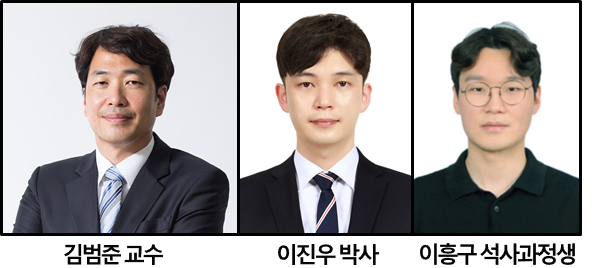
KAIST (President Kwang Hyung Lee) announced on the 26th that Professor Beomjun Kim's research team from the Department of Bio and Chemical Engineering developed a new type of conductive polymer material that simultaneously possesses high electrical performance and stretchability, realizing the world's highest performance stretchable organic solar cells.
Organic solar cells are electronic devices in which the photoactive layer that generates electricity upon light absorption is composed of organic materials. Compared to conventional inorganic material-based solar cells, they are lightweight and flexible, making them suitable for wearable electronic devices that can be worn on the body. Although solar cells are essential components that supply power to such electronic devices, existing high-efficiency solar cells have difficulty achieving stretchability, making them challenging to implement as wearable devices.
Professor Beomjun Kim's research team chemically bonded a highly stretchable polymer, which stretches like rubber, to a conductive polymer with high electrical properties, developing a new type of conductive polymer that simultaneously exhibits high electrical performance and mechanical stretchability.
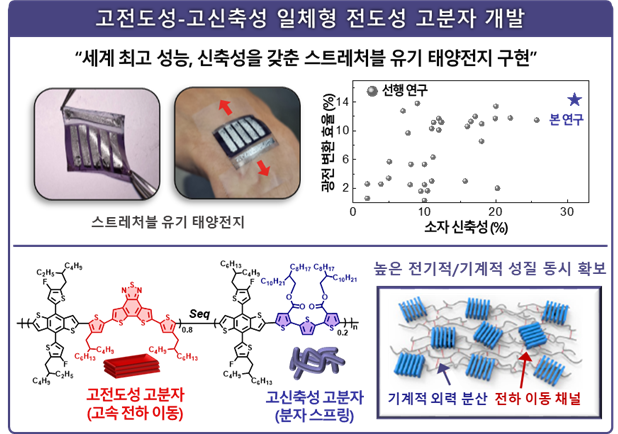
The developed polymer achieved over 10 times greater stretchability compared to existing devices while implementing organic solar cells with a world-class photoelectric conversion efficiency of 19%. It operated even when stretched over 40%, demonstrating the potential application of solar cells wearable by humans.
Professor Beomjun Kim of KAIST stated, "This research not only developed the world's highest performance stretchable organic solar cells but also has great significance in developing fundamental material technology applicable to various electronic devices requiring free form and stretchability through the development of a new concept polymer material."
Research assistants Jinwoo Lee and Heunggu Lee of KAIST participated as co-first authors, and the research was jointly conducted with Professor Taeksu Kim from the Department of Mechanical Engineering and Professor Sheng Li's team from the Department of Bio and Chemical Engineering. The study was published on December 1 in the international academic journal Joule.
© The Asia Business Daily(www.asiae.co.kr). All rights reserved.
![Clutching a Stolen Dior Bag, Saying "I Hate Being Poor but Real"... The Grotesque Con of a "Human Knockoff" [Slate]](https://cwcontent.asiae.co.kr/asiaresize/183/2026021902243444107_1771435474.jpg)
















