Yulchon LLC (Representative Attorney Kang Seok-hoon) held an online and offline seminar on the 20th under the theme of “Trends in Strengthening Global Climate Change Regulations (Debriefing UN COP28) and Corporate Response Strategies.”
The outcome document of the 28th Conference of the Parties to the United Nations Framework Convention on Climate Change (COP 28), which concluded on the 13th in Dubai, United Arab Emirates (UAE), explicitly mentioned for the first time the “transition from fossil fuels in the energy system.” It included decisions that will have a significant impact on the industry, such as tripling renewable energy by 2030 and including nuclear power and CCUS as zero-carbon technologies alongside renewable energy.
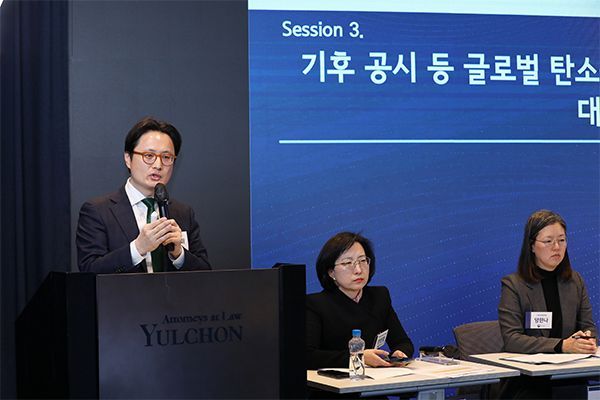
Co-hosted with the Korea Business Council for Sustainable Development (KBCSD), the seminar discussed not only the results of COP28 but also domestic emission trading system policy improvement directions, which are of great interest to companies, and the outlook for international climate disclosure systems.
The first presenter of the day, Han Min-young, Director of the Climate Environment Science Diplomacy Division at the Ministry of Foreign Affairs, spoke on “Key Results of COP28 and Government Policy Directions,” stating, “There was a positive signal in the US-China joint statement agreed on the 14th of last month. Based on the Global Stocktake, the UAE Consensus was adopted, successfully including an eight-point energy transition package such as the transition from fossil fuels.” He added, “A future task is to establish the 2035 Nationally Determined Contribution (NDC) within two years. Social discussions are crucial, and preparations for the full-scale agenda on climate finance are necessary.”
Yang Han-na, Director of the Climate Economy Division at the Ministry of Environment, presented on “Current Status and Improvement Directions of the Greenhouse Gas Emission Trading System,” evaluating that since the implementation of the emission trading system in 2015, 69 industries and 713 high greenhouse gas emitting businesses have been subject to it, making the system the most effective means of reducing emissions, covering 73.5% of the country’s total emissions.
Director Yang explained that future plans include improving allocation methods such as expanding paid and benchmark approaches to reduce corporate burdens while ensuring effective system operation. She also outlined plans to revitalize the market by expanding participants and diversifying trading products, alongside corporate support measures such as reinvesting all revenues from expanded paid allocations into corporate reduction activities.
Yoon Yong-hee (43, Judicial Research and Training Institute Class 35), a Yulchon attorney, gave a presentation titled “Corporate Response Strategies to Strengthened Global Carbon Neutrality Regulations Including Climate Disclosure,” stating, “There are three major disclosure trends: ISSB’s ESG disclosure standards, the EU’s Corporate Sustainability Reporting Directive (ESRS), and the US SEC’s climate disclosure rules. Although the US SEC’s climate disclosure proposal is now being discussed for adoption in the first half of next year, contrary to earlier expectations due to domestic circumstances, it is necessary to closely monitor future trends, and Korean companies need to proactively prepare disclosures.” He also introduced recent domestic and international trends regarding the EU Carbon Border Adjustment Mechanism and corporate greenwashing regulations.
Ha Sang-seon, Head of EcoEye, presented on “Key Negotiation Results of Article 6 of the Paris Agreement and Corporate Response Strategies,” pointing out that negotiations on Article 6 of the Paris Agreement were not concluded at COP28, and that delays in establishing international carbon market rules continue to burden companies. He urged the government to promptly establish operational standards for international reduction projects (especially Article 6.2) through a cross-ministerial approach and advised benchmarking countries like Switzerland and Singapore that have established international reduction project registration systems.
Lee Min-ho, Director of the Yulchon ESG Research Institute and chair of the comprehensive discussion, emphasized, “Climate change discussions at the Conference of the Parties resemble the footsteps of a giant. Although the giant’s steps may seem slow, they are large and impactful, so continuous corporate interest is most important. It is also essential to note that the role of climate finance is emerging as an international agenda.”
Hong Yoon-ji, Reporter for Legal Times
※This article is based on content supplied by Law Times.
© The Asia Business Daily(www.asiae.co.kr). All rights reserved.

















