Gmarket "For the First Time Ever, Pet Strollers Surpass Others"
Trend of Premiumization in Maternity and Childcare Products Also Influences
Sales of pet strollers have surpassed those of baby strollers for the first time. This appears to be due to changes in consumer patterns caused by the severe low birthrate phenomenon.
According to the distribution industry on the 25th, sales of pet strollers on Gmarket from the 1st to the 3rd quarter of this year exceeded those of baby strollers for the first time in history.
When the combined sales of the two products are set to 100, the share of baby strollers dropped significantly from 67% in 2021 and 64% last year to 43% this year. On the other hand, the sales share of pet strollers rose sharply to 57% in the 1st to 3rd quarters of this year, after a slight increase from 33% in 2021 to 36% last year.
A Gmarket official said, “The sudden reversal in the share of the two categories this year requires further analysis,” but added, “The trend of decreasing baby stroller sales and increasing pet stroller sales has been ongoing.”
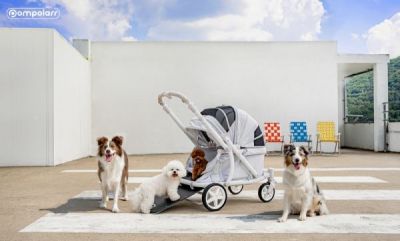
The number of households raising pets is increasing year by year. According to the Korea Rural Economic Institute, as of the end of last year, about 5.52 million households have pets. In terms of pet owners, the number reaches 12.62 million. This means that one in four households in the country has a pet.
The pet-related market size also grew from 1.9 trillion won in 2015 to 3.4 trillion won in 2021, and it is expected to exceed 4 trillion won this year.
Meanwhile, the low birthrate phenomenon is becoming increasingly extreme. According to Statistics Korea, the total fertility rate, which is the average number of children a woman is expected to have in her lifetime, has sharply declined from 1.48 in 2000, 1.23 in 2010, 0.84 in 2020, to 0.78 last year.
Statistics Korea projected that based on the median estimate, the total fertility rate will drop to 0.72 this year and further fall to 0.68 next year.
On the 2nd (local time), The New York Times (NYT) published a column titled “Is Korea Disappearing?” highlighting Korea as a prominent case study of population decline issues faced by developed countries. The column introduced Korea’s third-quarter birthrate statistics recently released and explained that “this population decline surpasses the population decrease caused by the Black Death in Europe in the 14th century.”
The dramatic change in sales between pet strollers and baby strollers is analyzed as a result of these intertwined social phenomena.
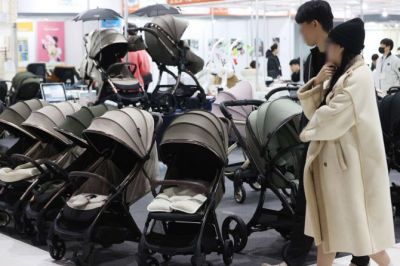 On the 7th, a pregnant woman is browsing childcare products at the 'Seoul Baby Kids Fair' held at SETEC in Gangnam-gu, Seoul. [Image source=Yonhap News]
Additionally, the trend toward premiumization of childbirth and childcare products seems to have had an impact. An analysis of Gmarket’s sales data from the 1st to 3rd quarters showed that per capita spending on childbirth and childcare products increased by 16% compared to the same period last year.
Spending on major product categories such as baby strollers (22%), formula and baby food (18%), and diapers (4%) all increased. In contrast, per capita spending on pet products increased by only 2%. Money spent on purchasing pet strollers actually decreased by 8%.
Despite the contraction of consumer sentiment due to high inflation, consumers tend to seek premium, high-priced products for childbirth and childcare items, while preferring products with good quality relative to price for pet products.
© The Asia Business Daily(www.asiae.co.kr). All rights reserved.
![Clutching a Stolen Dior Bag, Saying "I Hate Being Poor but Real"... The Grotesque Con of a "Human Knockoff" [Slate]](https://cwcontent.asiae.co.kr/asiaresize/183/2026021902243444107_1771435474.jpg)
















