5.1925 Trillion KRW Increase Compared to This Year's Original Budget
Largest Budget in History
The Ministry of Land, Infrastructure and Transport's budget for next year has been finalized at 60.9439 trillion won. This is an increase of 5.1 trillion won compared to this year, marking the largest budget ever.
The Ministry announced on the 22nd that its budget proposal and fund operation plan were finalized after being approved by the National Assembly plenary session on the 21st.
During the National Assembly review process, the budget was increased by 351.5 billion won compared to the government's proposal (23.3068 trillion won), and the housing and urban fund was increased by 54.7 billion won compared to the government's proposal (37.3403 trillion won), resulting in a total budget of 60.9439 trillion won.
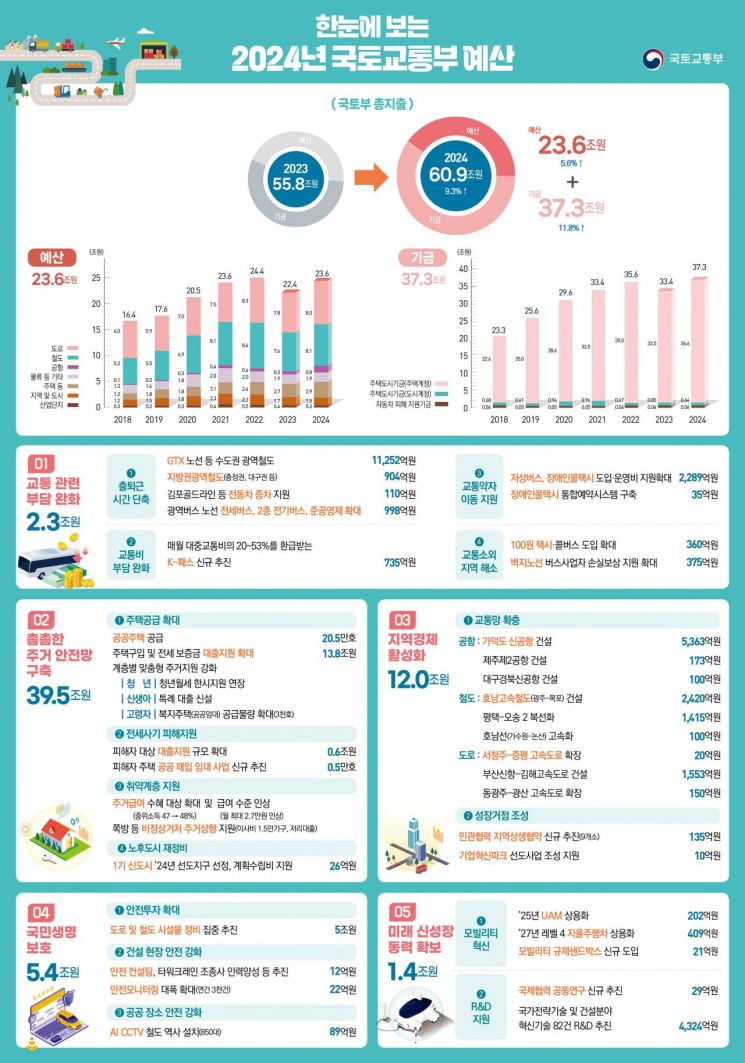 Infographic of the Ministry of Land, Infrastructure and Transport budget for next year. [Data provided by the Ministry of Land, Infrastructure and Transport]
In particular, the Ministry focused on public safety and economic growth in the formulation of next year's budget. First, a total of 2.3 trillion won will be invested to reduce commuting time and transportation costs.
Of this, 1.2 trillion won is allocated to support the timely opening of GTX lines and metropolitan railways to realize a 30-minute commuting era in the metropolitan area and a one-hour living zone in regional metropolitan areas.
Chartered buses (from 203 to 264 trips) and double-decker electric buses (from 40 to 50 units) will be additionally deployed on metropolitan bus routes, and semi-public operation routes (from 153 to 214 routes) will be significantly expanded (99.8 billion won).
To alleviate transportation costs for low-income and young people, the new K-Pass project will be launched (73.5 billion won), which refunds 20-53% of monthly public transportation expenses.
The project will be implemented early from May next year, ahead of the original plan (July), and the minimum usage frequency will be lowered from 21 to 15 times per month to expand benefits to the public.
To improve mobility convenience for transportation-vulnerable groups, the budget for introducing and operating low-floor buses and disabled call taxis has been increased (224.6 billion won → 228.9 billion won), and a new integrated reservation system will be established (3.5 billion won) to unify and link systems operated by local governments for disabled call taxi reservations.
To improve transportation convenience in areas lacking public transportation due to population decline, the introduction of 100-won taxis and call buses will be expanded (30.3 billion won → 36 billion won), and compensation support for losses of bus operators on remote routes will also be expanded (33.7 billion won → 37.5 billion won).
A total of 39.5 trillion won will be invested in housing supply and support for victims of jeonse fraud. In particular, 13.8 trillion won will be invested to supply 205,000 high-quality public housing units in prime locations and to expand support for housing purchase and jeonse deposit loans.
To help victims of jeonse fraud quickly recover their daily lives, the loan support scale for victims will be increased from 200 billion won to 600 billion won, and a new public purchase rental housing project for victims' homes will be launched.
To strengthen protection for housing-vulnerable groups, the target for housing benefits will be expanded (from 47% to 48% of median income), and the benefit level will be increased by up to 27,000 won per month. To upgrade housing from abnormal dwellings such as small rooms, moving expenses support and low-interest loans (up to 80 million won, around 1%) for relocation to public rental housing will continue. A project to renovate old permanent rental complexes will also be newly launched (11.4 billion won).
With the enactment of the ‘Old Planned City Maintenance Special Act’ (effective April 2024), leading districts for first-generation new towns will be selected and planning costs supported (2.6 billion won). Additionally, to revitalize small-scale housing maintenance projects, practical support such as expanding interest subsidy (from 4 billion won to 6.8 billion won, covering up to 2%p of interest rate difference) will be strengthened.
Furthermore, a total of 10 trillion won will be invested in transportation infrastructure construction to strengthen regional competitiveness and attract private investment, and 5.4 trillion won has been secured for road and railway facility maintenance to prevent traffic accidents and respond to climate change.
The government plans to submit and approve the ‘2024 Budget Announcement and Allocation Plan’ at the Cabinet meeting on the 26th, and the Ministry of Land, Infrastructure and Transport will thoroughly prepare in advance to begin execution immediately after the start of the fiscal year.
Kim Bae-seong, Policy Planning Officer of the Ministry, said, “The Ministry plans to focus investment on five top priority tasks for public stability and economic growth,” adding, “We will do our best to ensure the flawless execution of the 2024 budget confirmed by the National Assembly to achieve results that the public can feel.”
© The Asia Business Daily(www.asiae.co.kr). All rights reserved.
![Clutching a Stolen Dior Bag, Saying "I Hate Being Poor but Real"... The Grotesque Con of a "Human Knockoff" [Slate]](https://cwcontent.asiae.co.kr/asiaresize/183/2026021902243444107_1771435474.jpg)















