Posted Criticism Targeting Japanese Statue Exhibition
Japanese Director Who Planned Exhibition Wins Defamation Damages Case
A prominent Japanese right-wing figure who criticized the exhibition of the 'Statue of Peace,' erected to honor the victims of Japanese military sexual slavery, has lost a lawsuit and been ordered to pay a large sum in damages.
On the 20th (local time), according to Japan's NHK and other media, the Tokyo District Court ruled that Daisuke Tsuda, the artistic director who organized the 'Aichi Triennale 2019' exhibition, was awarded 2.5 million yen (approximately 27.7 million KRW) in damages from Katsuya Takasu, a well-known right-wing figure, in a defamation suit.
The court stated, "Due to Mr. Takasu's social influence and his unrepentant attitude, the victim's mental suffering was exacerbated."
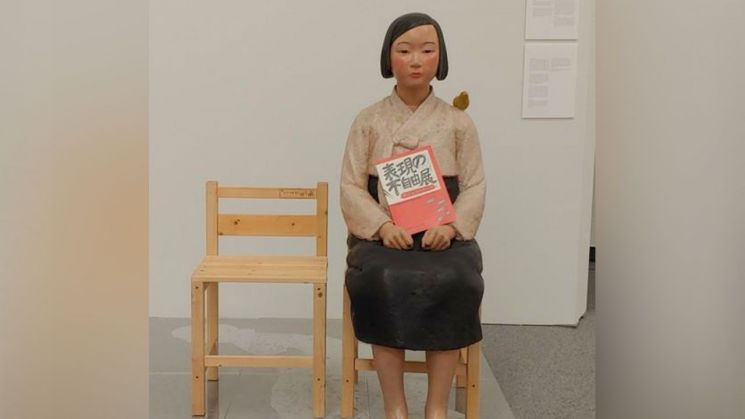 Girl Statue Holding a Pamphlet Titled 'Inheritance of Expression Restrictions' [Image Source=Yonhap News]
Previously, Director Tsuda held an exhibition titled 'After the Exhibition of Expression without Freedom' during the 2019 event, which featured the actual Statue of Peace for the first time in a Japanese public art museum.
However, the Statue of Peace faced strong criticism from some Japanese right-wing figures. There were also baseless reports claiming that the exhibition misused subsidies. Ultimately, the exhibition was suspended just three days after its opening, and the artists participating in the art festival issued statements of protest.
After the event ended, Director Tsuda filed defamation lawsuits against many prominent right-wing figures who attacked him, and he eventually won. The defeated Takasu is a famous right-wing figure who previously served as the president of the Japan Society of Aesthetic Surgery. In 2017, he attracted attention by purchasing the original memoirs of Emperor Hirohito, who was the emperor during the Pacific War, for $275,000 (approximately 358.57 million KRW).
From 2019 to 2020, he posted numerous criticisms of the Statue of Peace exhibition on social media, including expressions such as "anti-Japanese propaganda" and "an unpleasant existence." The court recognized that many of his posts constituted illegal acts.
© The Asia Business Daily(www.asiae.co.kr). All rights reserved.

















