① 'Ieum 5G' Technology Gaining Attention from Companies
Infrastructure for New Industries like Robots and Autonomous Driving
Emerging as an Alternative to Saturated Telecom B2C Market
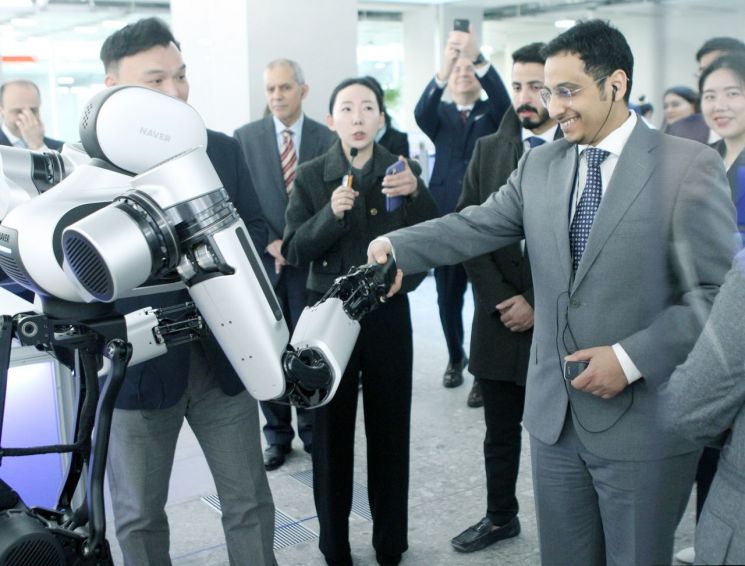 Alhassan Alhajimi, General Manager of the Saudi Arabia Data Artificial Intelligence Agency, is visiting Naver headquarters '1784' and shaking hands with a robot.
 [Photo by Naver]
Naver has introduced it, but Kakao has not yet done so. It is a communication technology for managing data quickly, accurately, and safely. It is mainly attracting attention in workplaces and logistics centers that utilize robots and artificial intelligence (AI). The answer? It is the 5G private network. The 5G private network is an advanced technology that allows uninterrupted ultra-high-speed internet use within a specific area in the AI era. It is also the next-generation growth engine that will revitalize the saturated B2C (business-to-consumer) communication market.
The brand name for the 5G private network, decided through a public contest held by the Ministry of Science and ICT, is ‘Eum 5G’. Globally, it is called ‘Private 5G’, and in Japan, it is named ‘Local 5G’. By building Eum 5G within a company, large volumes of data can be used quickly without going through mobile carriers such as SK Telecom, KT, or LG Uplus.
What is Eum 5G?
It is mainly used in the B2B (business-to-business) market rather than services provided by mobile carriers to general consumers. It is a 5G network that general companies can use at a low cost for their employees and customers without separately subscribing to a mobile carrier.
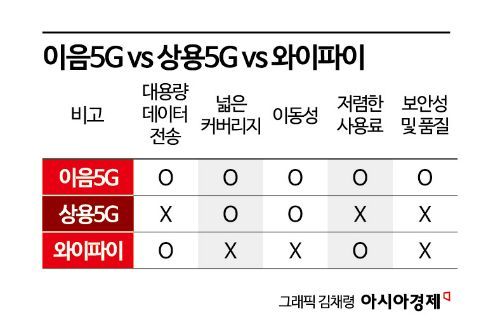
Let’s compare the 5G network to a highway. The cars running on the highway represent data. When consumers subscribe to a mobile carrier to use 5G services, that is commercial 5G. All cars (data) run at the same speed without discrimination. When many cars gather and the road gets congested, they inevitably slow down. This causes data delays.
However, Eum 5G solves this problem. It uses dedicated frequencies (4.7 GHz, 28 GHz), making it more stable than Wi-Fi or commercial 5G. Since it builds a 5G network independently for a certain area or building to be used by thousands to tens of thousands of people, it maximizes the advantages of 5G networks: ultra-high speed, ultra-low latency, and ultra-connectivity.
Why use Eum 5G?
In South Korea, there are 14 licensed telecommunications operators qualified to build Eum 5G. To be registered as an operator, they must present to the Ministry of Science and ICT their financial capability to receive frequency allocation, technical ability to respond to communication accidents, and user protection plans.
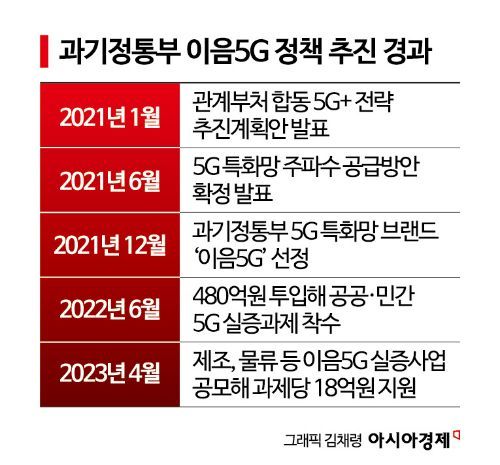
Naver Cloud became the first domestic operator to utilize Eum 5G in 2021. After completing registration as a licensed telecommunications operator, it built Eum 5G at Naver’s office building ‘1784’ and uses it for autonomous robot services. Here, robots roam the corridors delivering coffee and managing employees’ packages. A Naver Cloud official said, "This is a testbed space that directly demonstrates the possibility of building future-oriented spaces using advanced technologies like Eum 5G."
In May, Naver Cloud, together with Hoban Construction, built Eum 5G at a construction site and examined its effectiveness. By building Eum 5G at the construction site, communication is possible without dead zones, improving work efficiency and safety. Autonomous drones, safety vests capable of video calls, wireless CCTV, and thermal sensors were utilized based on the Eum 5G network.
The industry expects the need for Eum 5G networks to grow even more as the AI era fully opens. A typical example is when manufacturers, who tolerate no margin of error, use AI robots. For robot arms to move quickly, data transmission must be uninterrupted. In a situation where labor shortages are expected due to low birth rates, Eum 5G is emerging as a means to improve industrial productivity.
A telecommunications industry official said, "In the future, communication systems focused on the Internet of Things, such as robots and autonomous driving, will develop further," adding, "The Eum 5G infrastructure is expected to lay the foundation for the growth of AI-based content and software markets."
© The Asia Business Daily(www.asiae.co.kr). All rights reserved.
![Clutching a Stolen Dior Bag, Saying "I Hate Being Poor but Real"... The Grotesque Con of a "Human Knockoff" [Slate]](https://cwcontent.asiae.co.kr/asiaresize/183/2026021902243444107_1771435474.jpg)

















