Gyeongju International Conference Keynote Speech
Lee Cheol-woo "Nationwide Expansion of Success Model"
Abhijit Banerjee, a professor at the Massachusetts Institute of Technology (MIT) in the United States and Nobel laureate in Economics, emphasized the importance of local-led economic growth during his keynote speech at the ‘2023 International Conference on Local-led Economic Growth’ held at the Lahan Select Hotel in Gyeongju on the 21st.
Abhijit Banerjee, the 2019 Nobel Prize winner in Economics and professor at MIT, warned in his keynote speech titled “A Brief History of Growth and Its Implications for Korea” that “even wealthy countries like Korea could revert to the growth slowdown levels of the 1970s and 1980s due to structural issues such as rising household debt, inequality, and failures in redistribution.”
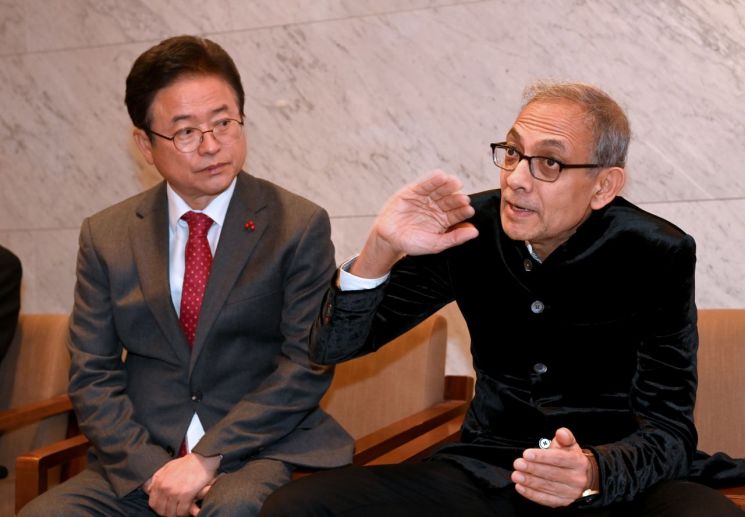 Professor Abhijit Banerjee (right), attending the 'Local-Led Economic Growth International Conference' held in Gyeongju, is conversing with Lee Cheol-woo, Governor of North Gyeongsang Province.
Professor Banerjee stressed, “The K-U City project, which can substitute policies related to workforce development, investment conditions, and residential environment in the era of decentralization and local-led economic growth, could serve as a good model for regional economic growth,” drawing enthusiastic applause and great interest from the attendees.
The event was graced by over 450 participants including Lee Cheol-woo, Governor of Gyeongbuk Province, who gave the opening remarks; a congratulatory video message from Lee Ju-ho, Minister of Education and Deputy Prime Minister for Social Affairs; a congratulatory letter from Lee Sang-min, Minister of the Interior and Safety; Park Young-seo, Vice Chairman of the Gyeongsangbuk-do Provincial Council; Michael Alexieff, professor at Indiana University; Richard Rosen, former director of the Federal Reserve Bank; Jang Yoo-sun, president of the Korean-American Economic Association; as well as domestic and international scholars, mayors and county heads, provincial council members, the Gyeongbuk Local Era Committee, university presidents, companies, and academic societies.
The event proceeded in the order of the ‘K-U City Project’ performance, keynote speech, policy session, main session, and thematic sessions, focusing on the major policy shift toward a youth-centered local settlement era.
During the K-U City performance, the commitment was made to jointly advance the transition from youth nomadism to a local settlement era by supporting a youth settlement package that includes win-win cooperation among one city/county, one university, and one specialized enterprise; investment attraction for mutual growth of companies and regions; integrated workforce development across universities, vocational colleges, and high schools; and the creation of campus-style premium residential infrastructure covering education, employment, housing, and marriage.
So far, Gyeongbuk Province has established a cooperative workforce development system for the ‘K-U City Project’ with 22 cities/counties, 29 universities, 30 high schools, and 95 companies, aiming to realize it as a representative model of local-led regional economic growth.
The policy session addressed topics such as diagnosing and resolving regional imbalances from an economic geography perspective, policies and challenges for local-led regional economic growth, fiscal, financial, and corporate support systems for local development, and talent-driven technological innovation leading regional economic growth. The main session in the afternoon featured presentations and discussions on local-led growth through decentralization and the voices of the MZ generation as key players in the local era.
Finally, the thematic sessions featured heated debates among academic societies and experts on establishing local government functions for decentralization, fiscal decentralization and regional economy, models for cultural cities and urban regeneration, reviewing local tax system improvements for regional balanced development, diagnosing and implications of domestic and international regional extinction policies, success conditions for decentralization breaking away from central government dominance, and performance-based budgeting systems for local-led growth.
Governor Lee Cheol-woo of Gyeongbuk Province stated in his opening remarks, “Although Korea achieved industrialization and democratization in the shortest period, the weakening of national competitiveness due to population decline and regional extinction is leading local areas down the path of disappearance and decline,” adding, “The true local era begins when the DNA of local areas changes from looking toward the central government.”
He also said, “If local areas jointly plan with universities and companies and lead investments, the central government will support the lacking parts. We will succeed in the Gyeongbuk K-U City project, a leading policy for the local era, and expand the field-centered platform-type local government model nationwide,” urging universities, companies, and academic societies to participate in realizing the local era led by Gyeongbuk.
© The Asia Business Daily(www.asiae.co.kr). All rights reserved.
![Clutching a Stolen Dior Bag, Saying "I Hate Being Poor but Real"... The Grotesque Con of a "Human Knockoff" [Slate]](https://cwcontent.asiae.co.kr/asiaresize/183/2026021902243444107_1771435474.jpg)















