Familiarity Index and Knowledge Index Up, Education Index and Food Index Down
A survey revealed that while the sea is familiar and well-known to Koreans, awareness regarding related education and food is low.
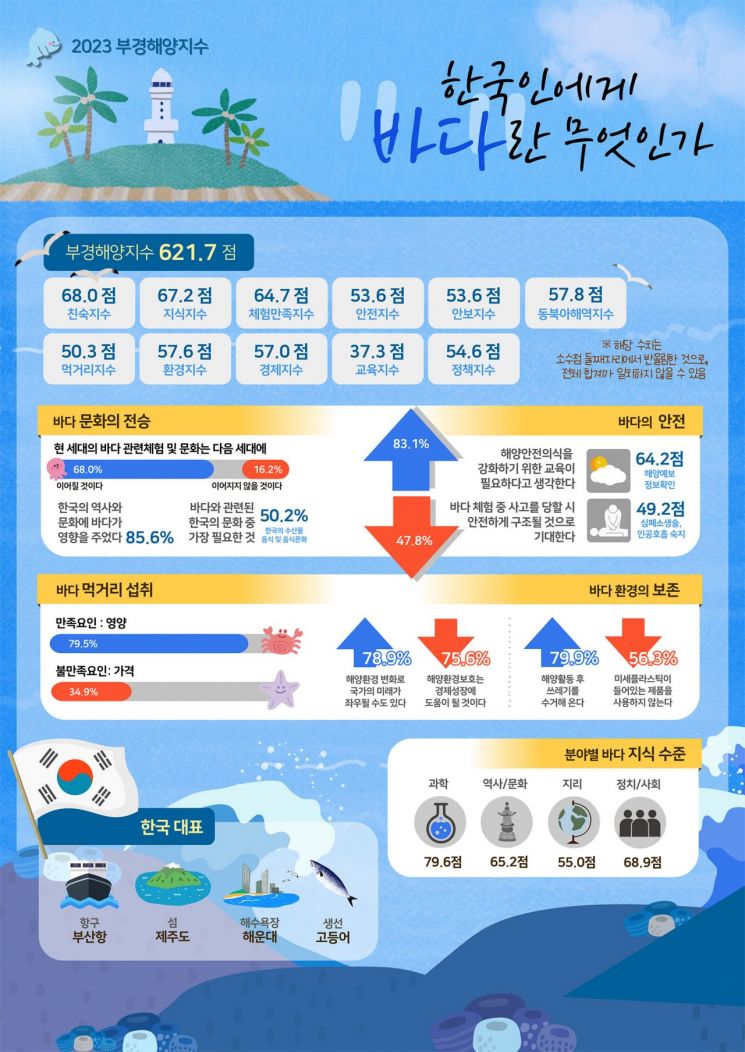
The Humanities Korea Plus (HK+) Project Group at Pukyong National University (Director Kim Chang-kyung) announced the ‘2023 Pukyong Marine Index’ on the 21st, which investigates and analyzes how the humanities meaning of marine areas is perceived and thought of according to region, generation, and individual experiences.
Pukyong National University first conducted and announced the Pukyong Marine Index in 2017 under the CORE Project Group, followed by surveys in 2018 and 2019. After skipping the COVID-19 period, this year marks the fourth survey. This year, the HK+ Project Group commissioned All That E&R to conduct an online survey targeting 1,000 adults aged 18 and over nationwide.
The Pukyong Marine Index, which comprehensively represents Koreans’ perception of the sea, scored 621.7 out of 1,000 points. This is the highest score compared to 609.4 in 2017, 586.5 in 2018, and 585.3 in 2019.
Looking at the detailed indices by subcategories, the ‘Familiarity Index’ was the highest at 68 points, followed by the ‘Knowledge Index’ at 67.2 points. The lowest indices were the ‘Education Index’ at 37.3 points and the ‘Food Index’ at 50.3 points. Other indices included the ‘Experience Satisfaction Index’ at 64.7 points, ‘Environment Index’ at 57.6 points, ‘Economy Index’ at 57.0 points, ‘Policy Index’ at 54.6 points, ‘Safety Index’ at 53.6 points, and ‘Security Index’ at 53.6 points. Higher scores indicate higher preference and positive perception.
The ‘Northeast Asian Marine Area Index,’ a humanities-based marine perception index first included in the previous survey, rose from 56.2 to 57.8 points. The ‘Knowledge Index’ (49.3 → 59.8 → 57 → 67.2) and ‘Economy Index’ (42.7 → 50.7 → 57) showed an increasing trend. Conversely, the ‘Education Index’ (60.1 → 37.3) and ‘Food Index’ (56.6 → 50.3) declined compared to the previous survey, along with downward trends in the ‘Security Index’ (74.9 → 59.4 → 56.8 → 53.6) and ‘Policy Index’ (74.1 → 58.4 → 54.6).
Regarding items representing the sea, as in last year, the port chosen was ‘Busan Port,’ the island ‘Jeju-do,’ the beach ‘Haeundae,’ and the fish ‘mackerel.’ Among detailed questions, 80.5% of respondents strongly agreed on the need to strengthen the government’s seafood safety management system, followed by 70.9% supporting the establishment of policy standards for marine environment protection, and 68.0% emphasizing the need for integrated management of dispersed marine policies.
Kim Chang-kyung, director of the HK+ Project Group, stated, “To establish the foundation of humanities related to Korea’s marine areas and expand its base, we conducted a nationwide humanities marine area survey under the theme ‘Research on the Dynamics of Northeast Asian Marine Areas and Humanities Networks.’ We have released the survey results so they can be used as basic data for marine area policies from the perspective of ‘marine literacy.’”
© The Asia Business Daily(www.asiae.co.kr). All rights reserved.
![Clutching a Stolen Dior Bag, Saying "I Hate Being Poor but Real"... The Grotesque Con of a "Human Knockoff" [Slate]](https://cwcontent.asiae.co.kr/asiaresize/183/2026021902243444107_1771435474.jpg)















